
A Chinese podcast · Same story, 4 levels
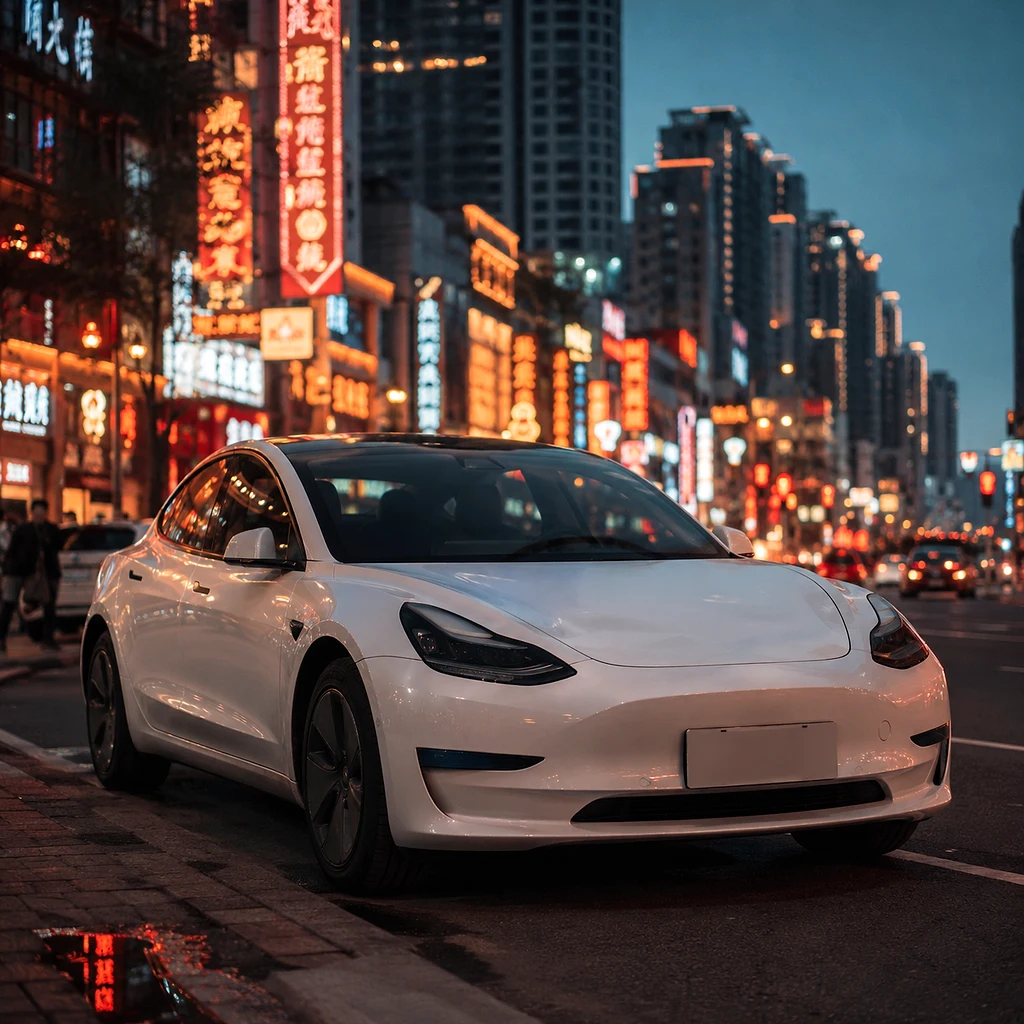
特斯拉 FSD 来中国了:车能自己开,但是你还得看着
Tesla FSD Arrives in China
About this story
Tesla FSD Arrives in China. HSK 3 Chinese listening practice.
This is an HSK 3 Chinese listening episode that runs about 4 minutes. The full Mandarin script is shown with tap-for-pinyin and a line-by-line English translation, so you can listen and read at once — comprehensible input in the sense of Stephen Krashen's i+1 theory. It teaches 12 key vocabulary words such as 今天、想、重要 and walks through 4 grammar patterns, each explained in English with examples. The same news story is retold at 4 difficulty levels — use the level selector above to find the version that is challenging but still understandable for you.
Read at your level
原文Read the complete story in Chinese. Reveal pinyin and English only when you need them.
English transcript reference
Today we'll talk about
a news story related to cars.
The main figure in the news
is a company:
Tesla.
Tesla is an American car company.
The cars it makes
are called "electric cars."
"Electric cars"
are cars that don't burn oil,
they use electricity.
Tesla's cars —
what's most famous isn't the car itself,
but one of its features
called "FSD."
"FSD" is English;
it means
"Full Self-Driving."
"Self-driving"
means the car drives itself;
you don't have to drive.
Sounds amazing,
right?
But
there's one very important point.
Tesla's FSD,
in its current version,
is not really "fully self-driving."
Its Chinese name
is more accurate:
"FSD Supervised Edition."
"Supervised"
means
you still have to watch from beside.
When the car drives itself,
you must sit in the driver's seat,
your eyes must watch the road,
your hands ready to grab the wheel at any time.
If the car makes a mistake,
you must take over and drive immediately.
So
the four characters "自动驾驶" (self-driving)
are, in fact, a little
misleading.
On May 21,
Tesla announced:
China can now also buy FSD.
This is a piece of news
people have waited many years for.
In China in the past,
for various reasons,
FSD couldn't be used.
Now it finally can.
But
Tesla's FSD,
in China, isn't cheap.
It costs 64,000 yuan
as a one-time purchase.
"One-time purchase"
means
you pay once
and use it forever.
What's interesting is:
in the US and other countries,
Tesla has already
stopped selling "one-time purchase."
You can only pay monthly.
But in China,
Tesla specifically kept
the "one-time purchase" option.
One reason
may be
that the China market is very important
and Tesla wants more business.
So,
what do Chinese car owners
think of this?
Some are very happy.
They've waited for FSD
a long time.
But some also say:
China's own car companies —
like Xiaomi,
Xpeng,
Huawei —
have had similar features for a while now.
And many of them
are given away free.
In other words,
this time when Tesla comes to China,
it's actually no longer "number one."
China's rivals
have already run out in front.
I read this news,
and I thought of one thing.
"Self-driving"
sounds very cool.
But we have to remember:
calling it "automatic"
doesn't equal really "automatic."
You still have to watch the road.
You still have to be responsible.
Finally I'll ask you:
If you had a car,
would you spend 64,000 yuan
to buy Tesla's FSD?
Or
do you think driving yourself
actually makes you feel safer?
Think about it.
Okay.
That's all for today.
Talk tomorrow.
Listen again
Try it without the transcript and notice what sounds clearer.
What vocabulary does this episode teach?
词汇Today. The narrator opens 今天我们说一个 — 'today we'll tell a story.'
To think. The narrator's reflection: 我想了一件事 — 'I thought of one thing.'
Important. 有一个很重要的地方 — 'there is one very important point' — the supervised caveat.
For example. 比如小米、小鹏、华为 — for example Xiaomi, Xpeng, Huawei — China's rivals.
The same. 中国自己也有这样的车 — China also has cars like this; 这样 echoes 一样.
Company. Tesla is 一家美国的车公司 — an American car company.
Car. Beyond HSK2. The whole story is about a particular kind of 车 — an electric, self-driving one.
Automatic. Beyond HSK2. Central term — 自动驾驶 — but the episode warns it is not yet truly automatic.
The USA. Beyond HSK2. Tesla's home country.
Impressive. Beyond HSK2. 听起来很厉害 — 'sounds amazing'; 特斯拉太厉害了 — 'Tesla is amazing.'
Supervise. Beyond HSK2. The episode glosses it: 你还要在旁边看着 — 'you still have to watch from beside.'
Free. Beyond HSK2. Many Chinese rivals' similar features are 免费送的 — given away free — making the 64K-yuan Tesla price feel high.
* beyond level超纲词
What grammar patterns appear in this episode?
语法X,意思是 Y
X + 意思是 + Y explains a term right after introducing it. The episode uses it to unpack FSD, 自动驾驶, 监督, 买断.
"自动驾驶",就是车自己开,不用你来开。
"监督",意思是,你还要在旁边看着。
A 不等于 B
不等于 separates two things people wrongly treat as the same. The episode's sharp point about the name versus reality.
名字叫"自动",不等于真的"自动"。
你还是要看路。
也就是说 restates a point more plainly. The episode uses it to draw the takeaway about Tesla no longer being #1 in China.
也就是说,特斯拉这次来中国,其实不是"老大"了。
中国的对手,已经跑在了前面。
还是说,X 反而 Y?
还是说 introduces an alternative — and 反而 marks an unexpected turn. The closing question's structure.
还是说,你觉得自己开,反而更安心?
还是人开车,反而让你更安心?
Proper nouns
专有名词Free account
Keep learning from this story
Create a free account to keep saved words and your preferred level together.
- Keep words with their story context
- Remember your preferred level
- Build your vocabulary over time