
A Chinese podcast · Same story, 4 levels
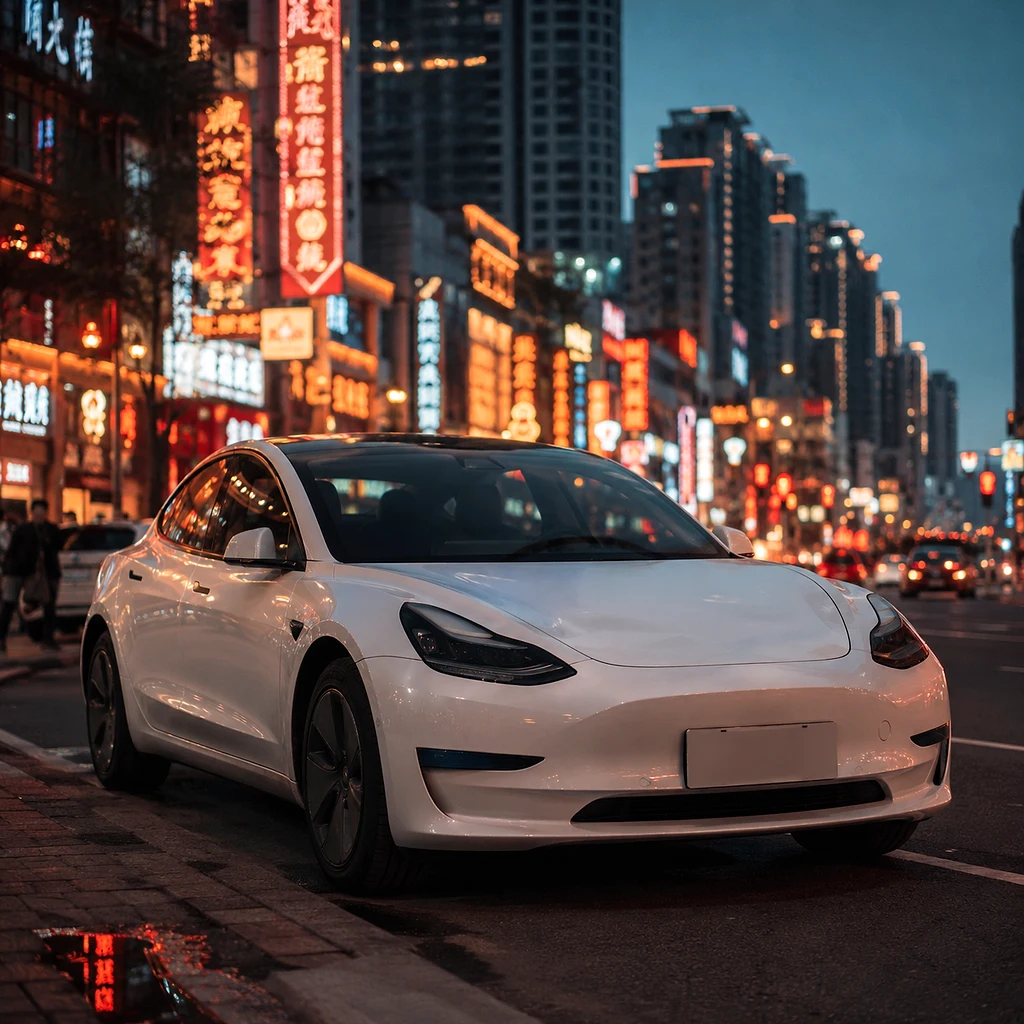
特斯拉 FSD 终于进入中国——但中国的对手,已经跑在前面
Tesla FSD Arrives in China
About this story
Tesla FSD Arrives in China. HSK 4 Chinese listening practice.
This is an HSK 4 Chinese listening episode that runs about 5 minutes. The full Mandarin script is shown with tap-for-pinyin and a line-by-line English translation, so you can listen and read at once — comprehensible input in the sense of Stephen Krashen's i+1 theory. It teaches 12 key vocabulary words such as 重要、比如、公司 and walks through 4 grammar patterns, each explained in English with examples. The same news story is retold at 4 difficulty levels — use the level selector above to find the version that is challenging but still understandable for you.
Read at your level
原文Read the complete story in Chinese. Reveal pinyin and English only when you need them.
English transcript reference
Today we'll talk about
a news story that's been very hot recently.
On May 21,
Tesla officially announced
that its "FSD Supervised Edition"
has gone live in China.
This is a piece of news
people have waited many years for.
For Chinese Tesla owners,
and for the entire Chinese car industry,
it is a big deal.
Let's first talk about
what FSD is.
FSD,
in English is "Full Self-Driving";
in Chinese it means
"完全自动驾驶."
"Self-driving"
means the car drives itself;
people don't need to drive.
It sounds amazing.
But
there is one key point.
Today's FSD
is not real autonomous driving.
Its full name
has four important characters:
"FSD Supervised Edition."
"Supervised"
means:
when the car is driving itself,
a person must sit in the driver's seat,
eyes on the road,
hands ready at any moment to take the wheel.
When the car makes a mistake,
you must immediately take over.
So
the truly accurate Chinese term
should be "assisted driving" —
helping you drive,
not replacing you.
Why is this story a big deal?
There are three reasons.
The first reason
is that it came too late.
Tesla, as early as 2024,
had already launched FSD
in many countries.
But in China,
it was stuck for several years.
One reason
is that China has very strict rules
about data.
If you want to sell autonomous driving in China,
you have to keep the data
inside China.
Tesla, in order to enter China,
specifically built a data center in Shanghai.
On top of that,
China's maps
also have to use local Chinese companies.
Tesla partnered with Baidu,
using Baidu's maps.
With all these conditions met,
in May of this year,
it finally went live.
The second reason
relates to politics.
In early May,
US President Trump visited Beijing.
Elon Musk went along with him.
A few days after the visit,
FSD went live in China.
Many people feel:
these two events
are not a coincidence.
They are China and the US,
doing some political and business exchanges.
The third reason,
and the most interesting:
when Tesla comes to China,
it isn't this market's leader.
China itself
already has many companies
doing similar features.
For example,
Xpeng Auto's "XNGP,"
Huawei's "ADS,"
Xiaomi's smart driving.
These features —
some are given away free,
some cost only a few thousand yuan.
But Tesla's FSD
costs 64,000 yuan.
That's 64,000 yuan,
not 6,400.
For many people,
that's about half the price
of a cheap car.
Another interesting point.
This past February,
Tesla, worldwide,
cancelled the "one-time payment" option.
People in other countries
can now only pay monthly.
But in China,
Tesla specifically kept
the "one-time purchase" option.
Why?
Experts feel:
the China market
is very important to Tesla.
And Chinese consumers
prefer "one-time purchase";
they don't like monthly payments.
So Tesla,
specifically for China,
made an exception.
This event
has many people debating:
when Tesla comes to China,
is this a victory,
or "making up a missed class"?
Those who call it a victory feel:
getting the China license
is a major achievement.
China regulates autonomous driving
very strictly.
Getting it
means Tesla did many things right.
Those who call it "making up a missed class" feel:
Tesla was supposed to be
the symbol of autonomous driving.
But because of various delays,
China's rivals
have run out in front.
Tesla coming in now
is catching up,
not leading.
I read this news,
and I thought of one thing.
"Self-driving"
is a
very seductive phrase.
But right now
it isn't really "self-driving."
Even when Tesla comes to China,
even when China's rivals are formidable,
the person who, in the end, sits in the car
is still responsible for their own safety.
The car's name can be called "auto,"
but your attention
cannot be put down.
Finally I'll ask you:
If you had 64,000 yuan,
would you spend it
on this feature that "helps you drive"?
Or
would you prefer
to drive yourself, slowly?
Think about it.
Okay.
That's all for today.
Talk tomorrow.
Listen again
Try it without the transcript and notice what sounds clearer.
What vocabulary does this episode teach?
词汇Important. 一个很关键的地方 — a key point; 这件事很重要 — the launch is a big deal for Chinese EV industry.
For example. The episode uses 比如 to introduce Xpeng, Huawei, and Xiaomi as Chinese rivals.
Company. The market is full of 公司 — Tesla, Xpeng, Huawei, Xiaomi — competing on smart driving.
Country. The episode addresses what each 国家 demands of foreign tech (data localization, mapping).
History. The story tracks Tesla's multi-year history of trying to land FSD in China.
Map. The mapping requirement — Chinese-licensed mapping (Baidu) — is one of the two barriers Tesla had to clear.
Automatic. Beyond HSK3. The naming controversy: 'self-driving' isn't yet really automatic — the 'Supervised' caveat matters.
Supervise. Beyond HSK3. The 'Supervised' in 'FSD Supervised Edition' carries the legal and practical truth.
License. Beyond HSK3. 拿到中国的牌照 — getting the Chinese license to operate — is the bureaucratic achievement.
Manufacturer. Beyond HSK3. Both Tesla and Chinese 厂商 are competing on smart driving.
One-time purchase. Beyond HSK3. The episode glosses it: 只要花一次钱,以后都能用 — 'pay once, use forever.'
Rival. Beyond HSK3. Tesla's China 对手 — Xpeng, Huawei, Xiaomi — got out in front while Tesla was waiting for approval.
* beyond level超纲词
What grammar patterns appear in this episode?
语法X 早就 + V
早就 emphasizes that something happened long before what the conversation focuses on. The episode uses it for Chinese rivals' prior smart-driving rollouts.
中国自己的车公司,比如小米、小鹏、华为,早就有类似的功能了。
特斯拉早在 2024 年,就在很多国家,上线了 FSD。
A,是因为 B
是因为 supplies the cause for a stated effect. The episode uses it for why the FSD launch took so many years.
原因之一,是中国对数据,有非常严格的规定。
原因,不是技术问题,是规则问题。
X 不只是 A,更是 B
Promotes a second meaning as more important than the first. The episode uses it to read the FSD launch as politics, not only product.
这件事,是和政治有关。
FSD 的最终放行,不只是行政审批的胜利。
X 来到中国的时候,Y
Sets the time-and-place frame for a contrast — what's happening in China at the moment X arrives.
特斯拉来到中国的时候,它不是这个市场的领导者。
当特斯拉终于进来的时候,本地玩家,已经做出了,不输甚至更便宜的产品。
Proper nouns
专有名词Free account
Keep learning from this story
Create a free account to keep saved words and your preferred level together.
- Keep words with their story context
- Remember your preferred level
- Build your vocabulary over time