
A Chinese podcast · Same story, 4 levels
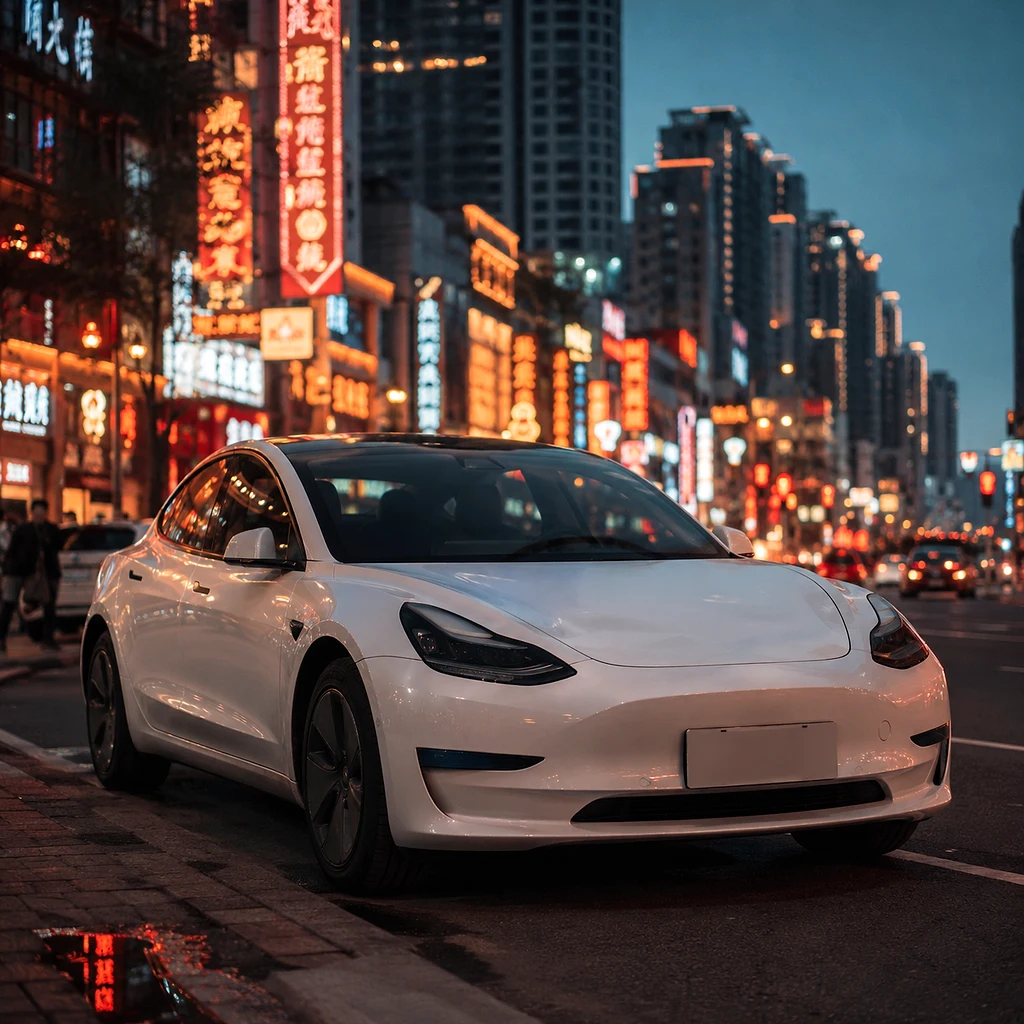
特斯拉 FSD 中国落地:自动驾驶、数据主权,与一个慢了一拍的领跑者
Tesla FSD Arrives in China
About this story
Tesla FSD Arrives in China. HSK 5+ Chinese listening practice.
This is an HSK 5+ Chinese listening episode that runs about 9 minutes. The full Mandarin script is shown with tap-for-pinyin and a line-by-line English translation, so you can listen and read at once — comprehensible input in the sense of Stephen Krashen's i+1 theory. It teaches 12 key vocabulary words such as 自动、数据、政治 and walks through 4 grammar patterns, each explained in English with examples. The same news story is retold at 4 difficulty levels — use the level selector above to find the version that is challenging but still understandable for you.
Read at your level
原文Read the complete story in Chinese. Reveal pinyin and English only when you need them.
English transcript reference
On May 21, 2026,
Tesla officially announced
that its "FSD Supervised Edition" autonomous-driving system
has gone live in China.
This day,
for Tesla,
for China's electric-vehicle industry,
and even for US-China tech relations,
is a major moment.
Today,
starting from this day,
we'll talk about several bigger questions.
First,
what is FSD?
Is it really "Full Self-Driving"?
Second,
why has this matter
waited so many years?
The politics behind it,
the data rules,
and the mapping problem —
what exactly are they?
Third,
and the most interesting:
when Tesla finally arrives in China,
what it faces is a market
completely different from a few years ago.
Let's first talk about FSD itself.
FSD,
in English fully stands for "Full Self-Driving";
the literal Chinese is "完全自动驾驶."
It sounds
like the science-fiction-movie kind:
you sit in the back seat,
and the car drives you home by itself.
But the reality is:
the current FSD,
its official name is actually
"FSD Supervised Edition."
The two words "supervised"
point at the truth:
the car drives itself,
but a person must
sit in the driver's seat watching,
ready at any time to take over.
According to industry classification,
the kind of autonomous driving where people don't have to watch the road
is called L4 or L5.
All "self-driving" production cars on the market today,
including Tesla's FSD,
in essence
are still at the L2+ level.
That is to say,
legally
and in practice,
the responsibility for driving
still sits with the driver.
With that understood,
we can now look at
why this matter dragged on for so long.
Tesla's FSD
went fully live in the US in 2024,
and then progressively entered Canada,
Mexico,
and some European countries.
But in China,
it was stuck for a full two years and more.
The reason
is not a technical problem;
it's a rules problem.
China set up
two key barriers for autonomous driving.
The first
is data localization.
Autonomous driving requires collecting massive amounts of
road-condition,
road,
and even driver-behavior data.
By Chinese rules,
this data
must be stored within China's borders;
it cannot be transmitted directly abroad.
For this reason, Tesla,
back in 2021,
built in Shanghai
a dedicated China data center.
But cutting the entire
cross-border data pipeline
completely clean
and making it compliant
itself takes many years.
The second
is mapping.
Autonomous driving relies heavily
on high-precision maps.
And China requires:
high-precision maps
can only be made by Chinese companies
with "Grade-A surveying qualification."
For this, Tesla
partnered with Baidu,
using Baidu's high-precision maps
to power FSD.
These two barriers —
one is data sovereignty,
the other is surveying security —
are both red lines for Chinese regulators.
Tesla satisfied them one by one,
taking several years.
So this "launch"
isn't a sudden technical success;
it's compliance finally walking through.
There is also a backdrop we cannot ignore:
politics.
In early May,
US President Trump
made a state visit to China.
Elon Musk,
as one of the Trump administration's
important advisors,
went to Beijing along with him.
About a week after the visit ended,
FSD officially went live in China.
The timing of these two events
is very close.
Observers broadly believe:
FSD's final clearance
is not only an administrative approval victory —
it's also the US and China,
in technology and trade,
making subtle mutual concessions.
But
what's most interesting
isn't "Tesla finally arrived" —
it's
"what kind of China Tesla arrived in."
In 2024,
when FSD went live in the US,
China's smart-driving market
was still very early.
At that time,
Tesla was the unquestioned
"synonym for autonomous driving."
But in these past two years,
China's market has gone through
a quiet but very deep change.
Xpeng's XNGP,
Huawei's ADS,
Li Auto's AD Max,
BYD's "God's Eye,"
and the much younger Xiaomi —
almost every one of them
has rolled out their own
highway navigation,
city navigation,
and automatic-parking systems.
What's even more crucial,
their business models
are completely different from Tesla's.
China's smart-driving features
are either given away free,
or bundled into the car's price,
or charged only a small fee.
But Tesla's FSD,
priced in China at 64,000 yuan,
one-time purchase.
By comparison,
it looks expensive.
What's even more subtle is the pricing model itself.
Just this past February,
Tesla, globally,
eliminated FSD's "one-time purchase,"
switching entirely to subscription.
Car owners in other countries
can now only pay monthly.
But in China,
Tesla specifically kept
the "one-time purchase" option.
The logic behind it is clear:
the China market is too important
to miss.
And Chinese consumers
are generally cool to "long-term subscription";
they prefer to "spend once,
use forever."
For this, Tesla
made a
business-model concession
specifically for the China market.
This event,
its symbolic significance may be
even bigger than the financial impact.
So,
how do we evaluate this "launch"?
Different angles
yield very different conclusions.
From Tesla's perspective,
this is a major victory:
the gates of the China market opened,
the entry ticket for autonomous driving
in the world's hardest market.
From the perspective of Chinese homegrown automakers,
this is a "wolf is coming" —
but this wolf
is not as scary as a few years ago.
Because Chinese rivals
have already, on home turf,
planted their feet.
From the perspective of Chinese consumers,
this is one more choice,
but not a must-buy.
64,000 yuan
isn't cheap.
From the perspective of technological progress,
all of the world's "autonomous driving"
is still within the L2+ range.
The truly "person-not-required" —
that future —
is still very far away.
At this point,
I want to leave some more general reflections.
This event
is in fact a concentrated expression
of several trends.
The first trend:
global technology companies,
to enter large markets,
increasingly have to play
by local rules.
Where data is stored,
who makes the maps,
how the model is trained —
none of these are decisions
tech companies can make unilaterally.
"Data sovereignty"
is becoming a question
every country has to answer.
The second trend:
the China market
is moving from being a "recipient"
to a "participant,"
even a "front-runner."
Five years ago,
when China brought in a new technology,
it was often "they teach me."
Today,
when Tesla finally comes in,
local players
have already built
products that are no worse, and often cheaper.
This kind of role reversal
is happening in many fields.
The third trend,
perhaps the most important —
no matter what manufacturers call this thing,
"Full Self-Driving" or anything else,
the person who, in the end, sits in the car
and is responsible for the steering wheel
is still you yourself.
No matter how advanced the technology,
it won't carry the risk for you.
Marketing can be very bold;
the laws of law and of physics
remain very cold.
Finally,
let me leave you with two questions.
The first:
if one day
cars really can fully drive themselves,
would you be willing to let a computer
decide, completely, your driving safety?
Or
do you hope
the one who, in the end, "makes the decision"
is still a person?
The second,
a bit closer to home:
today's "self-driving"
is still far from fully automatic.
So,
for car makers
to continue using the word "automatic"
in their marketing —
is that appropriate?
These two questions
have no standard answer.
But they
are worth thinking about slowly.
Okay.
That's all for today.
See you in the next story.
Listen again
Try it without the transcript and notice what sounds clearer.
What vocabulary does this episode teach?
词汇Automatic. The whole episode interrogates this word — and argues that today's '自动驾驶' is not yet really automatic.
Data. The first regulatory barrier: 数据本地化 — data localization — required Tesla to build a Shanghai data center.
Politics. The episode treats the FSD launch as inseparable from US-China political dynamics — Trump's Beijing visit, Musk's role.
Market. The China 市场 has changed dramatically since 2024 — local players have caught up while Tesla waited.
Trend. The episode closes on three larger 趋势: data sovereignty, China as front-runner, and human responsibility behind any 'automatic' system.
Responsibility. The episode's hard close: 为方向盘负责的人,还是你自己 — the responsibility behind the wheel is still yours.
Supervise. Beyond HSK4. The two characters '监督版' carry the truth — the driver supervises; the car doesn't drive alone.
Sovereignty. Beyond HSK4. 数据主权 — data sovereignty — is becoming the question every country must answer about foreign tech.
Red line. Beyond HSK4. China's data-localization and mapping rules are 监管的红线 — regulator's red lines — that Tesla had to clear.
To concede. Beyond HSK4. Both the US-China political 让步 and Tesla's business-model 让步 (keeping one-time pay for China only).
Subscription. Beyond HSK4. Tesla switched FSD to subscription globally in Feb 2026 — except for China, where one-time buyout was kept.
Coincidence. Beyond HSK4. Observers say it's no 巧合 that FSD's China approval landed days after Trump's state visit.
* beyond level超纲词
What grammar patterns appear in this episode?
语法不是 A,是 B (correcting a frame)
Used to swap a misleading explanation for the right one. The episode uses it to say the FSD delay was a rules problem, not a tech problem.
原因,不是技术问题,是规则问题。
所以这一次的"上线",不是技术突然成功,是合规终于走通。
从 X 的角度看,Y
从…角度看 frames the same fact from a specific viewpoint. The episode uses it four times to evaluate the launch from different perspectives.
从特斯拉的角度看,这是一次重大的胜利。
从中国本土车企的角度看,这是一次"狼来了"。
X 正在从 A,变成 B
正在从 + A + 变成 + B describes an ongoing transformation. The episode uses it for China's role shift in global tech markets.
中国市场,正在从"接受者",变成"参与者"。
"数据主权",正在变成一个,每个国家都要回答的问题。
不管 X,最终 Y
不管 + condition + 最终 + result holds regardless of variation. The episode's hardest close: whatever the marketing, the responsibility is still yours.
不管厂商把这个东西叫"完全自动驾驶"还是别的什么名字,
最终坐在车里、为方向盘负责的人,还是你自己。
Proper nouns
专有名词Free account
Keep learning from this story
Create a free account to keep saved words and your preferred level together.
- Keep words with their story context
- Remember your preferred level
- Build your vocabulary over time