
A Chinese podcast · Same story, 4 levels
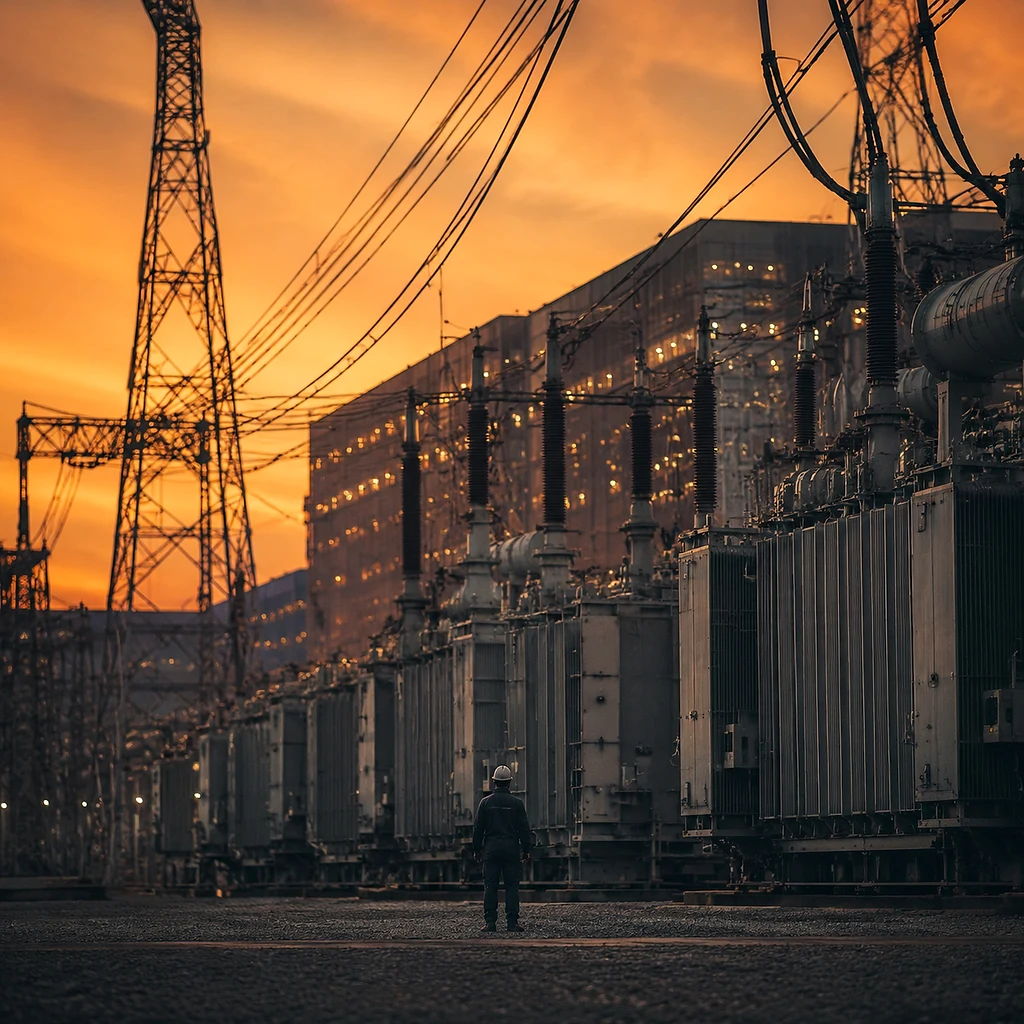
AI狂热的代价:七千亿豪赌如何引发全球资源短缺
AI's $700 Billion Gamble — How Amazon's Boardman, Oregon Data Centers Crowd Out Power
About this story
Washington Post on AI's $700B build-out — Amazon's Boardman data centers swallow power and electricians. HSK 5-6 Chinese listening practice.
This is an HSK 5-6 Chinese listening episode that runs about 4 minutes. The full Mandarin script is shown with tap-for-pinyin and a line-by-line English translation, so you can listen and read at once — comprehensible input in the sense of Stephen Krashen's i+1 theory. It teaches 12 key vocabulary words such as 社会、政策、市场 and walks through 5 grammar patterns, each explained in English with examples. The same news story is retold at 4 difficulty levels — use the level selector above to find the version that is challenging but still understandable for you.
Read at your level
原文Read the complete story in Chinese. Reveal pinyin and English only when you need them.
English transcript reference
Hello everyone, welcome to today's "Tech Frontier Observer."
I'm your host, Ming Zhe.
Hi everyone, I'm Zi Han.
The topic we're discussing today is explosive, and it's also closely related to all of our wallets.
That's right.
The Washington Post recently published an in-depth report revealing a jaw-dropping phenomenon.
The report points out that tech giants' frenzied spending on artificial intelligence is causing severe shortages in virtually every other sector.
Yes, the article mentions an astronomical figure: seven hundred billion dollars.
This is an unprecedented "money-burning" war.
This seven hundred billion dollars in capital expenditure, while driving the rapid advancement of AI technology, has also acted like a massive black hole, draining the resources around it.
What we need to discuss isn't just a matter of money, but of physical resources.
Zi Han, can you give everyone the most intuitive example?
Of course.
The most direct impact is — you might not be able to find an electrician.
This sounds a bit unbelievable.
How could high-end AI technology be competing with electricians who fix circuits?
The logic is actually quite simple.
AI's operation depends on massive data centers, and the construction and maintenance of these data centers require extremely complex electrical systems.
Exactly. Companies like Amazon AWS have established huge data center clusters in places like Boardman, Oregon.
To keep these facilities running, tech companies are hiring large numbers of skilled electricians and electrical engineers at premium wages.
This has led to an extreme shortage of electricians in other sectors of the market.
Many ordinary construction projects have even been forced to halt as a result.
It's not just manpower — the competition for raw materials has also reached a fever pitch.
Yes, the report mentions that orders for transformers and power generation equipment have been backlogged for years.
For cities that urgently need infrastructure upgrades, this is undoubtedly devastating news.
Beyond infrastructure, this shortage effect has also spread to the consumer electronics sector.
I heard that smartphones are going to get more expensive too?
That's practically a certainty at this point.
The reason lies in chips, especially memory chips.
As we know, training AI models requires massive amounts of high-performance memory.
This has led chip manufacturers to adjust their production lines.
Capacity that was originally used to produce smartphone and personal computer memory is now being heavily redirected to produce AI-specific high-bandwidth memory.
This has created a supply shortage of regular consumer-grade chips — a classic case of "demand exceeding supply."
According to forecasts, smartphone prices may continue to rise over the coming years because core components have become more expensive.
This is truly a case of "when gods fight, mortals suffer."
Before we can enjoy the conveniences AI brings, we first have to foot the bill for its costs.
There's another more hidden but far-reaching issue, and that's the "crowding-out effect" of capital.
This is exactly what I wanted to discuss.
When seven hundred billion dollars all rushes toward AI, innovation projects in other fields struggle to secure funding.
That's right.
Many startups in non-AI fields, no matter how good their technology is, now face the risk of "running out of fuel."
Because venture capitalists' attention has been captured entirely by AI — they see it as the only future.
This one-sided investment frenzy could stifle innovation in critical fields like biotechnology and clean energy.
The Washington Post article even used the phrase "unprecedented" to describe the scale of this spending.
This inevitably brings to mind the dot-com bubble, but this time it seems to involve competition for underlying physical resources.
Yes, in the past they competed for users' eyeballs; now they're competing for electricity, chips, labor, and capital.
How this massive gamble will end is still hard to say.
But the short-term pain, it seems, is a reality we must face.
For ordinary consumers, perhaps we need to mentally prepare ourselves: phones getting more expensive, renovations becoming harder, and even electricity bills potentially rising.
But this also reminds policymakers that they need to find a balance between AI development and people's livelihoods.
Very well said.
Technological progress is certainly important, but it shouldn't come at the cost of society's overall normal functioning.
That's about all the time we have for today's show.
I wonder what our listeners think about this "resource battle" triggered by AI?
Feel free to leave a comment and share your observations with us.
See you next episode!
Goodbye!
Listen again
Try it without the transcript and notice what sounds clearer.
What vocabulary does this episode teach?
词汇Used to describe a number that is extremely large, often referring to huge sums of money.
A colloquial term in business referring to spending capital very quickly, often to capture market share or build infrastructure.
Metaphorically used to describe something that consumes vast amounts of resources or money without giving much back immediately.
An abbreviation for '高端,大气,上档次'. Often used to describe technology or lifestyles that are premium and impressive.
Originally a Mahjong term for winning on someone else's discard. In business, it means snatching a deal, talent, or resource before someone else can.
Describes a situation (like competition or conflict) reaching its most intense stage.
HSK 1-4. society.
HSK 1-4. policy.
HSK 1-4. market.
HSK 1-4. price.
HSK 1-4. cost.
HSK 1-4. investment; to invest.
What grammar patterns appear in this episode?
语法Not only... but more importantly... / but also... (Used to emphasize the second part).
我们要聊的不仅是钱的问题,更是实体资源的问题。
Leading to / Causing / Resulting in (Usually followed by a negative or neutral consequence).
科技巨头们在人工智能领域的疯狂投入,正在导致其他所有领域出现严重的短缺。
这就造成了普通消费级芯片的供应紧张。
Rather than... it is better to... (Note: While not explicitly in the final draft, similar comparative structures are common. A related pattern used is '不是...而是...' or '不仅...连...').
这不是简单的竞争,而是资源的掠夺 (Example construction for context). In script: 不仅是高端芯片,连普通手机用的存储芯片都供不应求 (Pattern: Not only... even...).
Proper Nouns
专有名词Sources
来源Free account
Keep learning from this story
Create a free account to keep saved words and your preferred level together.
- Keep words with their story context
- Remember your preferred level
- Build your vocabulary over time