
A Chinese podcast · Same story, 4 levels
名厨做高档菜,下班后却爱吃塔可钟
Top Chefs Cook Fine Food and Reach for Taco Bell After Work
About this story
Why fine-dining chefs like Harold Moore, Bricia Lopez, and Dobbertin praise Taco Bell and reinvent its Crunchwrap. HSK 5-6 Chinese listening practice.
This is an HSK 5-6 Chinese listening episode that runs about 5 minutes. The full Mandarin script is shown with tap-for-pinyin and a line-by-line English translation, so you can listen and read at once — comprehensible input in the sense of Stephen Krashen's i+1 theory. It teaches 12 key vocabulary words such as 做、菜、喜欢 and walks through 4 grammar patterns, each explained in English with examples. The same news story is retold at 4 difficulty levels — use the level selector above to find the version that is challenging but still understandable for you.
Read at your level
原文Read the complete story in Chinese. Reveal pinyin and English only when you need them.
English transcript reference
A famous chef cooks high-end dishes, but after work he loves eating Taco Bell.
In New York, there is a restaurant called Cafe Commerce.
In the restaurant there is a chef named Harold Moore.
One dish he makes costs ninety-nine dollars.
This dish is a whole chicken, with herb butter placed under the chicken skin, and it comes out of the oven very fragrant.
This dish also comes with bread and mashed potatoes; the bread is crispy, and butter is added to the mashed potatoes.
It sounds very high-end, right?
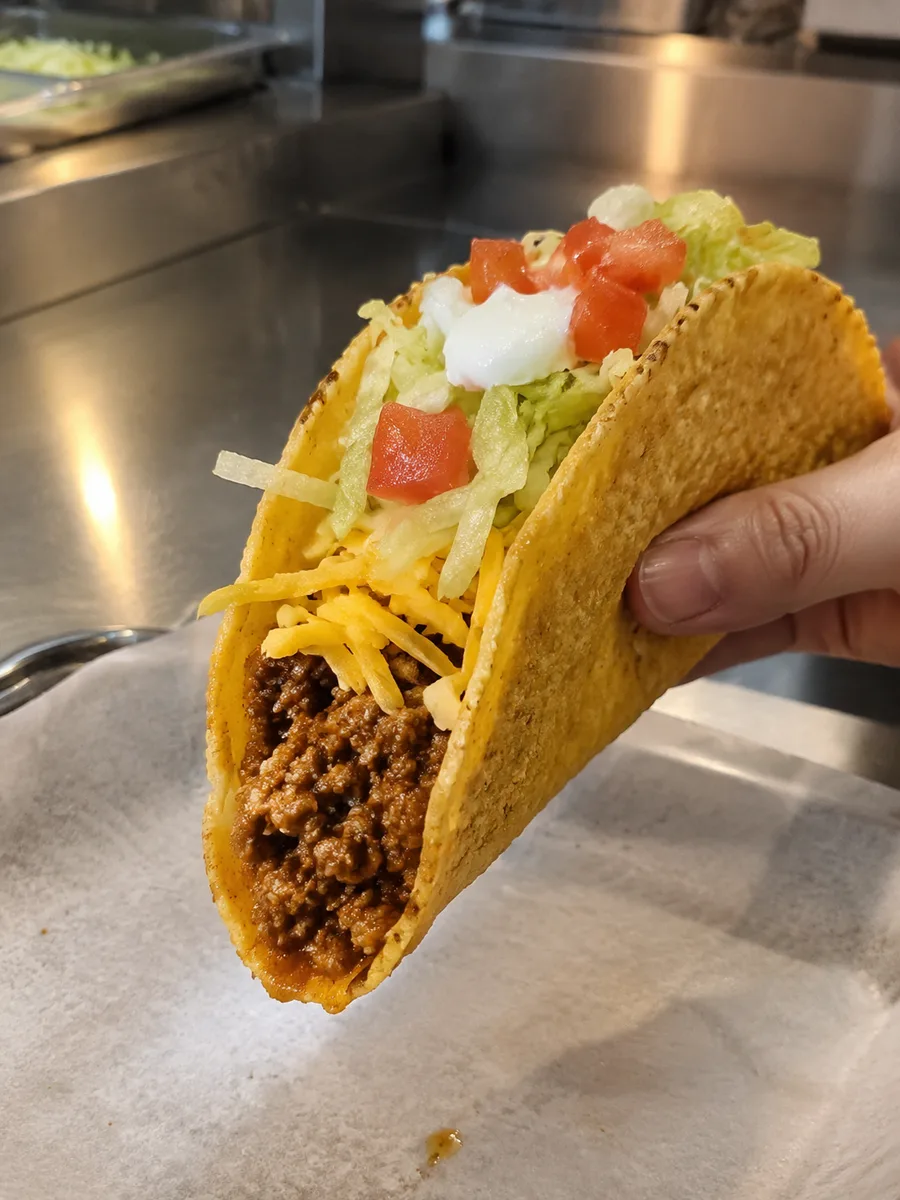
But this chef also praises Taco Bell's Crunchy Supreme taco.
He says that in one bite there is everything.
He says that in one taco there is hot, cold, crispy, and also soft.
There is spiciness, but the sour cream makes it milder again.
He says this is a very complete experience.
Think about it: a chef who makes ninety-nine-dollar dishes loves fast-food tacos — isn't that a bit interesting?
There is another chef named Bricia Lopez.
She co-runs an Oaxacan restaurant, and a critic once praised this restaurant.
She also likes Taco Bell.
She says the crispy, the oily, and the sour are all together, just to make your mouth happy and get your brain moving.
You see, these chefs are not just saying it casually.
They really do like it.
In the United States, Taco Bell is a brand that people both love and hate.
Some people laugh at it, saying its food is not high-end.
But many chefs and people who cook just love to eat it.
In Nashville, there is a chef named Dung Vo.
He co-founded Noko Hospitality.
He goes to Taco Bell and buys a chicken quesadilla, then adds steak and beef.
He says this combination is like the perfect choice for a meat lover, and you can eat it in the car without making a mess everywhere.
In San Antonio, there is a chef named Jennifer Dobbertin.
She runs a restaurant and has also received three James Beard Award nominations.
When her employees are about to leave, she holds a farewell party.
At the farewell party, she often buys Taco Bell — a lot of it.
She says that for many people who work in restaurants, Taco Bell is an everyday thing.
Last year, Taco Bell's Crunchwrap turned twenty.
This Crunchwrap is a hexagonal flatbread with meat and cheese folded inside, and the outside is grilled until crispy.
Last year, it sold more than one hundred million of them.
Many chefs also make their own versions.
They do not use Taco Bell's beef and cheese sauce, but instead use meat and sauce they make themselves.
For example, some use Korean barbecue, some use Mexican braised meat, and some make their own salsa.
Dobbertin spent many years in Thailand.
She made her own crispy roll, filled with marinated chicken, plus Thai Khao Soi coconut curry, along with a sauce and crispy noodles.
Vo also imitates Taco Bell's Crunchwrap.
He makes a grilled cheese sandwich in his own restaurant.
He says you pick it up with your hand, take a bite, and there is truffle mayonnaise, the saltiness of ham, and the buttery crispness of the bread.
He says this is very similar to the texture he likes.
The relationship between Taco Bell and chefs actually began a long time ago.
Taco Bell's founder is named Glen Bell.
He used to run a hot dog stand in San Bernardino, California.
Across from him there was a restaurant called Mitla Cafe.
The people at Mitla Cafe introduced him to the crunchy-shell taco.
Later, he started Taco Bell.
Taco Bell has a person who does food innovation, named Brett Pluskalowski.
He says that in 2012, Taco Bell made a Doritos taco, with a Doritos crunchy shell on the outside.
He believes this taco got many people to start thinking: anything can be made into a taco shell.
Now you can use baozi, use Indian flatbread, use pita, use seaweed to make tacos.
Pluskalowski has recently been thinking about using the crispy crust of Persian rice to make taco shells.
Crispy rice is the layer at the bottom of the pot that turns crunchy.
He has not succeeded yet.
But if he succeeds, many chefs will want to try it.
Think about it: why do these chefs who cook high-end dishes like Taco Bell?
There is another reason: Taco Bell lets you choose for yourself.
You can add this, add that, and make the flavor you like yourself.
Vo is like this: he adds steak, adds beef, and makes a very large quesadilla.
Dobbertin is also like this: she makes her own Crunchwrap.
So Taco Bell is not just fast food.
It is also a place that lets chefs play.
They can find new ideas there.
For example, the crunchiness of the Crunchwrap made Vo think of his grilled cheese sandwich.
Pluskalowski is also trying to use the crispy crust of Persian rice to make shells.
These ideas then go back into their restaurants.
A chef who cooks high-end dishes will also look for new ideas in fast food.
After you finish work, do you want to cook a complicated meal, or buy a fast-food item you love to eat?
Listen again
Try it without the transcript and notice what sounds clearer.
What vocabulary does this episode teach?
词汇HSK 2. Very common verb; here 做菜 'to cook a dish' and 做塔可 'to make tacos'.
HSK 3. 一道菜 'one dish'; 高档菜 'high-end dishes'; 瓦哈卡菜 'Oaxacan food'.
HSK 1. 爱吃/喜欢 both appear; 喜欢 is the neutral 'like', 爱 is stronger.
HSK 2. Used for permission and possibility: 可以在车里吃 'you can eat it in the car'.
HSK 3. 开始做塔可钟 'started Taco Bell'; 开始想 'started thinking'.
HSK 2. 一起经营 'co-run'; 都在一起 'all together'.
HSK 3. Appears twice: bread inside the chicken and the buttery bread of a sandwich.
HSK 3. Introduces examples: 比如,有人用韩式烤肉 'for example, some use Korean barbecue'.
HSK 4. 他还没做成功 'he hasn't succeeded yet'; 如果他做成功了 'if he succeeds'.
HSK 5. 奶酪夹饼 'cheese quesadilla'; 奶酪酱 'cheese sauce'.
Story word. Taco Bell's hexagonal grilled item; 脆 'crispy' + 卷 'roll/wrap'.
Story word. The crunchy layer of rice at the bottom of the pot; Pluskalowski wants to use it as a taco shell.
* beyond level超纲词
What grammar patterns appear in this episode?
语法叫 + Name(naming)
Use 叫 to give the name of a person, place, or thing: 'X 叫 Y'.
在纽约,有一家餐厅,叫 商业咖啡馆。
餐厅里有一位厨师,叫 哈罗德·穆尔。
塔可钟的创始人,叫 格伦·贝尔。
有 + Object(existence)
有 states that something exists or is present, often with a place or container first.
在纽约,有一家餐厅,叫 商业咖啡馆。
餐厅里有一位厨师,叫 哈罗德·穆尔。
这道菜还有面包和土豆泥,面包是脆的,土豆泥里加了黄油。
让 + Person + Verb(causative)
让 means 'to let/make someone do something'; the person follows 让, then the verb phrase.
有辣味,但酸奶油又让它变温和。
她说,脆的、油的、酸的,都在一起,就是为了让你的嘴开心,让你的脑子动起来。
他认为,这个塔可让很多人开始想:什么都可以做塔可的壳。
不用……而是……
Use 不用……而是…… to contrast an ingredient that is not used with the ingredient chosen instead.
他们不用塔可钟的牛肉和奶酪酱,而是用自己做的肉和酱。
Proper nouns
专有名词Sources
来源Free account
Keep learning from this story
Create a free account to keep saved words and your preferred level together.
- Keep words with their story context
- Remember your preferred level
- Build your vocabulary over time