
A Chinese podcast · Same story, 4 levels
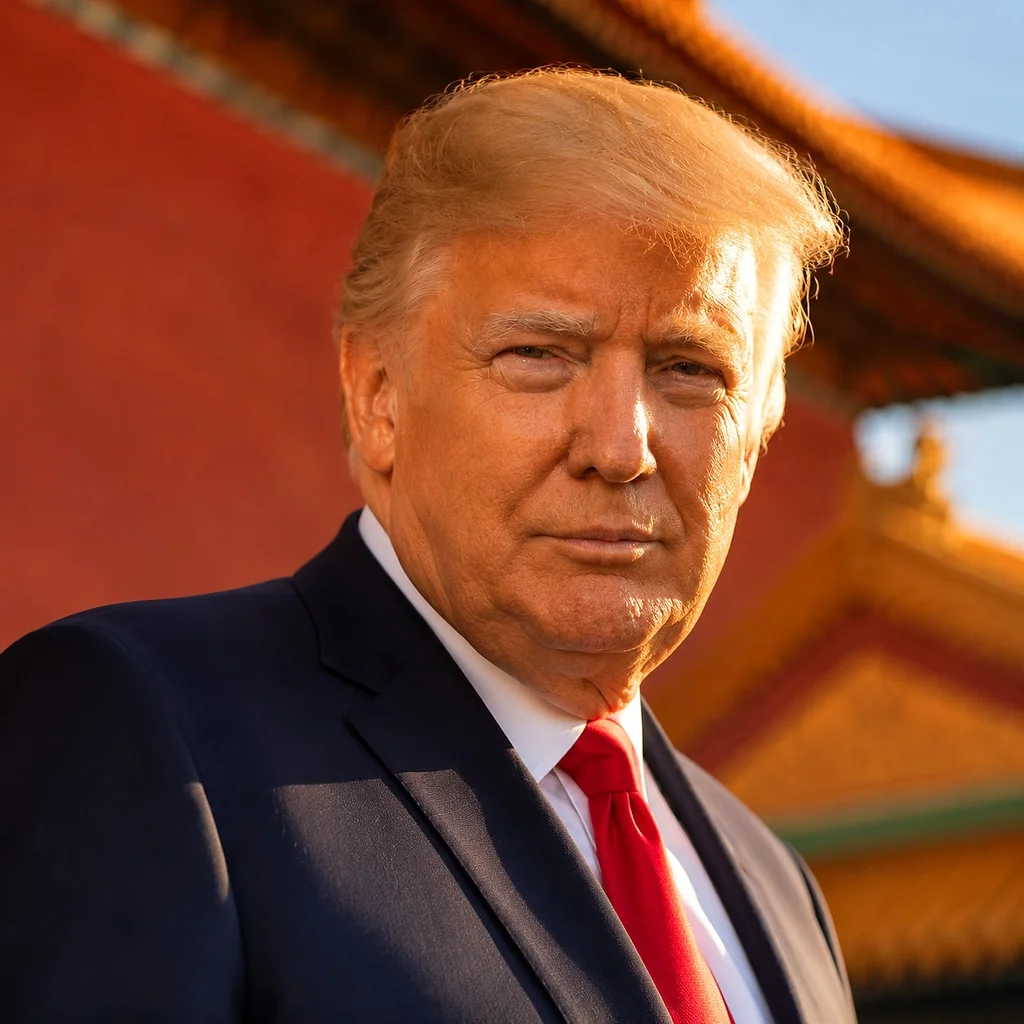
特朗普访华2026:中美如何在不和好的情况下,停止伤害彼此
Trump Visits China Amid US–China Tensions
About this story
Trump Visits China Amid US–China Tensions. HSK 5-6 Chinese listening practice.
This is an HSK 5-6 Chinese listening episode that runs about 9 minutes. The full Mandarin script is shown with tap-for-pinyin and a line-by-line English translation, so you can listen and read at once — comprehensible input in the sense of Stephen Krashen's i+1 theory. It teaches 12 key vocabulary words such as 投资、政府、经济 and walks through 4 grammar patterns, each explained in English with examples. The same news story is retold at 4 difficulty levels — use the level selector above to find the version that is challenging but still understandable for you.
Read at your level
原文Read the complete story in Chinese. Reveal pinyin and English only when you need them.
English transcript reference
Today we're talking about something that just wrapped up — Trump's visit to China.
On the afternoon of May 13, Air Force One landed at Beijing Capital International Airport.
All day on May 14, he and Xi Jinping held closed-door talks at the Great Hall of the People.
On the morning of May 15, the plane lifted off and flew back to Washington.
The whole trip: three days and two nights.
Compact, dense, and barely leaving the spotlights much room to improvise.
But the weight of these three days doesn't depend on the length of the schedule — it rests on one fact:
This is the first sitting US president to set foot on Chinese soil in nine years.
And it's the first formal Trump-Xi meeting on Chinese soil during this term.
Nine years was enough for the relationship to slide from "co-opetition" toward the edge of "decoupling."
And this visit was more like an outstretched hand bracing that falling curve.
Today we're going to peel it back layer by layer,
to see what this hand actually held up — and what it couldn't.
First layer: the makeup of the delegation itself.
This time Trump didn't just bring the Secretary of State and the National Security Adviser.
He also brought what could be called a "luxury" business team:
Musk of Tesla, Cook of Apple, Huang of Nvidia, Dimon of JPMorgan, Fink of BlackRock...
A long list, covering essentially half the kingdom of America's new economy and Wall Street.
This is a highly politicized signal.
The subtext is:
no matter how far Washington and Beijing argue on ideology,
the companies that actually decide American jobs, stock prices, and tax revenue
still treat the Chinese market as irreplaceable.
The reason they were willing to fly the Pacific aboard the president's plane
is that they understand:
the cost of being absent is much greater than the cost of attending.
Second layer: money.
After the talks ended, the two sides published a long list of agreements,
totaling over 250 billion dollars.
Two of them are most striking.
The first: Chinese companies pledging 84 billion to invest in West Virginia, USA, to build a natural gas and chemicals complex.
The second: China investing 43 billion in Alaska, joining a liquefied natural gas project.
Together those two come to nearly 130 billion.
The beauty of it is the structure.
China puts up money to build factories and buy energy in the US;
the US gets jobs, taxes, and local political wins;
and China locks in energy supply for the next ten, twenty years.
This "you bring the market, I bring the money" arrangement
is commerce on the surface, but strategy at its core.
It uses visible jobs and capital flows
to stabilize the invisible bilateral politics.
Third layer: geopolitical security.
The most concrete and urgent piece is the Strait of Hormuz.
You may not be familiar with where this strait sits, but you only need to remember one number:
about twenty percent of the world's oil passes through here every day.
Recently, this stretch of water has seen some unsettling activity.
Forces trying to charge "tolls," plans to blockade the channel, undercurrents of militarization.
For China, this is the lifeline of energy;
for the US, it's the key to allies and market stability.
The two countries clash on many issues, but on this one strait they have, remarkably, reached a rare consensus:
Hormuz must stay open, must not be militarized, and must not be "choked" by any one side.
This sentence is short when written down, but in reality it's one of the most operational outcomes of the visit.
Because it brings the abstract idea of "peace" down to the concrete level of a "shipping lane."
Fourth layer, and the one most worth unpacking — the redefining of the relationship.
This time President Xi put forward a new formulation:
"Constructive Strategic Stability Relationship."
Those eight characters look abstract,
but read piece by piece, not a single character is filler.
"Strategic" means this is a top-level framework, not a day-to-day matter.
"Stability" means the two countries acknowledge each other's presence and weight, and no longer try to change the other through drastic means.
"Constructive" means even when there are disagreements, both sides are willing to push toward getting things done, instead of sabotaging each other.
Personally I think there's a very sober judgment behind this formulation —
which is:
between the US and China, it's no longer possible to return to the romantic narrative of "constructive cooperative partnership" from twenty years ago;
but they also shouldn't slide into a "new cold war" confrontation.
A third path is acknowledging each other's un-eliminable existence,
and then, on the premise of not reconciling,
stopping the mutual injury.
This is a fairly mature, even slightly desolate realism.
During the talks, Xi also cited a frequently discussed concept — the "Thucydides Trap."
The term comes from the ancient Greek historian Thucydides.
He observed that the rise of Athens made Sparta afraid,
and that fear ultimately dragged both cities into war.
Later the American scholar Graham Allison generalized this observation,
arguing that in the past five hundred years,
out of sixteen cases where a rising power challenged an established one,
twelve ended in war.
Xi mentioned this term not to dramatize the danger,
but to remind everyone present:
this old historical road is not destiny.
Between the US and China, there is a third possibility.
Trump himself didn't directly engage with this concept in public.
He prefers a more commercial-sounding register:
he said his relationship with President Xi is "better than at any point in history";
he said the agreements signed this time are "fantastic" and "incredible."
He's not strong on philosophical themes, but he is strong at compressing a grand situation into a few adjectives.
This style isn't always convincing,
but it has effectively turned down the temperature of "confrontation" by a notch.
But we also have to stay clear-eyed.
This visit did not produce a joint statement.
What's a joint statement?
It's the most formal kind of document, jointly signed and jointly issued by both countries.
This time, there was none.
What replaced it was each side's own press release, each side's own talking points.
What does that mean?
It means the items that reached a genuine "black-on-white consensus" are far fewer than the headlines suggest.
The thorniest issues —
high-end chip export controls, the boundaries of the Taiwan question, navigation rules in the South China Sea, tariff details, AI governance —
have not really landed.
They've been put back by the two leaders onto the "to be discussed further" pile,
waiting to be inched forward over the next several years by officials at various levels.
So this visit is more like applying the brakes than hitting restart.
It didn't put US-China relations back into a honeymoon.
It just slowed the two countries' descent
from a very dangerous speed.
It gave the governments, the companies, and the markets on both sides
a little bit of breathing room.
And for those of us watching the news from the other side of a screen,
perhaps what we most need to digest is this fact:
real maturity between two superpowers
is not about who says more pleasantries,
or who is the first to extend the hand of friendship;
it's about whether both sides are willing to admit —
we cannot eliminate the other, nor can we turn the other into our own image.
Then the only rational choice is to keep on living the days.
A bit slower, a bit flatter, a bit less romantic — but without things blowing up.
This doesn't sound sexy.
And it doesn't sound as grand as "great changes unseen in a century."
But the health of great-power relations
has never been measured by how long the red carpet is,
but by whether, on a stormy night,
the leaders on either side are willing to pick up the other's phone call.
When Trump left this time, he waved at the reporters before boarding.
President Xi walked him to his car at the door of the Great Hall.
No hugs, but a long handshake.
No joint statement, but each side's wording was more restrained than expected.
Perhaps this is the best answer US-China relations can give the world in 2026.
Not reconciliation.
Not victory.
But —
we are still talking.
We can still sign contracts.
We can still agree on the strait.
That alone is not easy.
OK.
That's all the content for today.
Tomorrow we'll talk about something else.
Listen again
Try it without the transcript and notice what sounds clearer.
What vocabulary does this episode teach?
词汇Putting capital into a project to earn returns. 中国企业在美国投资八百四十亿 = Chinese firms invest 84 billion in the US.
The official body running a country. 两国政府 = the two governments.
The system of money, jobs, trade. 美国新经济和华尔街 = the US new economy and Wall Street.
Not shaky. 稳定关系 = a stable relationship. The 稳 (stable) in 建设性战略稳定关系.
To recognize a fact, even an uncomfortable one. 承认彼此不可能消失 = acknowledge the other cannot disappear.
An abstract idea. 修昔底德陷阱是一个概念 = the Thucydides Trap is a concept.
Top-level long-term planning. 战略稳定 = strategic stability — not day-to-day matters but framework-level positioning.
A formal arrangement, often signed. 签了一长串协议 = signed a long list of agreements.
A shared view that both sides reach. 罕见的共识 = a rare consensus — used here for the Hormuz agreement.
A formal topic for discussion. 最棘手的议题 = the thorniest issues — chips, Taiwan, tariffs.
Separating two economies. From 脱 (come off) + 钩 (hook). 不想脱钩 = don't want to decouple.
Used for events that just ended. 刚刚落幕的大事 = a big event that just concluded.
* beyond level超纲词
What grammar patterns appear in this episode?
语法之所以…是因为…
The reason why... is because... A more written-register way of giving causes.
他们之所以肯跟着总统的专机一起飞过太平洋,是因为他们清楚:缺席比出席的代价大得多。
不在于…而在于…
Not a matter of X but a matter of Y. Used to redirect a definition or emphasis.
大国关系的好坏,从来都不是看红毯铺得多长,而是看在风雨夜里,两边的领导人愿不愿意接对方的电话。
既…也…
Both... and... / Neither X nor Y, depending on polarity. Often used with negations to indicate two impossibilities.
我们既无法消灭对方,也无法把对方变成自己的样子。
对…而言
As far as X is concerned / for X. Used to introduce different perspectives.
对中国而言,这是能源命脉;对美国而言,这是盟友和市场稳定的关键。
Proper nouns
专有名词Free account
Keep learning from this story
Create a free account to keep saved words and your preferred level together.
- Keep words with their story context
- Remember your preferred level
- Build your vocabulary over time