
A Chinese podcast · Same story, 4 levels
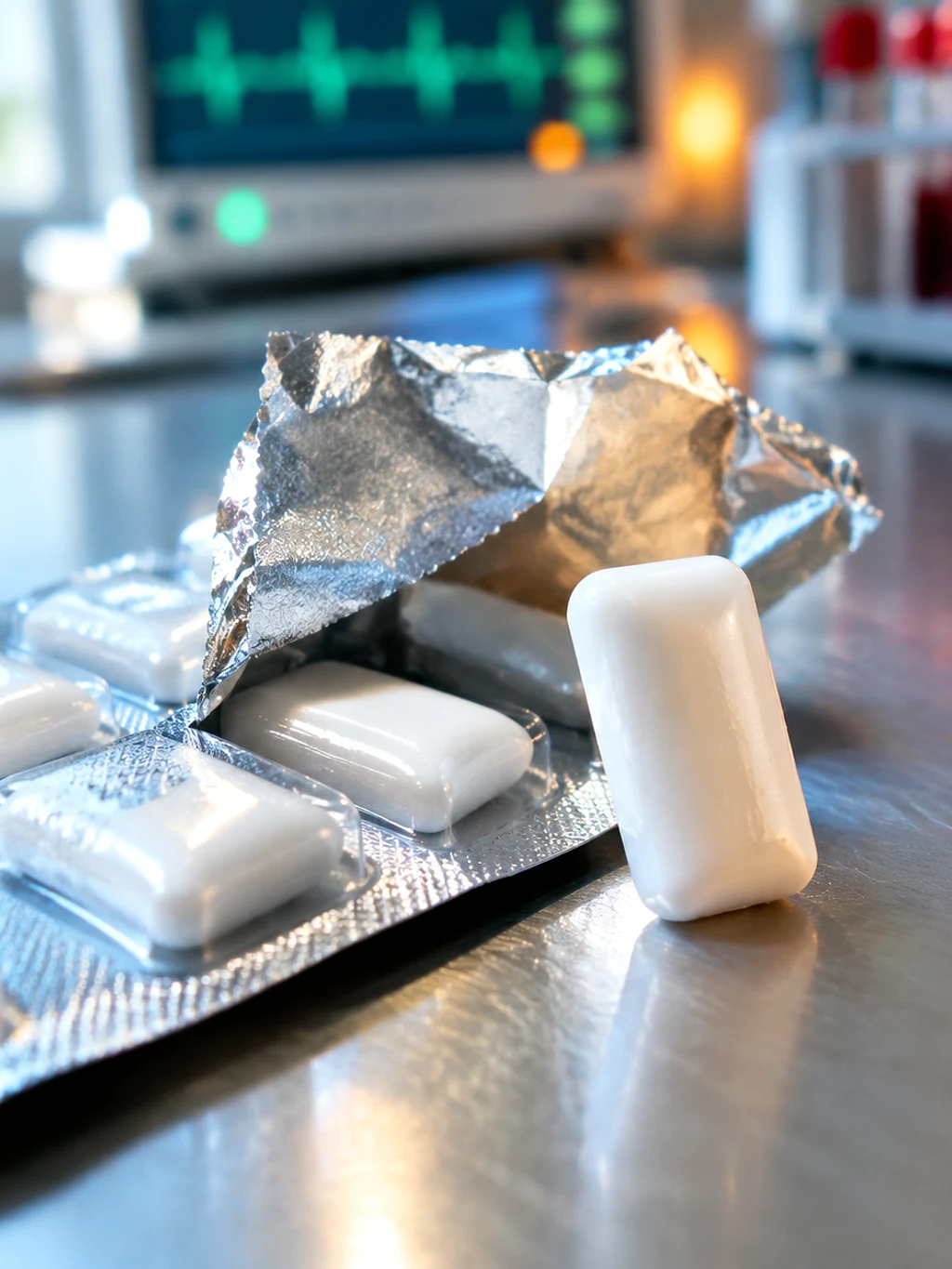
无糖口香糖里那个甜的东西,被发现和心血管事件有关:一万七千人,最高的一组高出百分之五十七
Study Links Xylitol to Heart Risk, Not Causation
About this story
At the European Society of Cardiology congress in September 2026, a Berlin team reported that across 17,710 people in two long-running cohorts, those with the highest blood xylitol had 57% more cardiovascular events in one cohort and 18% in the other. The study is observational, and the researchers said so first. Chinese listening practice at four levels. HSK 2 Chinese listening practice.
This is an HSK 2 Chinese listening episode that runs about 4 minutes. The full Mandarin script is shown with tap-for-pinyin and a line-by-line English translation, so you can listen and read at once — comprehensible input in the sense of Stephen Krashen's i+1 theory. It teaches 12 key vocabulary words such as 甜、医生、身体 and walks through 3 grammar patterns, each explained in English with examples. The same news story is retold at 4 difficulty levels — use the level selector above to find the version that is challenging but still understandable for you.
Read at your level
原文Read the complete story in Chinese. Reveal pinyin and English only when you need them.
English transcript reference
Today we are talking about something sweet.
Have you ever eaten something sweet?
Everyone has.
Sweet things — a lot of people love eating them.
But a lot of people think: sugar is bad.
Too much sugar and a person is not well.
So some people do not eat sugar.
They eat other sweet things instead.
This thing is sweet too.
But it is not sugar.
It is inside a great many things.
Inside some things you eat.
Inside some things you drink.
Many people eat it every day, and they do not know it.
They do not know they are eating it.
Why do they want to eat this?
Because they think: sugar is bad, this is good.
They think: I will stop eating sugar, I will eat this.
Then I will be fine.
That is how a lot of people think about it.
This year, some doctors did a new study.
These doctors are in Germany.
They looked at a great many people.
Seventeen thousand of them.
None of these people were young any more.
What did the doctors look at?
The doctors looked at their blood.
What is in blood?
There are a great many things in blood.
This sweet thing is in the blood too.
Some people have a lot of it, some have little.
The doctors watched for many years.
Then the doctors found something.
Among the people with more of it in their blood, more of them had bad hearts.
A bad heart — what is that?
Your heart is inside your body.
When the heart is bad, a person becomes very unwell.
Some of them die.
The number is not small.
Among the people with more of it in their blood, many more had bad hearts.
So — is this sweet thing bad?
The doctors say: we do not know.
The doctors say: we saw two things together.
The doctors say: but we do not know why.
A person has a lot of it in their blood.
Maybe it is because they eat a lot of it.
Or maybe it is because their body was not well to begin with.
When the body is not well, there is more of it in the blood.
Which one it is, the doctors do not know.
The doctors say: we still have to look.
The doctors also say: do not be afraid.
The doctors say: but do not eat a lot of it either.
Here is what I want to say about this.
Many people eat this because they think it is better than sugar.
But they have not looked.
They only heard someone say so.
There are a lot of things to eat in your house.
There is a lot of small print on them.
That small print — most people do not read it.
Think about it:
You stop eating one thing and eat another instead.
You think: this one is better than that one.
How do you know?
Did you look, or did someone tell you?
Listen again
Try it without the transcript and notice what sounds clearer.
What vocabulary does this episode teach?
词汇HSK 3. The whole episode is about one sweet thing that is not sugar.
HSK 1. Every claim in the episode is attributed to them, including the one that says they do not know.
HSK 2. 他的身体本来就不太好 — the alternative explanation the episode is careful to keep.
HSK 2. Used more often in the negative here than the positive, which is the point.
HSK 3. 医生发现了一件事 — what they found, and what they did not.
HSK 2. The episode turns on which 因为 is the right one, and says nobody knows yet.
HSK 3. The thing people are avoiding, and the reason they eat the other thing.
HSK 4. What the doctors measured — not what people said they ate.
Taught by location and consequence: 心在你的身体里面。心不好,人会很不好。
Introduced as an ordinary act — looking at a lot of people for a lot of years.
Where the doctors are. The episode names the source rather than saying "scientists say".
他们吃别的甜的东西 — the substitution that the entire episode examines.
* beyond level超纲词
What grammar patterns appear in this episode?
语法可能是因为……,也可能是因为……
It may be because of one thing, or it may be because of another. Chinese lays out two live explanations without ranking them — exactly what an observational result allows.
可能是因为他吃得多。
也可能是因为他的身体本来就不太好。
A 的人,B 的也多
Among the people who are A, there are also more who are B. This states a correlation and nothing more, which is the whole grammatical point of the episode.
血里这个东西多的人,心不好的人也多。
……过
Marks an experience that has or has not happened at some point. 没有看过 is stronger than 没看 — never once, not merely not today.
你吃过甜的东西吗?
可是他们没有看过。
Proper nouns
专有名词Sources
来源Free account
Keep learning from this story
Create a free account to keep saved words and your preferred level together.
- Keep words with their story context
- Remember your preferred level
- Build your vocabulary over time