
A Chinese podcast · Same story, 4 levels
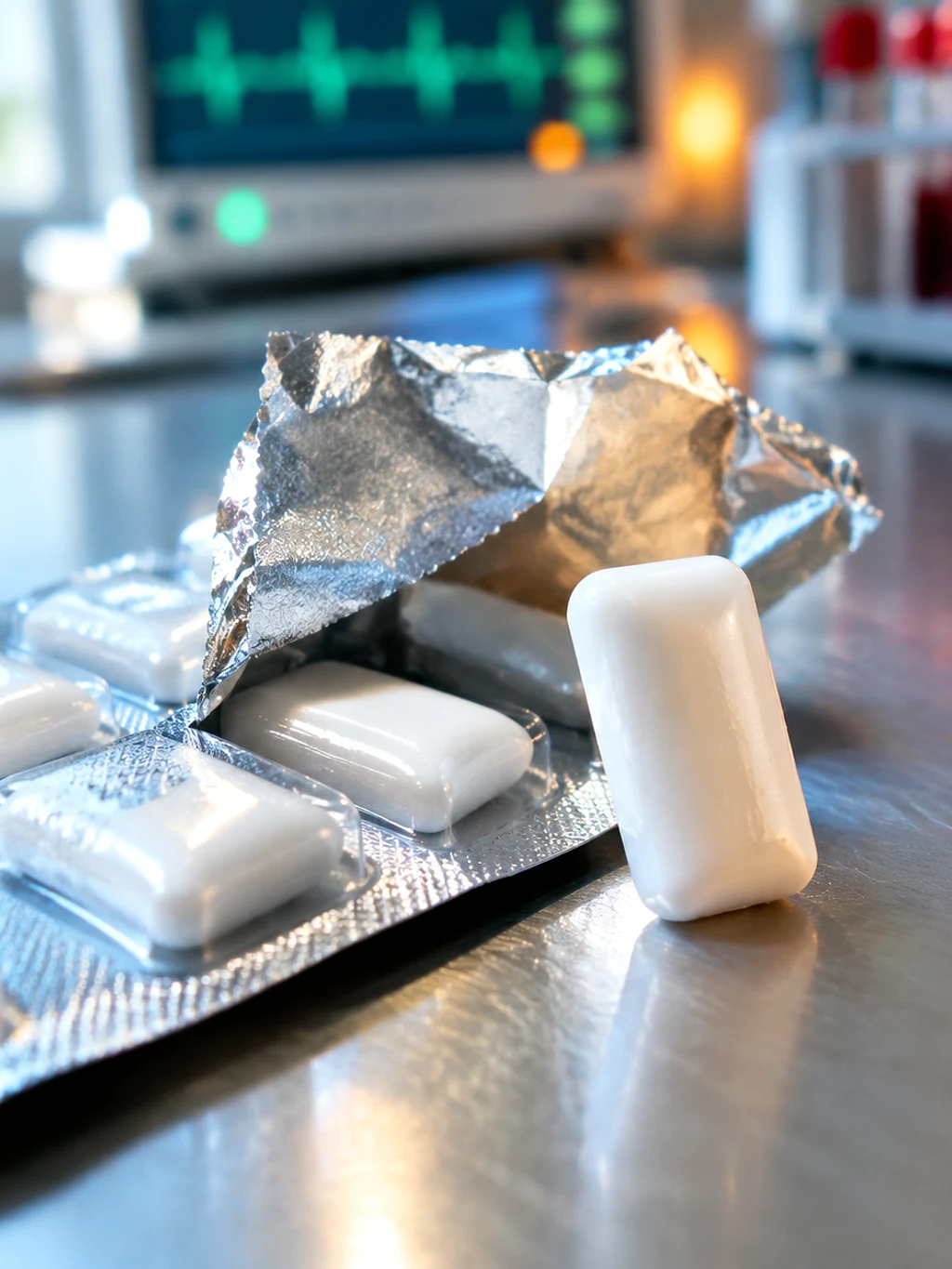
无糖口香糖里那个甜的东西,被发现和心血管事件有关:一万七千人,最高的一组高出百分之五十七
Study Links Xylitol to Heart Risk, Not Causation
About this story
At the European Society of Cardiology congress in September 2026, a Berlin team reported that across 17,710 people in two long-running cohorts, those with the highest blood xylitol had 57% more cardiovascular events in one cohort and 18% in the other. The study is observational, and the researchers said so first. Chinese listening practice at four levels. HSK 3 Chinese listening practice.
This is an HSK 3 Chinese listening episode that runs about 4 minutes. The full Mandarin script is shown with tap-for-pinyin and a line-by-line English translation, so you can listen and read at once — comprehensible input in the sense of Stephen Krashen's i+1 theory. It teaches 12 key vocabulary words such as 公司、身体、原因 and walks through 3 grammar patterns, each explained in English with examples. The same news story is retold at 4 difficulty levels — use the level selector above to find the version that is challenging but still understandable for you.
Read at your level
原文Read the complete story in Chinese. Reveal pinyin and English only when you need them.
English transcript reference
Today's story is about something you eat.
Let me ask you a question first.
When you buy something, do you read the small print on it?
Most people do not.
This September, doctors in Europe held a big conference.
At that conference, a team of German doctors presented a new study.
What they studied was something sweet.
This thing has a long name: xylitol.
The name is long, but you may well be eating it every day.
It is in sugar-free chewing gum.
It is in toothpaste.
And it is in a great many other things.
Why use it?
Because it is sweet, and it is not sugar.
These days a lot of people do not want to eat too much sugar.
Too much sugar and you gain weight, and your teeth go bad.
So a lot of companies use xylitol instead.
That way the thing is still sweet, but the label can say "sugar-free".
Sounds good, doesn't it?
These German doctors wanted to know one thing.
The people who eat this — how are their bodies actually doing?
They gathered a lot of people to look at.
Seventeen thousand of them in total.
Their average age was sixty.
What the doctors did was really quite simple.
They looked at these people's blood.
Everyone had a different amount of xylitol in their blood.
Some had a lot, some had a little.
Once they had looked, the doctors waited.
For one group, they waited six years.
For the other group, they waited thirty years.
Thirty years is a long time.
In thirty years, some of those people stayed well and some fell ill.
Then the doctors put the two things side by side.
Among those with more xylitol in their blood, more later had heart and blood-vessel trouble.
In the first group, there were about half as many again.
In the second group it was not that much, but there were still more.
The doctors also offered a possible reason.
There is a very, very small thing in our blood.
When you are hurt, it is what keeps the blood from running out.
This sweet thing may make them stick together more easily.
Outside a blood vessel, that is a good thing.
Inside one, it is not.
But the next sentence matters most, so please hold on to it.
The doctors said it themselves: this cannot show that it is the cause.
This is a study that looked, not a study that tested.
The doctors did not have half the people eat it and half not eat it.
They only looked, and then put the two things side by side.
Someone with more of it in their blood may simply eat more of it.
Or it may be that this person's body was not well to begin with.
Which one is the cause, nobody knows yet.
So the doctors say: do not be frightened, but do not eat a lot of it either.
Here is the part of this I find interesting.
A lot of people stopped eating sugar and switched to other sweet things.
Because they felt those were better.
But that word "better" — who said it?
Was it the doctors, or was it the people selling it?
Think about it:
How many things to eat are in your house that you have never once read the label on?
Listen again
Try it without the transcript and notice what sounds clearer.
What vocabulary does this episode teach?
词汇HSK 2. 很多公司就用木糖醇 — who actually makes the choice that ends up in your mouth.
HSK 2. 吃了这个东西的人,身体到底怎么样 — the question the study set out to ask.
HSK 3. 哪一个是原因,现在还不知道 — the sentence the episode is built to earn.
HSK 3 verb sense. Distinguished here from 试 — a study that looked, not one that tested.
HSK 3. Used once, to flag the caveat rather than the finding.
HSK 5. 你受伤的时候,是它们让血不流出去 — how the mechanism is explained without jargon.
Named up front, then placed: sugar-free gum, toothpaste, and a lot of other things.
The everyday object the whole study attaches to.
上面可以写"无糖"两个字 — two characters doing a great deal of persuading.
在血管外面,这是好事。在血管里面,这不是好事。
HSK 5. 平均年龄是六十岁 — who the seventeen thousand people actually were.
HSK 4. The second place it hides, and the one most people never think about.
* beyond level超纲词
What grammar patterns appear in this episode?
语法到底……
Presses for the real answer behind a vague one. Placed before the verb, it signals that the speaker is not satisfied with the surface account.
吃了这个东西的人,身体到底怎么样?
不能说明……
Cannot show that, cannot establish that. The standard Chinese way to draw the line between what evidence shows and what it does not.
医生自己说:这不能说明是它做的。
不要……,可是也不要……
Do not do X, but do not do the opposite either. Marks out a middle position instead of a recommendation, which is what the researchers actually gave.
所以医生说:不要怕,可是也不要吃太多。
Proper nouns
专有名词Sources
来源Free account
Keep learning from this story
Create a free account to keep saved words and your preferred level together.
- Keep words with their story context
- Remember your preferred level
- Build your vocabulary over time