
A Chinese podcast · Same story, 4 levels
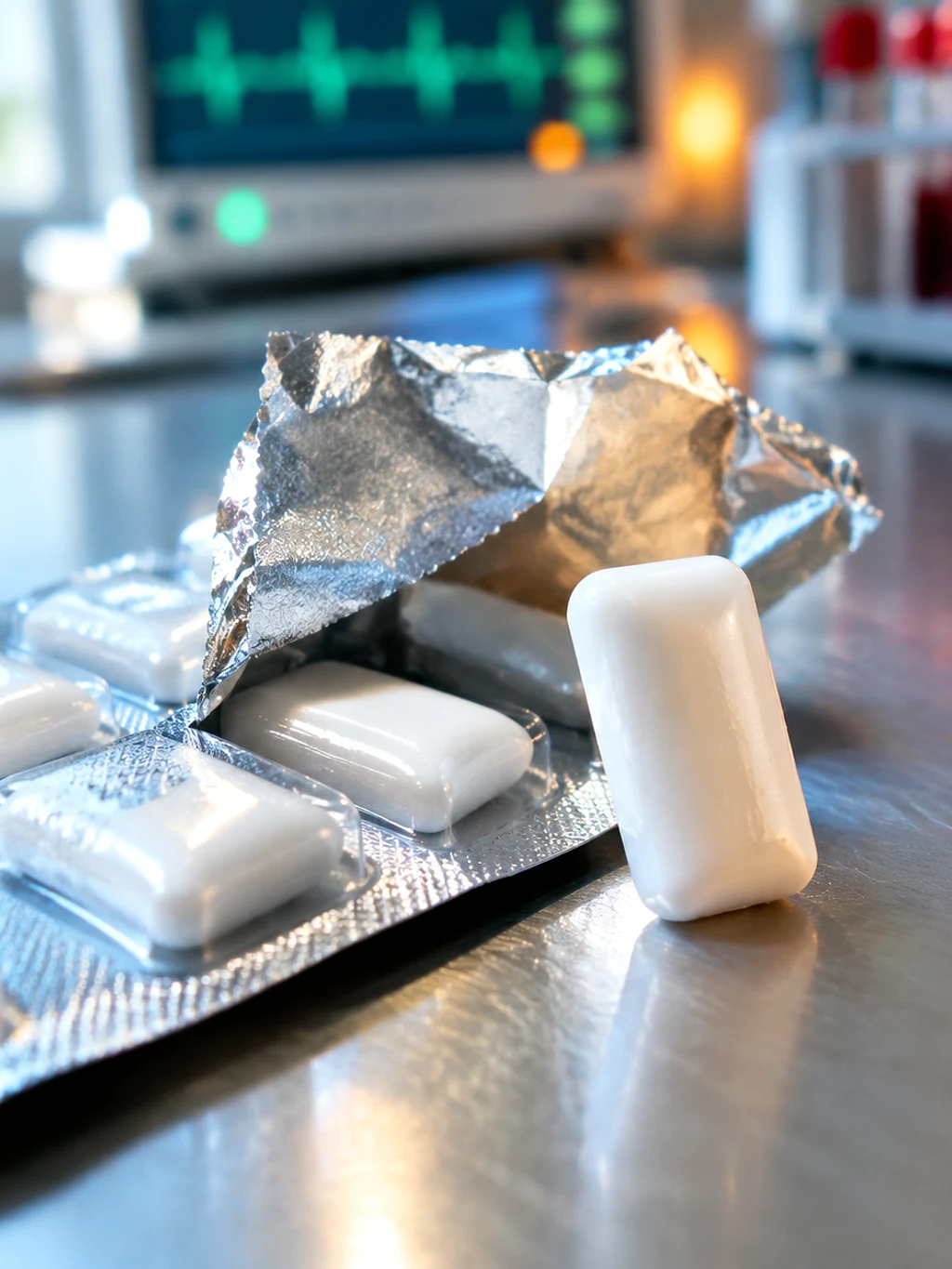
无糖口香糖里那个甜的东西,被发现和心血管事件有关:一万七千人,最高的一组高出百分之五十七
Study Links Xylitol to Heart Risk, Not Causation
About this story
At the European Society of Cardiology congress in September 2026, a Berlin team reported that across 17,710 people in two long-running cohorts, those with the highest blood xylitol had 57% more cardiovascular events in one cohort and 18% in the other. The study is observational, and the researchers said so first. Chinese listening practice at four levels. HSK 4 Chinese listening practice.
This is an HSK 4 Chinese listening episode that runs about 4 minutes. The full Mandarin script is shown with tap-for-pinyin and a line-by-line English translation, so you can listen and read at once — comprehensible input in the sense of Stephen Krashen's i+1 theory. It teaches 12 key vocabulary words such as 结论、原因、水平 and walks through 3 grammar patterns, each explained in English with examples. The same news story is retold at 4 difficulty levels — use the level selector above to find the version that is challenging but still understandable for you.
Read at your level
原文Read the complete story in Chinese. Reveal pinyin and English only when you need them.
English transcript reference
The conclusion first, then how it was reached, then where you can actually use it.
In early September this year, the European Society of Cardiology held its annual congress.
One new study presented there came from a large hospital in Berlin.
What it looked at was xylitol.
You may not have heard the name, but the odds are you have eaten it.
Xylitol is a sugar alcohol. It is sweet, and it is not sugar.
It turns up mainly in sugar-free chewing gum, in toothpaste, and in a good deal of processed food.
The logic of using it is plain: you want sweetness, and you do not want the word "sugar" on the label.
Over the past twenty years, the volume of sweeteners like this has climbed fast.
The reason is not hard to see — everyone knows too much sugar is bad for you.
The question now is: once you swap the sugar out, how much do we actually know about what you swapped in?
What this study did is not complicated to describe.
The researchers looked at more than seventeen thousand people, average age around sixty.
They were split across two groups, both drawn from long-running studies that already existed.
One group was in Canada, followed for six years.
The other was in Britain, followed for thirty.
The first thing the researchers did was measure the xylitol level in each person's blood.
Note that: the level in the blood, not a question about how much they had eaten.
That matters, because people are not accurate about what they have eaten.
After measuring, they waited, and then looked at who had an event.
By "an event" I mean heart attacks, strokes and the like.
Here are the results.
In the Canadian group, the people with the highest blood xylitol had a rate of later events fifty-seven percent higher than the people with the lowest.
In the British group, the figure was eighteen percent.
The direction of the two groups agrees; the size of it does not.
The researchers also proposed a possible mechanism.
Our blood contains platelets, whose ordinary job is to clot when you are injured.
Experiments show that xylitol makes platelets clump together more readily.
On a wound, that ability saves your life.
Inside a blood vessel, that ability is trouble.
By now a lot of people are ready to throw out the gum in the house.
Hold off, because the most important sentence has not been said yet.
This is an observational study.
An observational study can tell you two things appeared together. It cannot tell you which one caused the other.
The researchers put that sentence right up front themselves.
Why does this distinction matter so much?
Because high blood xylitol has at least two completely different explanations.
One: this person eats a lot of it, so the level is high, and that damages the blood vessels.
Two: this person's metabolism is already off, which is why the level is high, and what is actually damaging the vessels is the metabolic problem itself.
Under the second explanation, xylitol is not a cause. It is a signal.
Telling the two apart takes a different kind of study: take a group of people, split them at random, one half eats it and one half does not, then compare.
That kind of study is expensive, slow and hard to run — but it is the only one that can answer "did it do this?"
Nobody has run one yet.
So what is the reasonable stance?
The researchers' own advice is fairly restrained: no need to panic, and no need to pretend you did not see it.
The thing I want to add is something else.
A lot of people moved from sugar to a sugar substitute for the sake of their health.
There is nothing wrong with that move itself.
But "replacing something known to be a problem" and "replacing it with something that has been studied properly" are two different things.
The second one often is not true, and we simply assume it is.
Think about it: how many things in your house right now did you buy because they were "healthier"?
That "healthier" — where did you see it?
Listen again
Try it without the transcript and notice what sounds clearer.
What vocabulary does this episode teach?
词汇HSK 5. 先说结论 — and by the end, the conclusion is that there is not one yet.
HSK 3. Separated carefully from 相关 throughout the episode.
HSK 4. 血里木糖醇的水平 — measured, not self-reported. That distinction is the study's strength.
HSK 5. 研究者的建议相当克制 — restraint is itself the finding.
HSK 4. Contrasted with observation — the thing that has not been done here.
HSK 3. The word the closing question puts pressure on: who told you it was healthier?
A sugar alcohol: sweet, not sugar, and until now barely studied at this scale.
这类甜味剂的用量涨得很快 — the category, and why it grew.
The proposed mechanism: they clump more readily, which is life-saving on a wound and trouble in a vessel.
The single most important term in the episode — it can show two things co-occur, not which caused which.
能告诉你两件事同时出现,不能告诉你哪一件导致了另一件。
The rival explanation: the level is high because metabolism is already off, and that is what damages the vessels.
* beyond level超纲词
What grammar patterns appear in this episode?
语法先说 A,再说 B,最后说 C
Announces the shape of the talk before giving it. A very common spoken-analysis opener in Chinese; it lets the listener hold a frame while you fill it.
先说结论,再说是怎么得出来的,最后说这个结论能用到什么地方。
注意,是……,不是……
Flags a distinction the listener is about to slide past. The corrective 注意 does the work an English writer would do with italics.
注意,是血里的水平,不是问他们吃了多少。
A 和 B,是两回事
A and B are two different things. Compact and final — used to stop two ideas from being treated as one.
但"换掉一个已知有问题的东西",和"换上一个已经被研究清楚的东西",是两回事。
Proper nouns
专有名词Sources
来源Free account
Keep learning from this story
Create a free account to keep saved words and your preferred level together.
- Keep words with their story context
- Remember your preferred level
- Build your vocabulary over time