
A Chinese podcast · Same story, 4 levels
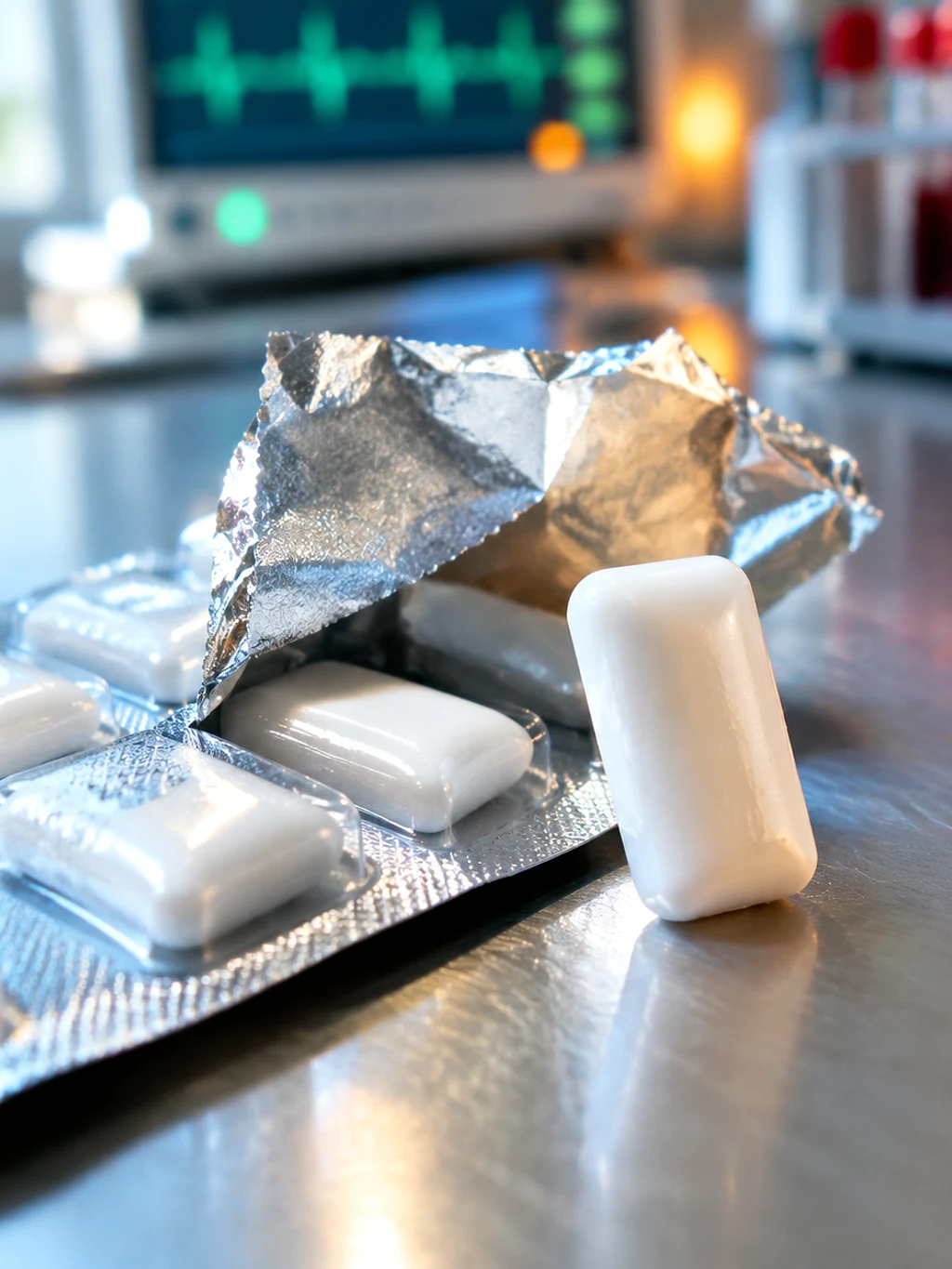
无糖口香糖里那个甜的东西,被发现和心血管事件有关:一万七千人,最高的一组高出百分之五十七
Study Links Xylitol to Heart Risk, Not Causation
About this story
At the European Society of Cardiology congress in September 2026, a Berlin team reported that across 17,710 people in two long-running cohorts, those with the highest blood xylitol had 57% more cardiovascular events in one cohort and 18% in the other. The study is observational, and the researchers said so first. Chinese listening practice at four levels. HSK 5+ Chinese listening practice.
This is an HSK 5+ Chinese listening episode that runs about 6 minutes. The full Mandarin script is shown with tap-for-pinyin and a line-by-line English translation, so you can listen and read at once — comprehensible input in the sense of Stephen Krashen's i+1 theory. It teaches 12 key vocabulary words such as 判断、证据、样本 and walks through 3 grammar patterns, each explained in English with examples. The same news story is retold at 4 difficulty levels — use the level selector above to find the version that is challenging but still understandable for you.
Read at your level
原文Read the complete story in Chinese. Reveal pinyin and English only when you need them.
English transcript reference
This episode is about a study just made public, and about a question worth more than the study itself: how do we decide that something is "healthier"?
The date is early September this year; the venue is the annual congress of the European Society of Cardiology.
A team from a large teaching hospital in Berlin presented long-term observational results on xylitol.
Let me define the subject first.
Xylitol is a sugar alcohol, a class of sweetener; it is close to sucrose in sweetness but lower in calories, and it does not raise blood glucose the way sucrose does.
Its most familiar homes are sugar-free chewing gum and toothpaste, and beyond that it is widespread across processed foods.
The logic behind its heavy use is very simple: consumers want sweetness, and they do not want the word "sugar" on the ingredient list.
Over the past twenty years, use of substitutes like this has climbed steadily alongside the public consensus on cutting sugar.
And a problem is already buried in that sentence — the thing being replaced has been studied exhaustively; the thing replacing it has not.
The design of the study itself is fairly direct.
The researchers enrolled just over seventeen thousand seven hundred participants, average age about sixty-one.
The sample came from two existing long-term cohorts: one in Canada, followed for six years, the other in Britain, followed for thirty.
The critical step is how exposure was measured: the researchers assayed xylitol levels in the participants' blood, rather than asking people to recall how much they had eaten.
That choice matters.
Self-reported dietary questionnaires carry enormous error; people's memory of what they have consumed over years is not reliable.
Using a blood marker instead of a questionnaire makes this data harder than that of comparable studies.
Then came follow-up, recording major adverse cardiovascular events — in plain terms, heart attacks and strokes.
The results are as follows.
In the Canadian cohort, the group with the highest blood xylitol had a subsequent cardiovascular event risk fifty-seven percent above the lowest group.
In the British cohort, the same comparison produced eighteen percent.
The two cohorts agree in direction and differ in magnitude.
Agreement in direction raises confidence; the difference in magnitude suggests that background population and follow-up length both affect the estimate.
The researchers also offered a plausible biological mechanism.
The normal duty of platelets is to aggregate into a plug at a break in a vessel and stop the bleeding.
In vitro work indicates that xylitol increases the tendency of platelets to aggregate.
At a wound, that capacity saves lives.
Inside an intact vessel, the same capacity is thrombotic risk.
The mechanism is coherent, and that makes the result harder to dismiss as noise.
But what really determines how this study should be used is its type.
This is an observational study.
Observational studies can establish correlation. They cannot establish causation.
The team put that sentence near the front themselves, which is the responsible thing to do.
Why is this distinction not academic nit-picking?
Because the single observation "blood xylitol is elevated" admits at least two explanatory paths running in opposite directions.
Path one: intake is high, blood level is high, platelet activity rises, vessels are damaged — on this path xylitol is the cause.
Path two: this person has an underlying metabolic disturbance, blood level is elevated as a result, and what is actually damaging the vessels is the disturbance itself — on this path xylitol is only a marker.
Both paths generate identical correlational data, and an observational design cannot separate them.
Only a randomised controlled trial can: recruit participants, randomise them, have one arm consume it and the other not, then compare endpoint events.
Trials like that are costly and slow, and on dietary components they are particularly hard — it is very difficult to hold people to a prescribed diet for decades.
For xylitol, no such trial exists yet.
So the only sound conclusion is this: a signal worth pursuing has appeared; a conclusion you could act on has not.
The researchers' advice sits at exactly that calibration: no need to panic, and no need to pretend you did not see it.
That covers the study.
I want to push one step further, because the decision structure is really the more interesting part.
For twenty years, public health guidance has pointed unambiguously at "reduce added sugar", and that direction has ample evidence behind it.
The problem is at the execution stage: the overwhelming majority of people cut sugar by substituting.
And the thing they substitute in usually satisfies exactly one condition — it is not sugar.
"Not sugar" is a negative description. It carries no positive information about safety.
Proving one thing harmful and proving another thing harmless are two independent judgements, each needing its own evidence.
In real decisions, we routinely transfer the evidence for the first to the second.
The words "sugar-free" on an ingredient list are what carry that transfer.
Legally it is only a statement of composition. Psychologically it gets read as a promise about health.
Two questions to leave you with.
The first is concrete: how many things in your house did you buy specifically because they were "healthier"?
And that judgement of "healthier" — where did you get it?
The second is bigger: when the evidence in a field only supports saying "we do not know yet", what should a person act on?
Listen again
Try it without the transcript and notice what sounds clearer.
What vocabulary does this episode teach?
词汇HSK 4. 是两个独立的判断,需要各自的证据 — the sentence the whole episode is built to deliver.
HSK 5. The episode tracks where evidence exists and where it is quietly assumed.
HSK 5. 样本来自两个既有的长期队列 — where the seventeen thousand people came from.
HSK 5. 用血液指标替代问卷 — the methodological choice that makes this data harder.
HSK 5. Reported as a comparison between groups, never as a statement about you.
HSK 5. 在法律上只是一个成分声明 — what the label legally is, versus what it is read as.
Establishes correlation, not causation — and the team said so before anyone else could.
The only design that could separate the two explanatory paths. None exists for xylitol.
The alternative role for xylitol: a symptom of metabolic disturbance rather than its cause.
关键的一步是暴露测量方式 — measured in blood, not recalled from memory.
The same platelet behaviour that saves you at a wound, occurring where it should not.
Where the transfer happens: a compositional statement read as a health promise.
* beyond level超纲词
What grammar patterns appear in this episode?
语法……,而不是……
Not a bare contrast but a correction of expectation: names what a thing actually is after the listener has assumed something else.
研究者检测的是受试者血液中的木糖醇水平,而不是让人回忆自己吃了多少。
为什么这个区分不是……?
Raises the objection the listener is already forming, then answers it. Pre-empting the pushback is more persuasive than ignoring it.
为什么这个区分不是学术上的吹毛求疵?
就……而言
As far as X is concerned. A written-leaning way to narrow a claim to a specific case before making it.
就木糖醇而言,目前还没有这样的试验。
Proper nouns
专有名词Sources
来源Free account
Keep learning from this story
Create a free account to keep saved words and your preferred level together.
- Keep words with their story context
- Remember your preferred level
- Build your vocabulary over time