
A Chinese podcast · Same story, 4 levels
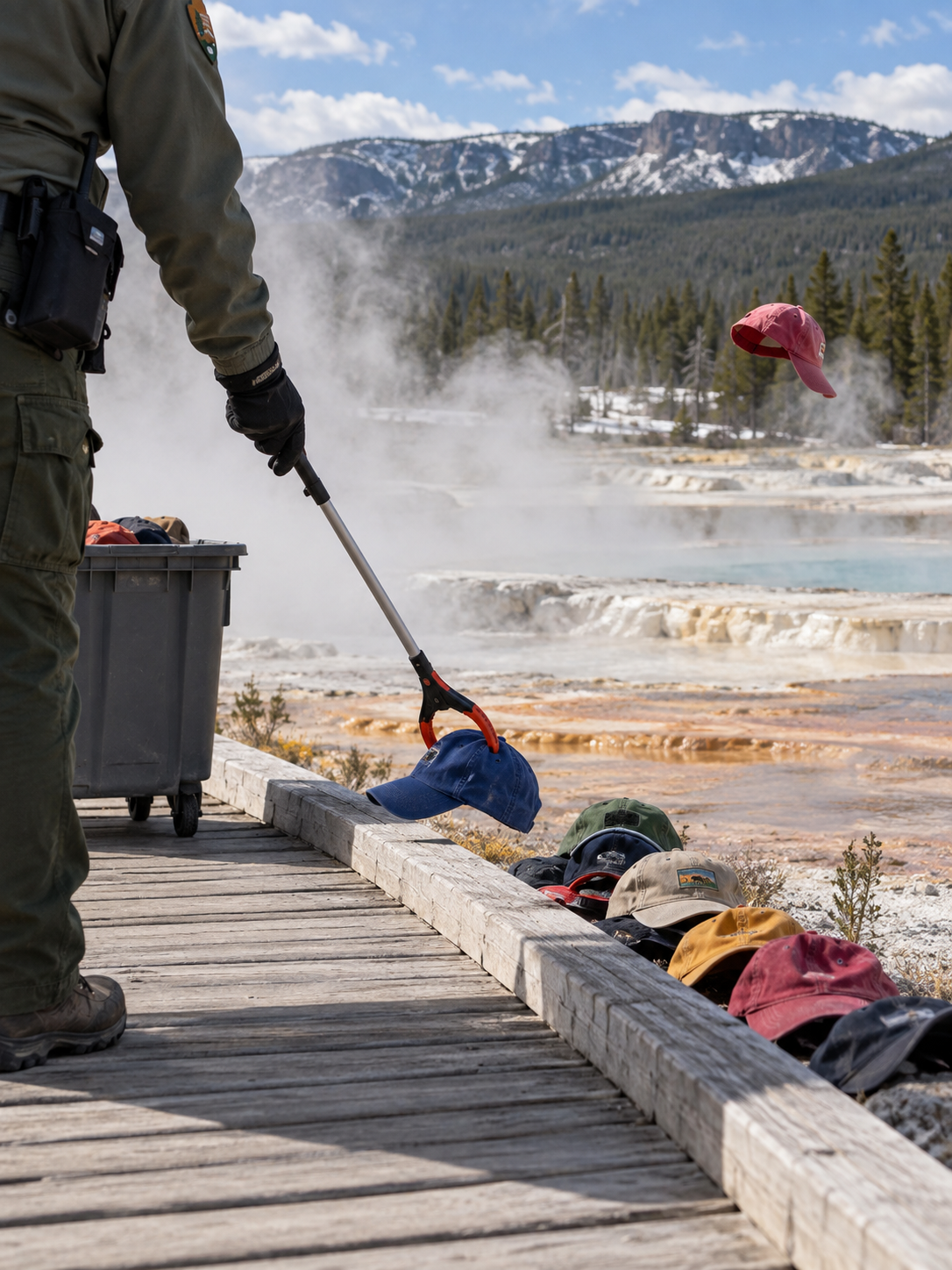
黄石公园热泉区清出280多顶帽子
Yellowstone Finds Over 280 Hats in Hot-Spring Areas
About this story
Yellowstone workers collected over 280 hats and more than 20,000 pieces of trash from hot-spring areas by early September 2026. Learn the story in beginner Chinese. HSK 1 Chinese listening practice.
This is an HSK 1 Chinese listening episode that runs about 3 minutes. The full Mandarin script is shown with tap-for-pinyin and a line-by-line English translation, so you can listen and read at once — comprehensible input in the sense of Stephen Krashen's i+1 theory. It teaches 8 key vocabulary words such as 水、东西、热 and walks through 3 grammar patterns, each explained in English with examples. The same news story is retold at 4 difficulty levels — use the level selector above to find the version that is challenging but still understandable for you.
Read at your level
原文Read the complete story in Chinese. Reveal pinyin and English only when you need them.
English transcript reference
Yellowstone has many hot springs.
People go to Yellowstone to see the hot water.
The water is beautiful, but it is too hot.
The water is too hot for people to enter.
One person goes to see the water with a hat on their head.
The wind comes, and the hat falls into the water.
The hat is gone, and the person wants it back.
But the person cannot go into the water to get it.
People who work at Yellowstone collect things near the hot water.
If a hat falls, they can look for it.
In 2026, they collected more than 280 hats.
Think about it: with over 280 hats, how many people cannot see their own hat anymore?
When one hat is in the water, they have to collect it.
When another hat is in the water, they have to collect that one too.
Some people say the wind is strong and hats can fall.
Other people put things in the water.
Some of these things are very small.
The people working at Yellowstone have to look carefully.
They see hats and many unwanted things.
These unwanted things are trash.
In 2026, they collected over 20,000 items near the hot water.
These items are trash.
More than 20,000 items is a very large number.
Yellowstone staff say there have not been this many before.
Why are so many things near the hot water?
When the wind comes, some things fall.
Some things are put in the water by people.
We cannot say everyone wanted to put things in the water.
But when these things are near the hot water, someone has to collect them.
You can look at the hot water, but you cannot go in.
If your hat falls into the water, do not go in after it.
The people who work at the park know what to do.
When you go to see the hot water, keep an eye on your hat.
While looking at the hot water, hold your hat in your hand.
More than 280 hats and more than 20,000 unwanted things.
Yellowstone's water is beautiful; people should stay beside it to look.
If you went to Yellowstone, what would you do?
Listen again
Try it without the transcript and notice what sounds clearer.
What vocabulary does this episode teach?
词汇水很漂亮,可是水太热。
这些东西,是垃圾。
水太热,人不能去水里。
在黄石公园工作的人,会在热水边拿东西。
风来了,帽子掉在水里。
风来的时候,有的东西掉了。
这些不要的东西,叫垃圾。
二零二六年,他们拿了二百八十多个帽子。
* beyond level超纲词
What grammar patterns appear in this episode?
语法有
Use 有 to say a place has something.
黄石公园有很多热水。
可以 / 不可以
Use 可以 for permission and 不可以 when an action is not allowed.
热水可以看,不可以去。
如果……会……
Use 如果 to imagine a situation and 会 to ask what someone would do.
如果你去黄石公园,会怎么做?
Proper nouns
专有名词Sources
来源Free account
Keep learning from this story
Create a free account to keep saved words and your preferred level together.
- Keep words with their story context
- Remember your preferred level
- Build your vocabulary over time