
A Chinese podcast · Same story, 4 levels
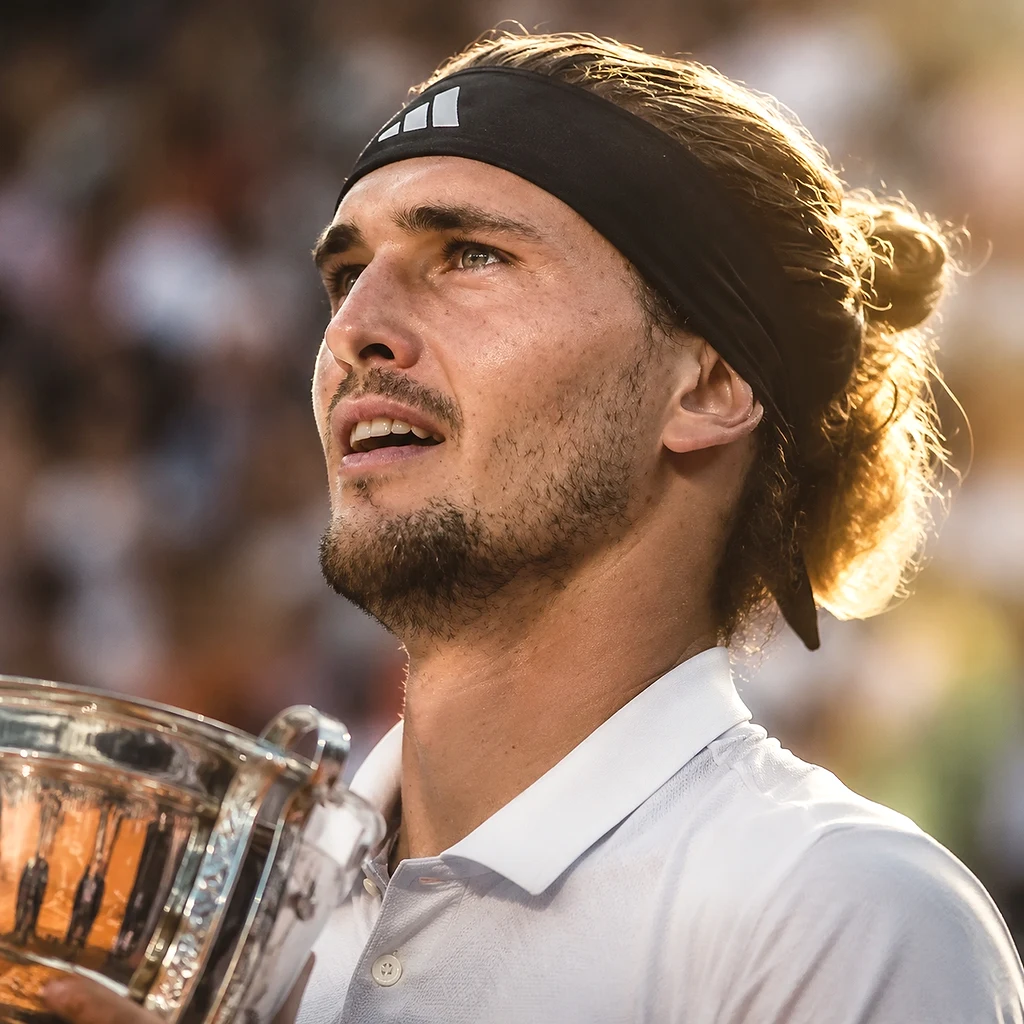
等了八年,兹维列夫终于在罗兰加洛斯捧杯
Zverev Wins First French Open After Eight Years
About this story
Advanced Chinese listening practice. The full story of Alexander Zverev's first Grand Slam at the 2026 French Open: an eight-year drought, three previous final losses, a four-hour-sixteen-minute battle with surprise finalist Flavio Cobolli, and the first German men's Slam title since Boris Becker. HSK 5-6 Chinese listening practice.
This is an HSK 5-6 Chinese listening episode that runs about 7 minutes. The full Mandarin script is shown with tap-for-pinyin and a line-by-line English translation, so you can listen and read at once — comprehensible input in the sense of Stephen Krashen's i+1 theory. It teaches 14 key vocabulary words such as 大满贯、决赛、红土球场 and walks through 8 grammar patterns, each explained in English with examples. The same news story is retold at 4 difficulty levels — use the level selector above to find the version that is challenging but still understandable for you.
Read at your level
原文Read the complete story in Chinese. Reveal pinyin and English only when you need them.
English transcript reference
Today we'll talk about a story that has stirred countless tennis fans.
The protagonist is German men's tennis player Alexander Zverev, twenty-nine this year.
For tennis fans, this name is no stranger.
Zverev has been one of the world's top players for years, but he was missing the most important piece — a Grand Slam title.
Let's briefly explain what a 'Grand Slam' is.
The professional tennis season has hundreds of matches each year, of which the biggest, most important, and hardest to win are the four Grand Slam events.
They are the Australian Open, the French Open, Wimbledon, and the US Open.
Winning any one of these four is the greatest honor a tennis player can earn in a lifetime.
For a top player like Zverev, having no Grand Slam title is like climbing eight thousand meters of a mountain but never reaching the summit.
This year, on the red clay of Roland Garros in Paris, he finally reached that summit.
Let's roll the time back.
Zverev had reached four Grand Slam finals in total before this.
The first three times, the endings broke his heart.
The first was the 2020 US Open final, against Austria's Thiem.
That match went five sets; he led by two sets, with the championship seemingly within reach.
But in the last three sets, set by set, Thiem clawed his way back.
The second final was the 2024 French Open, here at Roland Garros.
His opponent was Spain's young gun Alcaraz.
Zverev again led two sets to one, just one step from the title.
But in the end, he lost again.
The third final was the 2025 Australian Open.
His opponent was Sinner, then at the peak of his form.
In that match, Zverev was swept aside in straight sets, and his mood after was extremely low.
Losing three Grand Slam finals in a row is an enormous mental blow for any player.
Many began to wonder: would Zverev ever get a Grand Slam in his career?
Some media even began linking him with the label 'eternal runner-up'.
But Zverev himself never gave up.
He kept training and competing every day, waiting for the next chance.
This year, the chance came again.
He made it all the way to the final at Roland Garros.
His opponent this time was probably a surprise to many.
It was Italy's Cobolli — twenty-four years old, ranked world number fourteen.
Cobolli had never made it past a Grand Slam quarterfinal before.
His path to the final was helped by a semifinal walkover when opponent Arnaldi withdrew through injury.
So everyone thought: this time, Zverev's got it locked.
On June 7, the final began on the Philippe-Chatrier center court.
The match lasted four hours and sixteen minutes.
The final score was 6-1, 4-6, 6-4, 6-7, 6-1 — Zverev came out on top.
But the score alone falls far short of telling the story of this match.
First set: Zverev won 6-1, controlling the rhythm from start to finish.
But in the second set, Cobolli held up under pressure and grabbed a set back.
The score became one set all.
The third set was key.
At 5-5, Zverev hit three consecutive pinpoint winners to break Cobolli's serve.
He took the third set 6-4.
The fourth set was the most nerve-wracking of the entire match.
The two went to a tiebreak, with Zverev leading 3-1 at one point.
Just as everyone thought he was about to close the match out, Cobolli won four straight points.
Including a near-miraculous drop shot.
Cobolli pulled off the comeback and dragged the match into a deciding set.
At that moment, the atmosphere in the stadium shifted.
The same image flashed through everyone's mind:
Was Zverev about to replay that old script?
But Zverev this time wasn't carried away by emotion.
Entering the fifth set, he immediately delivered a 'double break', quickly building an advantage.
Across the entire fifth set, his first-serve win rate hit eighty-three percent.
Cobolli had four break-point chances; Zverev held off every one.
Finally, 6-1 — Zverev took the deciding set.
He fell to both knees on the red clay, gazing up at the sky, unable to speak for a long while.
In his on-court speech, he said this:
'This court means so much to me.
I've had my happiest moments here, and my lowest moments too.
Today, finally, is a happy ending.'
That line brought tears to nearly everyone in the stadium.
Because everyone knew: the 'lowest moments' he spoke of were the night two years earlier on the same court, when Alcaraz turned the match around on him.
Today, in the same place, he untied that knot.
This is the first German men's Grand Slam singles title in many years.
The last one was won by Boris Becker back in the nineties.
So this victory carries great meaning for German tennis too.
German media even wrote:
'We finally have a Grand Slam champion of our own again.'
Zverev's father is also a tennis coach who taught him the game from childhood.
His older brother Mischa Zverev was also a professional player.
You could say the family's whole fate is tied to tennis.
So today, when he lifted that trophy, the first people he thought of were probably his family.
As for Cobolli, the man who almost broke Zverev — though he lost.
He was also one of the biggest discoveries of this French Open.
Before the semifinal, he had never reached the quarterfinal of any Grand Slam.
This time, he made the final, pushed Zverev to five sets, and the whole world remembered his name.
In the years to come, he will most likely become the next face of Italian men's tennis.
So this title doesn't really belong to Zverev alone.
It belongs to everyone who has given everything, only to fall at the final step time and time again.
At the end of the show, let's think together.
In your own life, is there something you have done seriously three times, but still haven't pulled off?
Are you feeling like you can't do it, ready to give up?
Or are you willing to try once more?
Zverev waited eight years and got his first Grand Slam on his fourth try.
Maybe, your own 'fifth set' is just around the corner.
Listen again
Try it without the transcript and notice what sounds clearer.
What vocabulary does this episode teach?
词汇The four biggest tennis tournaments. Defined inline as Australian Open, French Open, Wimbledon, US Open.
HSK 5. 决赛 vs 半决赛 vs 八强 — final / semifinal / quarterfinals.
Roland Garros's surface. 红土 = red earth/clay; 球场 = court.
不少人开始怀疑 = many began to doubt / wonder.
HSK 1-4. percent.
HSK 1-4. media.
HSK 1-4. advantage.
前三次结局都让他心碎 = the endings of the first three times all broke his heart.
被阿尔卡拉斯逆转 = was reversed by Alcaraz (he came back from behind).
被对手直落三盘横扫 = was swept aside in straight three sets.
没有挣扎 = no struggle (he gave up resisting).
Tennis term. 两人打到抢七 = the two went to a tiebreak.
Tennis term. 一波双破发 = a double-break run; 破发机会 = break-point chance.
Implied background pattern for Zverev's eight-year drought.
* beyond level超纲词
What grammar patterns appear in this episode?
语法最 X 的 Y 之一
'one of the most X Y'. Used for elite-membership claims.
他是世界顶尖的几位球员之一。
他也是这次法网最大的发现之一。
Subject + 一直 + Verb
'X has been V-ing all along'. Marks unbroken duration.
他一直是世界顶尖的几位球员之一。
兹维列夫自己始终没有放弃。
Subject + 让 / 被 + Object + Verb-phrase
Causative 让 and passive 被. Frequent in news Chinese.
让无数球迷情绪激动的故事
被对手直落三盘横扫
被阿尔卡拉斯逆转的那个夜晚
就像 X 一样 / 就像 X
'just like X'. Used for vivid analogies.
就像爬山爬到八千米,但是没能登顶。
Verb + 出 / 起 / 下 (resultative complements)
Direction/outcome markers after verbs. News register.
建立起优势
拿下决胜盘
抢下一盘
拖进决胜盘
所有人都 + 觉得 / 以为 / 想 + Clause
'everyone thought/assumed X' — used to set up the narrative reversal.
所有人都觉得:兹维列夫一定会赢。
所有人都以为他要拿下比赛的时候。
甚至 + Clause
'even...' — marks an extreme example.
甚至有些媒体已经开始把他和'永远的亚军'挂在一起。
甚至有德国媒体写道:
Subject + 心隔多久 + 再次 + Verb
'after a long gap, X happens again'. Marks historic re-occurrence.
这是德国男子选手时隔很多年再次拿到大满贯单打冠军。
Proper nouns
专有名词Free account
Keep learning from this story
Create a free account to keep saved words and your preferred level together.
- Keep words with their story context
- Remember your preferred level
- Build your vocabulary over time