
A Chinese podcast · Same story, 4 levels
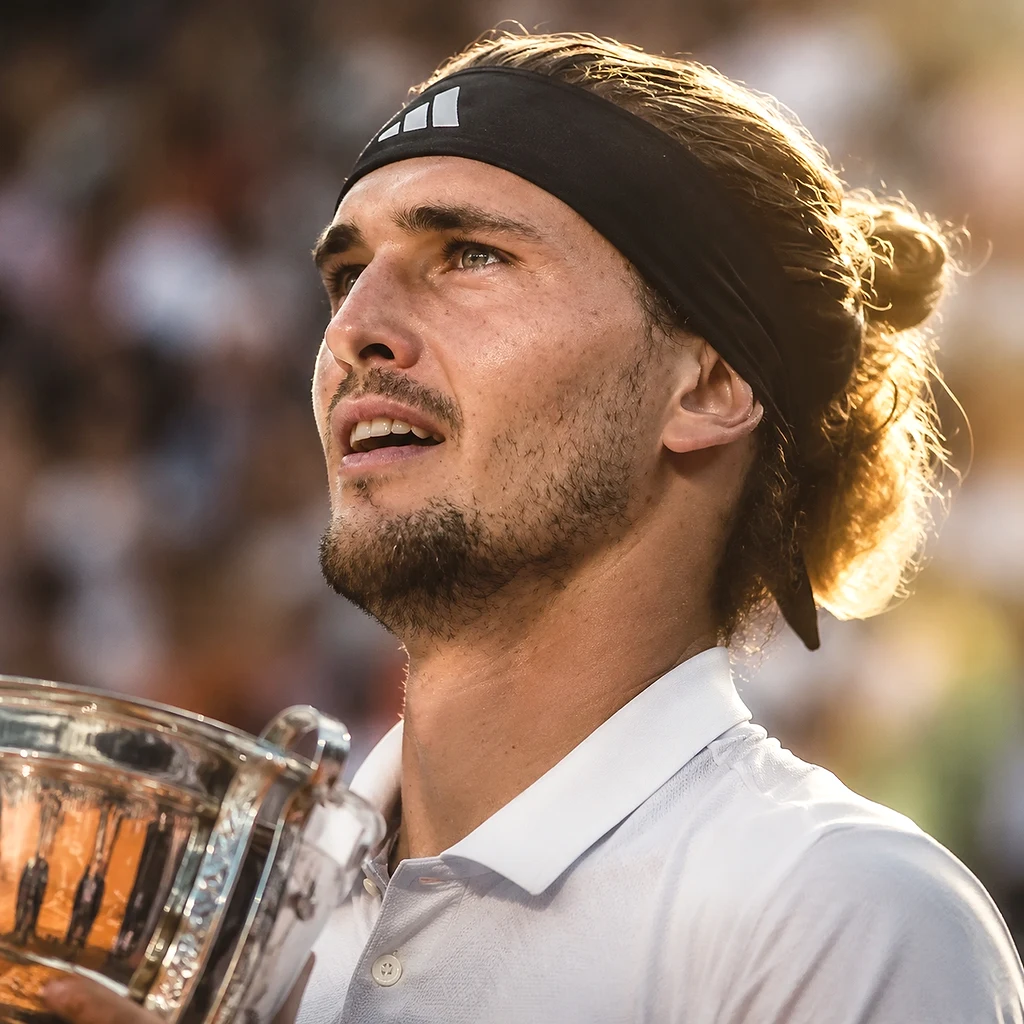
兹维列夫终于赢了第一个大满贯
Zverev Wins First French Open After Eight Years
About this story
Zverev's path to his first Grand Slam at Roland Garros: three previous final losses (Thiem, Alcaraz, Sinner), a four-hour, five-set battle with Cobolli, and the heart-stopping fourth-set comeback that almost shattered him. HSK 3 Chinese listening practice.
This is an HSK 3-4 Chinese listening episode that runs about 5 minutes. The full Mandarin script is shown with tap-for-pinyin and a line-by-line English translation, so you can listen and read at once — comprehensible input in the sense of Stephen Krashen's i+1 theory. It teaches 13 key vocabulary words such as 冠军、放弃、相信 and walks through 7 grammar patterns, each explained in English with examples. The same news story is retold at 4 difficulty levels — use the level selector above to find the version that is challenging but still understandable for you.
Read at your level
原文Read the complete story in Chinese. Reveal pinyin and English only when you need them.
English transcript reference
Today we'll talk about a story that has made many tennis fans very happy.
It's about a German person, called Zverev.
He is twenty-nine years old this year.
He has been playing tennis for many years.
He is one of the best tennis players in the world.
But he had never won the biggest kind of tournament.
The biggest kind of tournament is called a 'Grand Slam'.
What is a 'Grand Slam'?
We'll go slowly.
Tennis players have to play many, many matches every year.
Some are small, some are big.
But among them, four are the biggest.
These four biggest are called the 'Grand Slams'.
The last day of a Grand Slam is called the 'final'.
Whoever wins the final gets the Grand Slam.
Winning a Grand Slam is the biggest dream for any tennis player.
A top-level player like Zverev wants a Grand Slam every year.
But Zverev has waited many years.
He has reached the Grand Slam final four times.
The first three times, he didn't win.
We'll talk about these three times slowly.
The first final was in America several years ago.
His opponent was Austria's Thiem.
That match went to five sets, and he led two sets to one.
It looked like the championship was almost in his hands.
But in the last three sets, set by set, his opponent caught up.
In the end, he lost.
That was the first time he learned:
what it feels like to almost win a Grand Slam.
The second final was again here, in France.
His opponent was Spain's young Alcaraz.
Zverev again led two sets to one.
Everyone thought he was going to win.
But in the end, he lost again.
The third final was in Australia.
His opponent was Sinner, who was playing the best at the time.
That time, he lost in just three sets.
No struggle.
After that match, he himself started to feel:
'Maybe in my whole life I'll never win a Grand Slam.'
His fans also started to worry:
'Is it true he really can't win one?'
But Zverev didn't give up.
He kept training and playing matches every day.
He believed: there will still be chances.
This year's French Open started again.
Zverev reached the final once more.
This was his fourth Grand Slam final.
He himself also knew:
'If I don't win this time, maybe I really won't have another chance.'
Where was the final this year?
Right in France, on a court called Philippe-Chatrier.
Zverev was familiar with this court.
He had been there many times.
He said:
'This court is very special to me.
I've had my happiest moments here.
And my saddest moments too.'
His opponent was called Cobolli.
Cobolli is Italian.
He is twenty-four years old.
He is five years younger than Zverev.
Today was Cobolli's first time playing a final this big.
He himself hadn't expected to reach this stage.
So everyone thought: Zverev would definitely win.
The match began.
It lasted over four hours.
It went five sets.
Set one, Zverev played extremely well.
He won 6-1.
Everyone thought: Zverev's got this today.
But in set two, Cobolli suddenly played very well.
He won the set 4-6.
The match became one set all.
Set three, Zverev won again.
6-4.
He thought: one more set and I've done it.
Set four was the most interesting set.
The two played a long time.
By the end, the scores were very close.
Zverev led 3-1.
Everyone assumed he was about to win.
But Cobolli won four points in a row.
Cobolli took set four.
The match went to set five.
Whoever won set five gets the Grand Slam.
At the start of set five, everyone was thinking:
'Is Zverev going to lose again this time?'
But Zverev didn't let everyone down.
He played extremely steady.
His first-serve win rate hit over eighty percent.
Cobolli had four chances to break his serve.
All four failed.
In the end, 6-1.
Zverev won set five.
He got his first Grand Slam title.
He had waited for this moment, waited many years.
He fell to his knees on the court.
He couldn't speak.
Later he said to everyone:
'This court is very special to me.
I've had my best moments here.
And my worst moments too.
Today, it's a happy ending.'
Finally, let's think.
Is there something you have done four times and still haven't succeeded at?
But you're not willing to give up?
You can think of Zverev.
Maybe, the next time is your 'set five'.
Listen again
Try it without the transcript and notice what sounds clearer.
What vocabulary does this episode teach?
词汇HSK 3 noun. 拿到冠军 = get the championship. The dream Zverev chased for years.
HSK 4 verb. 他没有放弃 = he didn't give up. The story's emotional spine.
HSK 3 verb. 他相信还会有机会 = he believed there would be another chance.
HSK 3 noun. 还会有机会 = there will still be chances.
HSK 3 adverb. 科博利突然打得很好 = Cobolli suddenly played very well.
HSK 1-3. world.
HSK 1-3. match, game.
Glossed inline: 网球里最大的四个比赛叫'大满贯' = the four biggest tournaments in tennis are called Grand Slams. The core noun of the story.
HSK 5 noun. The last match of a tournament. 大满贯决赛 = Grand Slam final.
顶尖球员 = top-level player. Common term in Chinese sports commentary.
HSK 4 noun. 他对手是奥地利的蒂姆 = his opponent was Austria's Thiem.
HSK 5 verb. 他领先两比一 = he was leading two sets to one.
稳了 / 打得特别稳 = (it's) locked in / played extremely steady. Common spoken term.
* beyond level超纲词
What grammar patterns appear in this episode?
语法是 + ... 之一
'is one of...'. HSK 3-4 structure used to mark elite membership.
他是这个世界上,打得最好的几个人之一。
一直 + Verb
'has been V-ing all along'. Marks ongoing state up to now.
他一直没有拿到过最大的那种比赛。
他每天还在打。
Subject + 让 + Object + Verb / Adj
Causative: 'X makes Y do/feel Z'.
他没有让大家失望。
让很多球迷都很高兴的事。
他没有被情绪牵着走。
差一点(就) + Verb
'almost did X'. Marks the dramatic near-miss.
他差一点就赢了。
眼看冠军就要到手。
是不是 / 会不会 + Clause? (suspended question)
Yes-no question used as rhetorical doubt.
他是不是真的拿不到了?
兹维列夫这次会不会又输?
从来没 + Verb + 过
'has never V-ed before'. Marks first-time experience.
科博利之前从来没打进过大满贯八强。
Subject + 也许 + Clause
'maybe X'. Marks tentative speculation. Common spoken hedge.
也许我这辈子,都拿不到大满贯了。
也许下一次就是你的'第五局'。
Proper nouns
专有名词Free account
Keep learning from this story
Create a free account to keep saved words and your preferred level together.
- Keep words with their story context
- Remember your preferred level
- Build your vocabulary over time