
A Chinese podcast · Same story, 4 levels
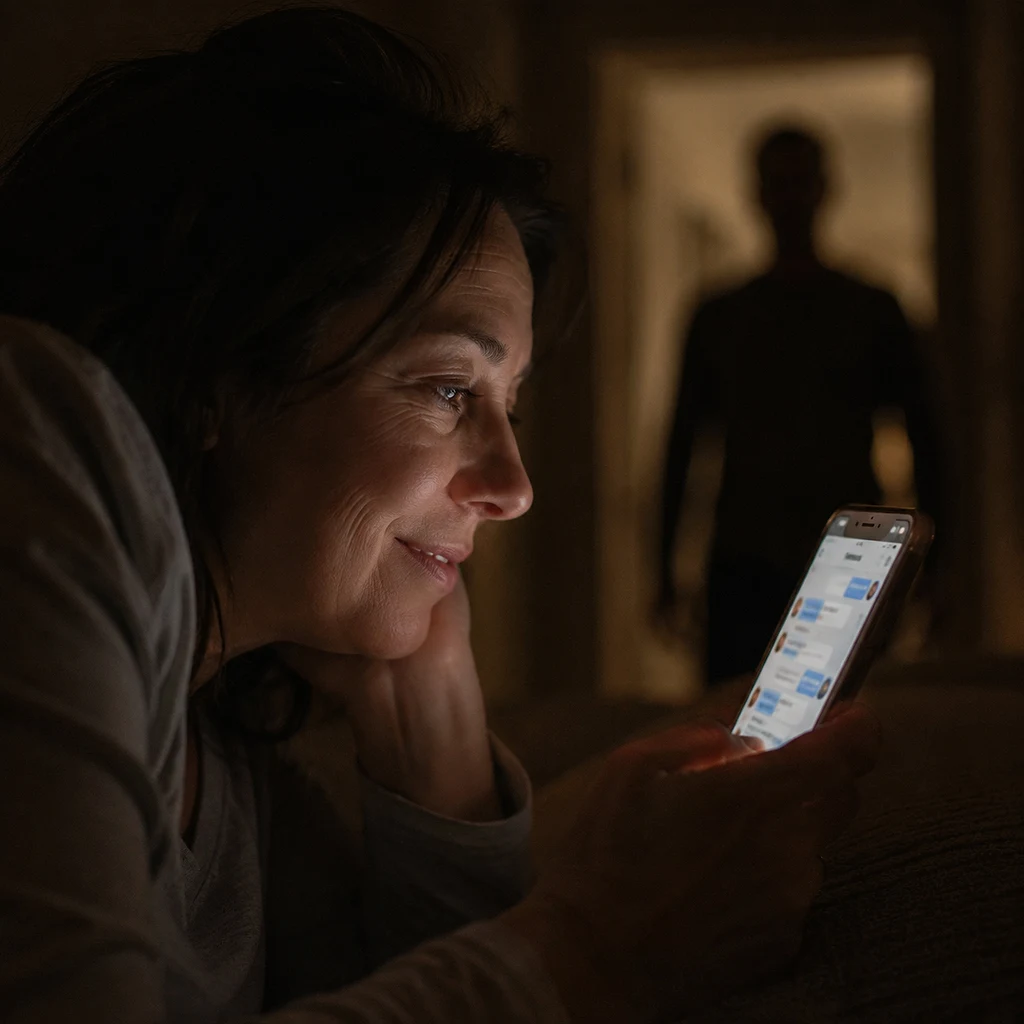
是爱情还是AI骗局?
AI Romance Scams Use Fake Video Calls
About this story
Xiao Li's online match is humorous, charming, patient — the warning signs of an AI romance scam in everyday Chinese. HSK 3 Chinese listening practice.
This is an HSK 3-4 Chinese listening episode that runs about 8 minutes. The full Mandarin script is shown with tap-for-pinyin and a line-by-line English translation, so you can listen and read at once — comprehensible input in the sense of Stephen Krashen's i+1 theory. It teaches 16 key vocabulary words such as 怀疑、印象、甚至 and walks through 6 grammar patterns, each explained in English with examples. The same news story is retold at 4 difficulty levels — use the level selector above to find the version that is challenging but still understandable for you.
Read at your level
原文Read the complete story in Chinese. Reveal pinyin and English only when you need them.
English transcript reference
Speaking of how many people nowadays like to find boyfriends or girlfriends online, we are going to discuss a very serious topic.
The internet is very convenient now; you can get to know people from all over the world on your phone.
Many people feel that finding love online is a very romantic thing.
However, have you ever thought that the person on the other side of the phone might not be a real person at all?
This is the issue we are going to discuss today: Is what you encountered love, or an AI scam?
We all know that current science and technology are developing very fast.
Especially artificial intelligence technology, which is what we often call AI, has become very smart.
In the past, if someone sent you a photo, you might doubt whether the photo was real.
So you would ask the other person to video chat with you.
Because in our impression, video is very hard to fake.
If I see his face and hear his voice in the video, then he must be real.
However, the situation now has completely changed.
Current AI technology can not only make fake photos but can even make fake videos.
This technology can swap one person's face with another person's face.
Even if it is a bad person, he can use this technology to turn himself into a handsome guy or a beautiful woman.
Doesn't this sound a lot like a story in a movie?
But this is indeed happening in our lives.
Let's imagine a concrete example.
There is a young person, let's call him Xiao Li.
Xiao Li is a very hard-working person, but he is usually very busy and has no time to make friends.
So, he often feels very lonely.
One day, he met a girl online.
This girl's photos were very beautiful, and she looked very gentle.
They started chatting online every day.
This girl was very good to Xiao Li; she would send a message saying "Good morning" every morning and "Good night" every evening.
She seemed to understand Xiao Li very well, knowing what Xiao Li liked and what he didn't like.
Xiao Li felt that he had finally found true love.
To verify that this girl was real, Xiao Li asked to video chat with her.
They video chatted on their phones several times.
In the video, the girl looked exactly the same as in the photos.
Her voice sounded very nice, and she spoke with humor.
Xiao Li completely believed her, feeling she was the most important person to him in this world.
However, what Xiao Li didn't know was that this "girl" actually didn't exist.
That face in the video was created by a computer program.
That pleasant voice was also altered using voice-changing software.
On the other end of the phone, it might be a bad person specializing in swindling money, or even a man.
This is a typical AI romance scam.
So, why do these bad people do this?
They have only one goal, and that is money.
After Xiao Li completely trusted this girl, things would change.
One day, this girl might suddenly tell Xiao Li that she has encountered some difficulties.
Perhaps her family member is sick and needs to go to the hospital.
Perhaps her business has problems and needs some money to resolve them.
Or, she might tell Xiao Li some "good news."
She says she knows a very good investment opportunity where investing just a little money can earn a lot.
Because Xiao Li already considered her his girlfriend, Xiao Li wouldn't suspect her.
Xiao Li would feel that helping his girlfriend is the right thing to do.
So, Xiao Li transferred his money to her.
But, once the money was transferred, this girl would disappear.
Xiao Li could never contact her again.
Only at this moment did Xiao Li realize he had been cheated.
This was not just losing money; more importantly, Xiao Li's feelings were greatly hurt.
These kinds of things are happening more and more now; we must increase our vigilance.
So, how should we protect ourselves?
First, we need to know that although AI technology is very powerful, it is not without flaws.
During the video call, you can carefully observe the other person's face.
If it is an AI face swap, sometimes the edges of the face will be a bit unnatural.
Especially when the lighting changes, or when the person moves quickly, the face might look strange.
You can ask the other person to do some special movements.
For example, you can ask him to put his finger on his face, or ask him to turn his head quickly.
Current AI technology often makes mistakes when processing images where hands and faces are together.
If you see his finger pass through his face, or the face suddenly becomes blurry, then it is definitely fake.
Secondly, we must maintain a skeptical attitude towards "perfection" online.
In real life, no one is perfect.
If a person is especially good to you online, never loses their temper, and has especially good conditions, then you have to be careful.
Bad people often exploit the psychology of people wanting to be loved to create a perfect image.
They will understand your hobbies based on your social media posts.
Whatever you like, they pretend to like it too.
This way you will feel that you two are destined for each other.
Actually, these are all scripts they have designed.
In addition, the most important point is, no matter how good your relationship is, do not easily transfer money to the other person.
True love should not be built on the foundation of money.
If someone asks you for money or asks you to invest shortly after meeting you, then he is 100% a scammer.
Whether it is borrowing money for medical treatment or taking you to make money, do not believe it.
You must remember, protecting your wallet is protecting your life.
Besides money, you also need to protect your personal information.
Do not tell your ID card number, home address, or bank card password to strangers online.
Because bad people might use this information to do more bad things.
Some scammers will even record your video, then use AI technology to swap it with your face to cheat your family and friends.
Therefore, when chatting online, you must pay attention to protecting your privacy.
Although technology has brought us a lot of convenience, allowing us to contact friends anytime and anywhere.
However, technology has also given bad people new tools.
While we enjoy the happiness brought by technology, we must not forget safety.
Facing online romance, we must keep a cool head.
Do not blindly believe the sweet words of strangers just because of loneliness.
True feelings need time to prove.
It needs to be felt face-to-face in this real world.
If you meet someone online who moves your heart, you must ask "why" a few more times.
You can try to ask him to meet in real life.
If he always finds various reasons to refuse to meet, such as being abroad or being too busy with work, then you have to be careful.
A person who truly likes you will try every means to see you.
Instead of just talking to you inside a phone screen.
Also, if you suspect the other person is a scammer, you can discuss it with friends or family around you.
Sometimes, when we are in the middle of it, we may not see clearly.
But friends and family are bystanders; they might discover many problems you didn't notice.
Listening to other people's opinions more often can help you avoid a lot of trouble.
Now, many countries and police departments are also fighting this kind of cybercrime.
However, the methods of scammers are also constantly changing.
Therefore, the most important thing is that we ourselves must improve our awareness of prevention.
Don't think this kind of thing is far away from you; it might happen right beside you or your friends.
We also need to tell the elderly at home, because they may not understand these new technologies very well.
Many elderly people have kind hearts and easily trust others, so they are more likely to be cheated.
We should care more about our family members, tell them this knowledge, so that they can also protect themselves.
In this digital age, trust has become increasingly precious and increasingly fragile.
We hope everyone can find true love, but we don't want anyone to get hurt because of looking for love.
So, when you meet that "perfect" person online, please stop and think first.
Is this really the arrangement of fate?
Or is this just a carefully designed program?
Have a little more reason, a little less impulse.
Don't let your kindness be exploited by bad people.
As long as we all increase our vigilance, scammers will have no chance.
Although the online world is big, as long as we keep safety in mind, we can avoid many dangers.
I hope everyone can keep their eyes open when going online, and see clearly what is real and what is fake.
For those friends met online, while maintaining friendliness, also maintain some distance.
Until you truly understand each other in real life.
After all, true care is not just sending a few emojis or making a few video calls.
True care is substantial companionship and support.
Listen again
Try it without the transcript and notice what sounds clearer.
What vocabulary does this episode teach?
词汇A verb used when you question the truth or someone's motives.
Noun. Often used in the structure '在……印象中' (in ...'s impression).
Adverb/Conjunction used to emphasize a case that goes beyond expectation.
Adjective describing someone with a sense of humor.
Can be a noun (facing difficulties) or an adjective.
Often used with '做' (to do business).
Commonly used in '发脾气' (to lose one's temper).
HSK 1-3. country.
A noun referring to a deceptive scheme.
Technical term. '人工' means artificial/man-made, '智能' means intelligence.
Verb/Adjective. To be on the lookout for danger.
Adjective describing the feeling of loneliness.
Adjective. Used here for visual blurriness in videos.
Noun. The written text of a play or movie, here used metaphorically for a planned scam.
Noun referring to personal secrets or private information.
Adjective. Easily broken or damaged (physically or emotionally).
* beyond level超纲词
What grammar patterns appear in this episode?
语法Not only... but even... (Used to emphasize that something goes beyond what is expected).
现在的AI技术,不但可以做假的照片,甚至可以做假的视频。
Even if... still... (Indicates that the result remains the same despite a hypothetical concession).
即使是一个坏人,他也可以利用这种技术,把自己变成一个帅哥或者美女。
The 'Ba' construction creates a disposal sentence where the subject acts upon an object to change its state.
这种技术可以把一个人的脸换成另一个人的脸。
于是,小李就把自己的钱转给了她。
As long as... then... (Indicates a sufficient condition).
只要投入一点钱,就能赚很多钱。
只要我们大家都提高了警惕,骗子就没有机会了。
Once... then... (Indicates that as soon as a condition is met, a result follows immediately).
可是,一旦钱转过去了,这个女孩子就会消失。
Actually not / emphatic negative. Used to correct a misconception or emphasize a negative.
但是,小李不知道的是,这个“女孩子”其实并不存在。
Proper nouns
专有名词Free account
Keep learning from this story
Create a free account to keep saved words and your preferred level together.
- Keep words with their story context
- Remember your preferred level
- Build your vocabulary over time