
A Chinese podcast · Same story, 4 levels
北京:护城河的负空间
Beijing: The Hill Made From the Palace's Own Moat
About this story
720,000 square metres, 8,700 rooms, 24 emperors — and why Jingshan is literally the hole beside the palace, piled up. HSK 3 Chinese listening practice.
This is an HSK 3-4 Chinese listening episode that runs about 5 minutes. The full Mandarin script is shown with tap-for-pinyin and a line-by-line English translation, so you can listen and read at once — comprehensible input in the sense of Stephen Krashen's i+1 theory. It teaches 12 key vocabulary words such as 护城河、渣土、门槛 and walks through 3 grammar patterns, each explained in English with examples. The same news story is retold at 4 difficulty levels — use the level selector above to find the version that is challenging but still understandable for you.
Read at your level
原文Read the complete story in Chinese. Reveal pinyin and English only when you need them.
English transcript reference
A lot of people treat the Forbidden City as a checklist to be completed: see the Hall of Supreme Harmony, take the photo, leave.
Walk it that way and after a few hours what's left is mostly fatigue.
Try it differently: don't count the halls, follow the line down the middle.
The Forbidden City covers about seven hundred and twenty thousand square metres, with nine hundred and eighty surviving buildings and more than eight thousand seven hundred rooms.
Construction began in 1406 and was completed in 1420.
From then on, twenty-four emperors of the Ming and Qing lived here, across nearly five hundred years.
Fourteen Ming, ten Qing.
The Qing ended in 1912, and on 10 October 1925 the Purple Forbidden City became the Palace Museum, open to the public.
In 1987 it was inscribed as a World Heritage Site.
So this building has changed identity three times: an emperor's home, a closed former palace, and a public museum.
Once you pass through the Meridian Gate, the space immediately changes your sense of scale.
Vast courtyards, palace gates unfolding layer by layer, the principal halls at the centre.
All of it pulls your gaze and your steps in one direction: due south to due north.
The Hall of Supreme Harmony area was used for state ceremonies; the further in you go, the more you enter where the emperor and his family actually lived.
Who could pass through which gate, and who stood where, were strictly regulated.
Architecture here doesn't merely provide rooms; it converts status and order into distance and thresholds.
Coming out of the Gate of Divine Prowess in the afternoon, Jingshan is directly opposite.
Jingshan is forty-five point seven metres high, with the Wanchun Pavilion at the summit.
This hill is not natural.
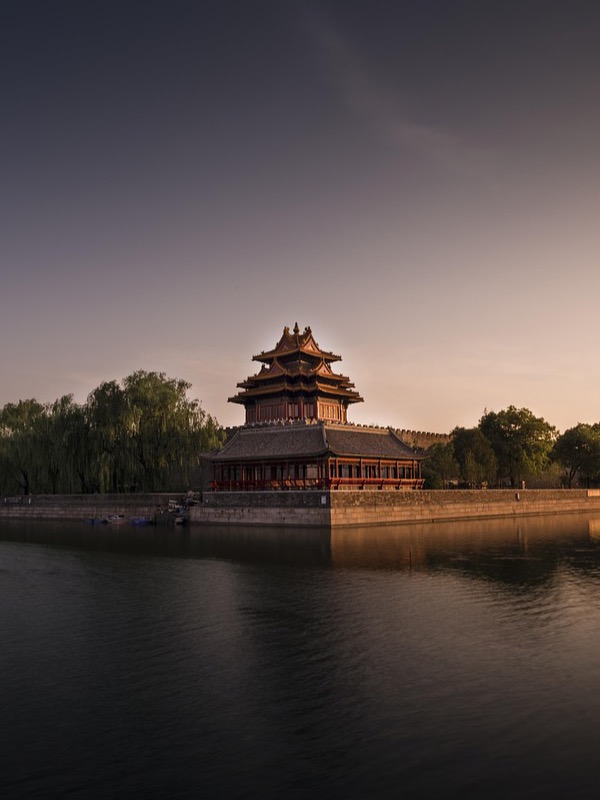
In 1420, while Beijing was being built, workers excavated the moat around the Forbidden City and demolished the Yuan-dynasty palace at the same time.
The earth dug out and the rubble taken down were piled together into this hill, then called Wansui Hill.
Put another way: the hill you climb is the negative space of the moat beside the Forbidden City.
The soil was moved north and piled into a viewing point — one that happens to overlook exactly where it came from.
Climbing the Wanchun Pavilion doesn't take long, but the change in viewpoint is decisive.
The courtyards that seemed endless a moment ago suddenly become clear.
The golden roofs spread southward along a straight line.
That line runs south to Tiananmen, Zhengyangmen and Yongdingmen, and north to the Bell and Drum Towers.
It is seven point eight kilometres long, one of the longest urban axes in the world.
Today we call it the Beijing Central Axis.
On 27 July 2024, UNESCO inscribed the Beijing Central Axis on the World Heritage List.
The property comprises fifteen components: the Bell and Drum Towers, Wanning Bridge, Jingshan, the Forbidden City, Tiananmen, the Imperial Ancestral Temple, the Altar of Soil and Grain, Zhengyangmen, the Temple of Heaven, the Altar of Agriculture, Yongdingmen and others.
Standing on Jingshan, that list stops being a string of names and becomes a line you can actually see.
But the grand axis is only half of Beijing.
Looking east and west from Jingshan, you see wide fields of grey roofs and narrow lanes — the hutongs.
The hutong is often packaged as nostalgic scenery, but first of all it is space residents actually use.
Someone buys breakfast at dawn, someone wheels a bicycle out, and some people have to deal with maintaining old houses and paying rent.
Coffee shops, traditional snacks, a visitor's camera and a resident's life may all appear on the same street.
This coexistence isn't always romantic, but it is more real than a quiet photograph of old Beijing.
The Forbidden City shows how state order was written into architecture.
The hutong shows how ordinary people go on living inside that structure.
The two can't be split simply into ancient and modern: the Forbidden City is a public museum today, and hutong life is shaped by conservation policy.
In the afternoon I came down from Jingshan and didn't rush to the next sight.
I bought lunch nearby and sat at the mouth of a hutong, watching children, delivery riders and lost tourists go past.
Walking in through the Meridian Gate that morning, I thought Beijing's most important story was inside the high walls.
Leaving the hutong at dusk, I realized that those walls, that seven-point-eight-kilometre line, and the changing life outside them were one story all along.
If you had one day, would you start with the grand history, or sit in a hutong for half of it?
Listen again
Try it without the transcript and notice what sounds clearer.
What vocabulary does this episode teach?
词汇HSK 4. It does more than provide rooms.
HSK 5. Whose real space the hutong is.
HSK 3. Which also shapes hutong life today.
HSK 4. Converted from status into distance.
Excavated in 1420; its spoil is the hill.
From the Yuan palace, piled in with the moat soil.
What status and order were converted into.
Written into the architecture, walkable.
7.8 kilometres, fifteen components, inscribed 2024.
Endless from inside, a straight line from above.
The palace's third identity, from 1925.
1987 for the palace, 2024 for the axis.
* beyond level超纲词
What grammar patterns appear in this episode?
语法把 A 变成 B
States a transformation.
它把身份和秩序变成了距离和门槛。
换句话说
Restates the point more plainly.
换句话说,你爬的这座山,是故宫旁边那条河的“负空间”。
不只是 …,它 …
Says A is true but insufficient, then adds.
建筑在这里不只是提供房间,它把身份和秩序变成了距离和门槛。
Proper nouns
专有名词Sources
来源Free account
Keep learning from this story
Create a free account to keep saved words and your preferred level together.
- Keep words with their story context
- Remember your preferred level
- Build your vocabulary over time