
A Chinese podcast · Same story, 4 levels
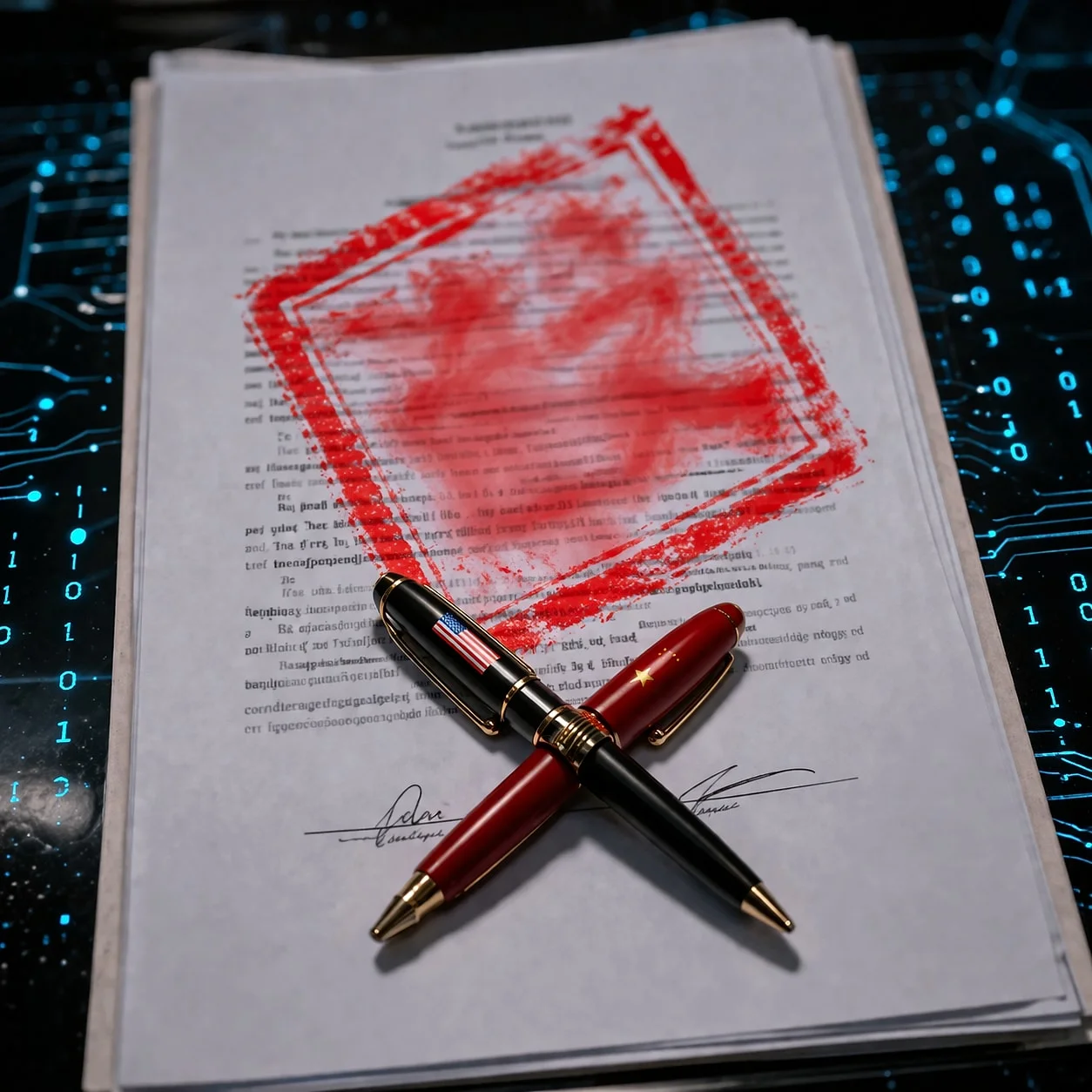
叫停Manus:中国对"新加坡洗白"亮出底牌
China Blocks Meta's $2B Manus Deal
About this story
China's NDRC blocks Meta's 2B Manus acquisition — the end of 'Singapore washing' for Chinese AI startups after DeepSeek. HSK 5-6 Chinese listening practice.
This is an HSK 5-6 Chinese listening episode that runs about 10 minutes. The full Mandarin script is shown with tap-for-pinyin and a line-by-line English translation, so you can listen and read at once — comprehensible input in the sense of Stephen Krashen's i+1 theory. It teaches 16 key vocabulary words such as 收购、交易、措辞 and walks through 8 grammar patterns, each explained in English with examples. The same news story is retold at 4 difficulty levels — use the level selector above to find the version that is challenging but still understandable for you.
Read at your level
原文Read the complete story in Chinese. Reveal pinyin and English only when you need them.
English transcript reference
Speaking of today's biggest tech-world news — China's NDRC has officially halted Meta's roughly two-billion-dollar deal to acquire Manus.
The weight of this event is probably much greater than it appears on the surface.
Today we're going to walk through the whole story, see what actually happened, and what it means.
First, what happened today.
April 27th, Monday, Beijing.
The National Development and Reform Commission — the NDRC for short — issued a notice with extremely firm wording.
The core message of the notice was one sentence: prohibit foreign investment in the acquisition of the Manus project, and require both parties to withdraw the deal.
In plain language: Meta, you cannot buy Manus; Manus, you cannot sell to Meta.
And this isn't just a refusal to approve — both sides are being told to "withdraw" what they've already done.
That word "withdraw" is significant.
China's usual stance on foreign acquisitions is "approved" or "not approved."
But this time, an already-announced deal is being forcibly unwound.
That kind of situation is very rare in China.
The last similar case was Li Ka-shing's CK Hutchison selling its global ports to BlackRock last year.
That deal ultimately had China step in and demand a re-examination.
Today's Manus deal is widely interpreted as an event of the same magnitude.
Meaning: high-intensity, high-level, signal-sending of the highest order.
So what is Manus, exactly, that warrants such a heavy hand from China?
We have to tell its story in full.
Manus is a company that builds "general-purpose AI agents."
In English: General AI agent.
What is an AI agent?
It's not the same as the chatbots you use day-to-day, like ChatGPT or Wenxin Yiyan.
A chatbot is question-and-answer: you ask, it answers.
If you don't ask, it just sits there.
But an AI agent doesn't.
You give it a goal — say, "Help me sort this week's customer emails by priority and send a summary of the important ones to my WeChat."
Then it plans the steps itself, searches online itself, reads emails itself, sorts them itself, writes the summary itself, sends it itself.
You don't have to manage it in between.
When it's done, it tells you the result.
Put simply: an AI agent is what you get when AI evolves from "tool" toward "employee."
ChatGPT is like an encyclopedia; an AI agent is like an assistant who actually gets work done.
Whoever does this first holds the key to the next generation of AI.
That's why Manus's arrival caused such a stir.
When Manus launched its product in March last year, it was a startup almost no one had heard of.
But after launch, the industry exploded.
The reason: what they built was the most polished general-purpose agent on the market at the time.
And it didn't rely on a self-built foundation model — it used Western large language models, like those from OpenAI, Anthropic, and Google. They built only the agent layer on top, but built that layer with extreme finesse.
The result?
Eight months, from zero to one hundred million dollars in annual recurring revenue.
What does that mean?
Globally, that's one of the fastest SaaS growth curves on record.
Even OpenAI took about two years to go from zero to a hundred million.
So during that period, the entire Chinese tech world was shouting "Manus is the next DeepSeek."
DeepSeek was the company last year that trained a top-tier large model at extremely low cost and shocked the world.
The "next DeepSeek" label carries serious weight.
Back to Manus's identity.
This is where things get complicated.
Manus was started in Beijing, with a team of about a hundred-plus, all Chinese engineers.
But shortly after the company was founded, its legal entity was moved to Singapore.
And then a parent company was set up in the Cayman Islands.
Why all this maneuvering?
For one thing: to take foreign money.
Over the past year or two, the US-China standoff in AI has grown ever sharper.
The US Treasury issued a new rule — banning American funds from directly investing in AI companies inside China.
In theory, US funds can't give money to Chinese AI companies.
So how do Chinese companies take US money?
A workaround emerged, known in the industry as "Singapore washing."
The mechanics: move the legal entity to Singapore or the Caymans. The employees are still Chinese, but legally they become a "Singapore company."
This way US funds can invest, since the counterparty is "not a Chinese company."
Manus took exactly this path.
Last spring, the well-known US venture firm Benchmark led Manus's Series B at seventy-five million dollars.
That investment immediately drew the attention of the US Treasury.
They opened an investigation right away to see whether it violated the new outbound-investment ban.
And it didn't end there.
Last December, Meta announced it was acquiring Manus outright for two billion dollars.
Some reports said 2.5 billion — close enough.
For Meta, this was about filling a gap on the AI agent side.
Meta has poured huge sums into generative AI, but it's clearly behind OpenAI and Google in this new agent direction.
Meta wanted to bring the Manus team and product in directly, integrating them into Facebook, Instagram, WhatsApp, and its own Meta AI assistant.
Billions of users at the entrance, plus the world's strongest agent team — that was Zuckerberg's calculation.
But the moment the acquisition was announced, everyone realized one thing:
China might not allow it.
Why?
Because Manus isn't just a commercial product. Its underlying technology, architecture, and training data were all built by Chinese people inside China.
Letting an American internet giant absorb this kind of core AI tech is essentially handing over the keys to the "next-generation AI entry point."
China launched its antitrust and foreign-investment review in January.
The official rationale: assess whether the deal complies with export controls, technology import/export rules, and overseas investment regulations.
In plain language: stall the process and see whether they can find legal grounds to kill the deal.
That stall went on for over three months.
Today, the conclusion came out: no, withdraw.
The policy implications of this conclusion are far bigger than the deal itself.
Let me unpack three layers.
Layer one: this seals off the "Singapore washing" route entirely.
Until now, "washing" was practically the default playbook for Chinese AI startups.
If you wanted top-tier US fund money, a global market, a future IPO — you moved the company to Singapore.
Today's decision is essentially telling every Chinese AI founder:
This route is dead as of today.
Where your people are and where your code is matters more than where your legal entity is.
You want to leave — fine.
But you have to get my permission first.
For a wave of companies that are planning to leave or have already left, this is a sharp blow.
Layer two: this is China clearly drawing a red line on the "outflow of core AI technology."
Until now, everyone vaguely knew this red line existed, but no one knew exactly where.
Today, the line has been drawn very clearly — AI agents, this kind of "next-gen entry-point" technology, cannot be sold to American giants.
Once this red line is set, going forward, not just Meta but all American giants — Google, Microsoft, Amazon, OpenAI — will face dramatically higher difficulty acquiring AI companies in China.
Conversely, the valuation logic for domestic Chinese AI companies will also shift.
Previously, valuations were anchored on "could be acquired by a US giant in the future."
With that exit closed, valuations have to be reset.
Layer three: this marks US-China tech rivalry entering a new phase.
Previous moves in the rivalry mostly came from the US side — export controls, investment bans, chip restrictions.
China was largely playing defense.
Today's move is China going on offense.
And the timing was chosen with great care.
In mid-May, Trump is set to visit Beijing to meet Xi Jinping.
This will be the first formal head-of-state meeting between the two countries since the pandemic.
Two to three weeks before that meeting, China made this move.
The signal to the US side is clear:
At the negotiating table, we have cards.
Your tech companies wanting to do acquisitions or partnerships in China — that's not your call.
It's our call.
This kind of proactive posture hasn't been seen for years.
Finally, I want to say something that connects to ordinary people.
You may think: this is all between big companies and big governments — it has nothing to do with me.
But it actually does.
The current AI wave, whether you like it or not, is going to change how everyone works.
And the direction of AI's development will be deeply shaped by competition between countries.
Between China and the US, technology is increasingly fragmenting.
China has its own AI ecosystem; the US has its own AI ecosystem.
The AI products you use in the future may run on a completely different system from the ones a Silicon Valley engineer uses.
It's not just a Chinese-versus-English difference — the underlying architecture, value orientation, training data, and safety norms will all be different.
This "two AIs" landscape may not be a good thing for humanity as a whole.
Because the best state of science and technology is openness, sharing, and mutual borrowing.
But geopolitics is tearing that ideal apart.
The Manus event is just one wave in this larger trend.
But the splash from this wave is loud enough, and far-reaching enough.
That's it for today.
April 27th — Beijing halts Meta's acquisition of Manus.
Let's remember this day.
Listen again
Try it without the transcript and notice what sounds clearer.
What vocabulary does this episode teach?
词汇HSK 6 but central to business journalism. 收 (gather) + 购 (purchase). Specifically a corporate buyout, not just any purchase. 全资收购 = full acquisition.
HSK 5. 交 (exchange) + 易 (change). Both noun and verb. 一笔交易 = one deal. Differs from 生意 (business) — 交易 emphasizes the specific transaction.
Used here to characterize the firmness of language: 措辞非常硬的通知 = a notice with extremely firm wording. Common in diplomatic and journalistic register.
HSK 5. 强 (strong) + 制 (control). 强制拆开 = forcibly unwind. Often paired with 执行 (enforce).
禁 (prohibit) + 令 (order). Specifically a formal prohibition issued by an authority. The episode mentions the US 对华投资禁令 (anti-China investment ban).
Both noun and verb. 外资审查 = foreign-investment review. 反垄断审查 = antitrust review. Suggests a formal regulatory examination.
HSK 6. Used for state intervention, often with negative connotations. 中国出手干预 = China stepped in and intervened. Compare 介入 (more neutral).
对 (face) + 峙 (stand erect). Two parties facing each other in tension. The Chinese phrase 中美对峙 = US-China standoff.
Originally a board game; now used for strategic competition (game theory: 博弈论). 中美科技博弈 = the US-China tech game.
Lit. 'stomach mouth.' Used metaphorically for capacity or interest in something. (Note: this word doesn't appear in this episode but is a useful related register word.)
Idiom. 重拳 (heavy fist) + 出击 (strike out). Used in journalism for forceful regulatory action.
Borrowed from Christian/Arthurian lore. Used for the ultimate, long-sought prize in any field. (Not in this episode — but commonly used in tech: AI 的圣杯 = the Holy Grail of AI.)
Originally a martial-arts term — a routine of moves. Now widely used colloquially for a 'standard tactic' or 'pattern,' often with mild cynicism.
封 (seal) + 堵 (block). Used for closing routes, loopholes. The episode says 'Singapore washing' has been 彻底封堵 (sealed off entirely).
Lit. 'short plank' — from the saying that a barrel can hold only as much water as its shortest plank. Used in business for a company's weak area.
Idiom. Lit. 'a club straight to the head.' Conveys the shock of a sudden setback.
* beyond level超纲词
What grammar patterns appear in this episode?
语法X 也就是 Y (apposition / 'that is to say')
Used to clarify or restate. More formal than the basic 就是 definition pattern.
翻译成大白话,就是:Meta,你不能买Manus。
也就是说:高强度、高规格、信号意义极强。
说人话就是:先把流程拖住。
把 + Object + Verb + Result
Disposal construction with explicit result. Required when an act produces a measurable outcome on the object.
正式叫停了Meta收购Manus这笔大约二十亿美元的交易。
把法人主体搬到了新加坡。
把'下一代AI入口'的钥匙交出去。
被 + (Agent) + Verb (passive)
Mandarin passive marker. The agent can be omitted (then the action is depersonalized). Strong association with formal/journalistic register.
已经宣布的交易,要被强制拆开。
被外界普遍解读为同样级别的事件。
AI 的发展方向,会被国家和国家之间的博弈深刻地塑造。
不仅仅是 ... 还有 ... (not merely X, also Y)
Stronger version of 不只是. Used in expository register to add weight.
不仅是不批,是要求双方把已经做的事情都'撤'回来。
不只是Manus一家公司的事。
不只是中文和英文的差别,是底层架构、价值取向、训练数据、安全规范,全都不一样。
越 X 越 Y
'The more X, the more Y.' Two clauses of progressive change linked. Note the structure: 越 + verb/adj, 越 + verb/adj.
中美在AI领域的对峙越来越尖锐。
技术上越来越分裂。
让这种合作变得越来越难。
X 相当于 Y (X amounts to Y)
Equivalence framing. Used to interpret an action: 'X is essentially Y.' Common in analysis/commentary.
相当于把'下一代AI入口'的钥匙交出去。
今天这个决定相当于告诉所有中国AI创业者...
一旦 X 就 Y
'Once X happens, Y...' Implies inevitability of the consequence — stronger than 如果.
一旦这条红线确立,未来不只是Meta...
对 ... 来说 / 在 ... 看来 (perspective markers)
Topicalizers establishing whose viewpoint is being summarized. 对 X 来说 = 'for X' (impact/consequence). 在 X 看来 = 'in X's view' (opinion).
对Meta来说,这是要补上自己AI智能体这块短板。
对一大批正在筹划、或者已经搬出去的公司来说,这是当头一棒。
对全人类来说,未必是好事。
Proper nouns
专有名词Free account
Keep learning from this story
Create a free account to keep saved words and your preferred level together.
- Keep words with their story context
- Remember your preferred level
- Build your vocabulary over time