
A Chinese podcast · Same story, 4 levels
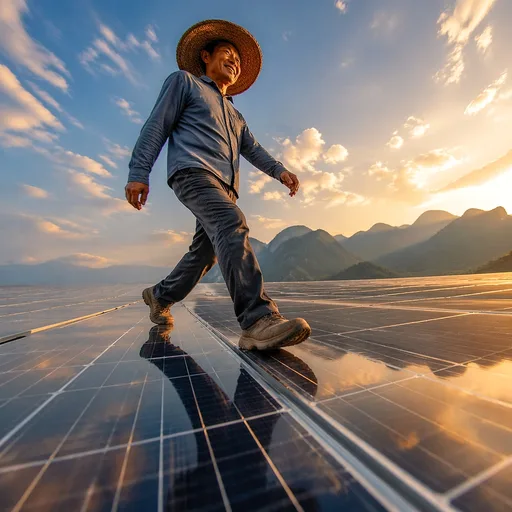
中国五年计划:太阳和风来发电
China's 15th Five-Year Plan Backs Clean Energy
About this story
A simple story about how the sun and water make electricity, and why China wants to use more clean energy. HSK 1 Chinese listening practice.
This is an HSK 1 Chinese listening episode that runs about 3 minutes. The full Mandarin script is shown with tap-for-pinyin and a line-by-line English translation, so you can listen and read at once — comprehensible input in the sense of Stephen Krashen's i+1 theory. It teaches 11 key vocabulary words such as 太阳、水、知道 and walks through 4 grammar patterns, each explained in English with examples. The same news story is retold at 4 difficulty levels — use the level selector above to find the version that is challenging but still understandable for you.
Read at your level
原文Read the complete story in Chinese. Reveal pinyin and English only when you need them.
English transcript reference
China has a new plan.
This plan is very big.
The plan is about energy.
What is energy?
The sun is energy.
The wind is also energy.
Water is also energy.
These are clean energies.
Clean energy is very good.
Let's tell a story.
Xiaoming lives in a small home.
Xiaoming's home is very small.
Xiaoming's home has electricity.
Where does electricity come from?
Xiaoming doesn't know.
Xiaoming asks his mom.
Mom, where does electricity come from?
Mom says, look at the sun.
The sun is very big and very bright.
The sun gives us electricity.
Xiaoming says, the sun gives electricity?
Mom says, correct.
Look above our house.
There are solar energy things up there.
The sun's light comes.
The light becomes electricity.
Xiaoming is very happy.
The sun is really good!
Xiaoming asks his mom again.
What else gives electricity?
Mom says, wind also gives electricity.
Look over there.
There is a very big thing over there.
When the wind comes, it will move.
When it moves, there is electricity.
Xiaoming says, wind also gives electricity?
Mom says, correct, wind also gives electricity.
Xiaoming says, that's great!
The sun gives electricity, and the wind also gives electricity.
Mom says, water also gives electricity.
Big water, a lot of water.
When water moves, there is also electricity.
Xiaoming says, water also gives electricity!
Sun, wind, and water all give electricity.
These are all clean energies.
Clean energy is not dirty.
Xiaoming is very happy.
Xiaoming says, I like clean energy.
Mom is also very happy.
Mom says, China also likes it.
China has a big plan.
This plan is called the Five-Year Plan.
China wants to use more solar energy.
China wants to use more wind energy.
China wants to use more water energy.
China already has a lot.
But China still wants more.
China's plan is until the year 2035.
To have more clean energy.
Xiaoming says, China is really good.
Our energy will be very clean.
Clean energy is good for everyone.
Listen again
Try it without the transcript and notice what sounds clearer.
What vocabulary does this episode teach?
词汇A common noun for the sun. The measure word is 个 (gè).
A basic noun for water. It is uncountable, but can be quantified with measure words like 杯 (bēi, cup) or 瓶 (píng, bottle).
A fundamental verb meaning to know a fact or have information about something.
An adjective used to describe a temporary state of happiness or gladness.
A basic verb used to express fondness for a person, thing, or action.
An adjective phrase meaning 'more'. '更' acts as an adverb of degree meaning 'even more'.
Can be used as a noun (a plan) or a verb (to plan). In this text, it is used as a noun.
A formal noun referring to sources of power such as solar, wind, or fossil fuels.
An adjective meaning clean or neat. Here it is used metaphorically for 'clean energy' (pollution-free).
A verb indicating a transformation from one state or thing into another.
A compound noun formed by '太阳' (sun) and '能' (energy/power).
* beyond level超纲词
What grammar patterns appear in this episode?
语法This structure is used to indicate existence, meaning 'There is/are [Object] at [Place]'.
小明的家有电。
上面有太阳能的东西。
那边有很大的东西。
This pattern indicates the origin of something or someone, translating to 'comes from [Place]'.
电从哪里来?
The auxiliary verb '会' (huì) can indicate a future possibility or a natural tendency for something to happen.
风来了,它会动。
我们的能源会很干净。
This structure expresses the effect or attitude of A towards B. It translates to 'A is [Adjective] for/to B'.
干净的能源对大家都好。
Proper nouns
专有名词Free account
Keep learning from this story
Create a free account to keep saved words and your preferred level together.
- Keep words with their story context
- Remember your preferred level
- Build your vocabulary over time