
A Chinese podcast · Same story, 4 levels
中国要用更多干净的电
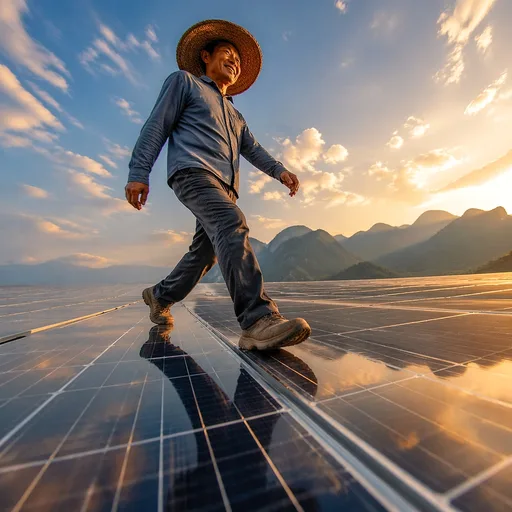
China's 15th Five-Year Plan Backs Clean Energy
About this story
China's new Five-Year Plan calls for more solar and wind power, decided at the Two Sessions — a look at what changes. HSK 2 Chinese listening practice.
This is an HSK 2 Chinese listening episode that runs about 3 minutes. The full Mandarin script is shown with tap-for-pinyin and a line-by-line English translation, so you can listen and read at once — comprehensible input in the sense of Stephen Krashen's i+1 theory. It teaches 19 key vocabulary words such as 计划、重要、需要 and walks through 7 grammar patterns, each explained in English with examples. The same news story is retold at 4 difficulty levels — use the level selector above to find the version that is challenging but still understandable for you.
Read at your level
原文Read the complete story in Chinese. Reveal pinyin and English only when you need them.
English transcript reference
Today we're going to talk about China's energy plan.
China has a big plan.
This plan is called the Five-Year Plan.
A new one is made every five years.
This year is 2026.
China has made a new Five-Year Plan.
This is the fifteenth one.
This plan is very important.
Because it says what China wants to do.
So many people are paying attention.
Let's first talk about what energy is.
Energy is electricity and heat.
We use electricity every day.
Phones need electricity.
Lights need electricity.
Cooking also needs energy.
But there are two kinds of energy.
One kind is old energy.
For example, coal and oil.
These have been used for many years.
But they are not very good.
Because they make the air dirty.
So we need new energy.
What is new energy?
For example, solar energy.
The sun is there every day.
We can use the sun's light.
And turn it into electricity.
There is also wind energy.
When the wind blows.
We can use the wind.
And turn it into electricity.
These are all clean energy.
Using them won't make the air dirty.
What does China's new plan say?
The plan says there should be more new energy.
In the energy China used before.
Clean energy was quite little.
Now it needs to reach twenty-five percent.
That means one out of every four.
That's quite a lot.
China also wants to build wind power at sea.
The wind at sea is very strong.
Stronger than the wind on land.
So offshore wind power is very good.
By the year 2030.
There will be a lot of offshore wind power.
China also wants to use nuclear energy.
Nuclear energy is also clean.
Although nuclear energy is a little difficult.
But it is very useful.
China also had plans before.
The previous plan said.
Solar and wind energy should be a lot.
Did China achieve it?
Yes, it did!
And it was earlier than planned.
It was achieved in 2024.
This shows that China moved very fast.
What is the problem now?
Before, we needed to build more wind and solar power.
Now we have built a lot.
But how do we use them well?
This is a new problem.
The sun is not there every day.
Sometimes it rains.
The wind doesn't blow every day either.
So we need to find a way.
To store the electricity.
And use it when we need it.
The new plan is talking about this.
Not just making more.
But also using it better.
Okay, let's come back to this topic.
In March 2026, China.
Held the Two Sessions.
And passed the fifteenth Five-Year Plan.
The plan says clean energy will be the main power source in the future.
China wants to, before 2035.
Make solar and wind energy even more and stronger.
Listen again
Try it without the transcript and notice what sounds clearer.
What vocabulary does this episode teach?
词汇A plan or project. Used here as 五年计划 (five-year plan), China's national development strategy.
Something that matters a lot. 这个计划很重要 means this plan is very important.
To need or require something. 我们需要新能源 means we need new energy.
Used to express comparison or "fairly/rather." 干净能源比较少 means clean energy is relatively little.
Can mean either a question or a problem depending on context. 现在的问题是什么 means what is the current problem.
A way to solve a problem. 想办法 means to think of a way/solution.
Refers to an earlier time. 以前中国用的能源 means the energy China used before.
To indicate or demonstrate something. 这说明中国做得很快 means this shows China did it very fast.
HSK 1-2. mobile phone.
HSK 1-2. but; however.
Power sources like electricity and fuel. Used as 新能源 (new/renewable energy) throughout this episode.
Energy from the sun. 太阳 (sun) + 能 (energy). One of the main clean energy sources discussed.
Energy from wind. 风 (wind) + 能 (energy). China is building wind power both on land and at sea.
Energy from nuclear reactions. Described as clean but a little difficult (有一点难).
A traditional fossil fuel. Listed alongside 石油 (oil) as old energy sources that make the air dirty.
Crude oil, a fossil fuel. One of the 旧的能源 (old energy sources) that pollutes the air.
Free from dirt or pollution. 干净的能源 means clean energy — energy that does not pollute the air.
The air we breathe. Old energy sources 让空气变脏 (make the air dirty).
To save or store something for later use. 让电可以存起来 means to let electricity be stored.
* beyond level超纲词
What grammar patterns appear in this episode?
语法因为...所以...
Because... therefore... — Expresses cause and effect. 因为 introduces the reason, 所以 introduces the result. Either half can be omitted in casual speech.
因为会让空气变脏,所以我们需要新能源。
因为它说了中国要做什么,所以很多人在看。
让 + Object + Verb
To make/let someone or something do something. 让 is a causative verb that introduces the action caused.
让它变成电。
会让空气变脏。
让太阳能和风能变得更多更强。
比如
For example — Used to introduce specific examples of a general category. Placed at the start of a clause.
比如煤和石油。
比如太阳能。
虽然...但是...
Although... but... — Expresses a concession. 虽然 introduces the conceded point, 但是 introduces the contrasting main point.
虽然核能有一点难,但是它很有用。
不只是...还要...
Not only... but also need to... — Expresses that something goes beyond one aspect to include another.
不只是做更多,还要用得更好。
Verb + 得 + Adjective (Complement of degree)
Describes how well or to what degree an action is performed. 得 links the verb to the descriptive complement.
中国做得很快。
还要用得更好。
...的时候
When... — Indicates the time when something happens. Attached to a verb or clause to create a time expression.
风吹的时候,我们可以用风。
要的时候再用。
Proper nouns
专有名词Free account
Keep learning from this story
Create a free account to keep saved words and your preferred level together.
- Keep words with their story context
- Remember your preferred level
- Build your vocabulary over time