
A Chinese podcast · Same story, 3 levels
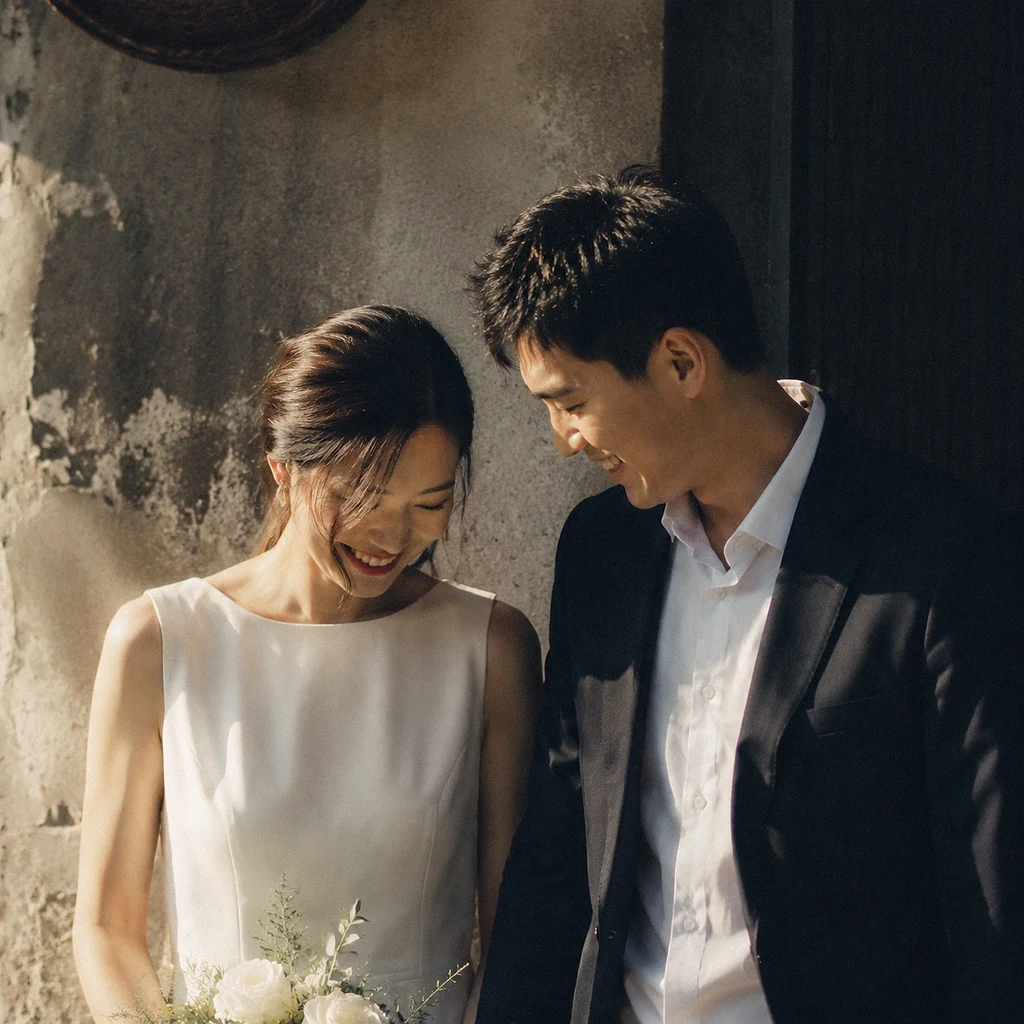
中国年轻人正在重新定义婚礼:只选对的,不选贵的
Chinese Millennials Reject Expensive Weddings
About this story
Sichuan, Hangzhou and Shenzhen couples Xiao Bao and Xiao Lyu push back on costly weddings — right over expensive. HSK 3 Chinese listening practice.
This is an HSK 3-4 Chinese listening episode that runs about 10 minutes. The full Mandarin script is shown with tap-for-pinyin and a line-by-line English translation, so you can listen and read at once — comprehensible input in the sense of Stephen Krashen's i+1 theory. It teaches 15 key vocabulary words such as 拒绝、压力、坚持 and walks through 5 grammar patterns, each explained in English with examples. The same news story is retold at 3 difficulty levels — use the level selector above to find the version that is challenging but still understandable for you.
Read at your level
原文Read the complete story in Chinese. Reveal pinyin and English only when you need them.
English transcript reference
Speaking of recent weddings among young Chinese people, we've discovered a very interesting new trend.
In the past, everyone believed that getting married required spending a lot of money and hosting many guests at a fancy hotel.
But now, more and more young people are starting to reject this kind of expensive traditional wedding.
They're no longer willing to spend their parents' savings of hundreds of thousands of yuan just to save face.
This change isn't just due to economic reasons — it's also because they want a lifestyle that truly belongs to them.
On social media, many young people have shared their stories of "low-cost" weddings.
Some celebrated at fast food restaurants, some went hiking, and some even took photos at music festivals.
Behind these choices is really an answer to an important question: whose life are we building?
The first story we want to share is about a young couple named Xiao Bao and Xiao Lü.
They decided not to hold a traditional banquet but instead to have a travel wedding on the plateaus of Sichuan.
This decision wasn't easy, because they faced enormous pressure from their families.
Xiao Lü proposed to Xiao Bao at an altitude of four thousand meters.
He said, our love is like this cup of milk tea — it may look ordinary, but it didn't come easy.
Originally, they planned to get married during the 2025 Spring Festival and even went to meet each other's parents.
But when it came to discussing the specific conditions, conflicts arose.
The bride's parents insisted that the groom buy a house first and also provide a large bride price.
The young couple felt that since they were working in a big city and hadn't decided where to settle down yet,
they didn't want to buy a house for now, nor did they want to take on heavy debt just to get married.
The parents were very angry when they heard this, feeling that without buying a house, the wedding simply couldn't happen.
At that moment, Xiao Bao felt very sad — she realized her parents didn't understand her.
She felt that her parents were not only rejecting her boyfriend, but also rejecting her independence in this world.
So she made a very brave decision.
She told her parents: "I'm going on a trip to Sichuan, and I'll pick up the marriage certificate along the way."
Her mother responded sarcastically: "Congratulations, getting married with nothing at all."
Although these words hurt her deeply, she didn't change her mind.
They only spent two weeks preparing, buying some outdoor gear and a veil.
In mid-September, they drove from Hangzhou, covering over 2,500 kilometers.
On their wedding day, they found a place with beautiful scenery but no other people around.
They set up a camera and took their own wedding photos.
There was no makeup artist, no fancy lighting, and their hair was blown messy by the wind.
But they felt incredibly happy, because this was the way they had chosen for themselves.
After returning to Hangzhou, they spent only a few hundred yuan treating their friends to milk tea and a simple meal.
Although their parents were very unhappy about this and even left the family group chat, Xiao Bao was very clear in her heart.
She believes that marriage is about finding someone who respects you and can share life with you.
That matters more than whether the other person has money or a house.
This travel wedding only cost about 20,000 yuan, much cheaper than a traditional banquet.
Xiao Bao said the most precious ceremonies are often the unexpected ones.
For example, seeing a herd of cattle passing by on the road and both of them stopping to wait together.
Or when facing difficulties, comforting each other instead of blaming each other.
This is how modern young people understand marriage: the focus is on the relationship between two people, not the show put on for others.
The second story we want to tell took place at a rock music festival.
The main characters are Shi Lin and her husband Xiao Chen.
They went to a music festival in November, where young people were everywhere.
When the band started playing, everyone around them began to dance.
Someone suggested they go into the middle of the crowd for photos, since they happened to have brought a veil that day.
As a result, strangers all around them began cheering and congratulating them on their marriage.
Although nobody knew each other, everyone was very enthusiastic — some even handed them beers.
At that moment, Shi Lin felt this was more lively and genuine than any traditional wedding.
Actually, they had previously considered going to a photo studio for traditional wedding portraits.
But she felt those photos all looked fake, like products off an assembly line.
Everyone looked the same with the same stiff smiles — that wasn't what she wanted.
Later, a friend suggested that since they loved music, why not take photos at a music festival?
The idea was brilliant, and they immediately decided to do it.
Although time was tight that day and they had to change clothes on-site, even asking passersby to help fasten her dress,
the results were surprisingly great — after posting the photos online, many people came to like them.
Even Shi Lin's father couldn't believe his eyes when he saw the photos.
Her father asked: "How are these people so cooperative?"
"Was this made with computer AI?"
Her mother, seeing the well-wishes from netizens, felt very happy and replied to the comments one by one.
This made Shi Lin realize that as long as you feel happy, parents can actually accept new things.
Shi Lin and Xiao Chen met through work and later discovered they both loved rock music.
When Shi Lin was going through the roughest time at work, it was Xiao Chen who supported her throughout.
They believe that the most important thing in marriage isn't the form, but whether two people can have fun together.
This "wedding" at a music festival made them feel both relaxed and unforgettable.
The protagonist of the third story is Qian Qian, who held a "vegetable garden wedding."
She's an environmentalist who is strongly against extravagance and waste.
She had attended many other people's weddings and always felt exhausted, with so much food going to waste.
So when it was her turn to get married, she decided to do things differently.
She wanted it to be simple and healthy, with no alcohol or cigarettes, and producing no trash.
She partnered with a friend who runs a vegetarian restaurant and held the event in a garden.
It wasn't just a wedding — it was more like a sustainable living market.
She posted about it online and unexpectedly attracted many strangers to attend.
Over forty vendors set up stalls, and everyone shared handicrafts and stories together.
The food was entirely plant-based, there were no assigned seats, and people wandered freely.
Next to each dish was a QR code — scan it and you could hear the story behind that dish.
In a big city like Shenzhen, a typical wedding banquet costs 500 to 1,000 yuan per person.
But Qian Qian's wedding averaged only about 100 yuan per person.
Over 500 people came that day, and although most were strangers, the atmosphere was wonderful.
However, there was one regret — Qian Qian's parents didn't come.
This wasn't because of a quarrel, but because the two generations genuinely have different values.
Her parents thought the occasion was too strange, and besides, they had already promised to attend someone else's wedding.
Qian Qian wasn't angry about this — she considered it a "comfortable distance."
Although her parents didn't come, they helped her prepare a lot of fruit at home.
This shows that even though her parents didn't understand the format, they still loved her.
Qian Qian believes that many people think this kind of wedding is just about saving money.
Indeed, saving money is one advantage, but more importantly, it's about building trust.
Traditional wedding services are often cold commercial transactions.
But at her wedding, all the help came from genuine friendship between friends.
She and her husband now live a very simple life, not chasing luxury goods.
They feel that rather than comparing who has more money, it's better to compare who is happier.
These three stories are different, but they all share one common thread.
That is, young people are rethinking what it means to be an "adult."
In the past, the markers of adulthood were buying a house, buying a car, and throwing a respectable wedding.
Now, the marker of adulthood is having the ability to define your own life.
They're no longer willing to sacrifice their own feelings to meet the expectations of relatives and friends.
Even if this brings some family conflict, they're willing to communicate and stand firm.
This trend also reflects changes in Chinese social values.
People are shifting from caring about the collective "face" to caring about individual happiness.
For the parents' generation, a wedding is the union of two families and must follow the rules.
If the wedding is too simple, parents feel they can't hold their heads up in front of relatives.
But for today's young people, a wedding is a private matter between two people.
They'd rather spend money on travel or save it for daily life than blow it all on one banquet.
This clash of values will continue to exist for some time.
But we can see that more and more parents are starting to try to understand their children.
Just like Shi Lin's parents — they didn't understand at first, but seeing their child happy made them happy too.
Of course, there are also cases like Xiao Bao's parents, where acceptance is very difficult.
This requires young people to have strong inner resilience to face the loneliness of not being understood.
However, as Xiao Bao said, you don't need to be a perfect daughter.
You can also accept an imperfect mother.
This kind of psychological maturity may be more valuable than a grand wedding.
If you're also preparing to get married, what would you choose?
Would you choose a traditional wedding that makes everyone satisfied, or a unique way that makes yourself happy?
Actually, whichever choice it is, as long as it suits you, it's the best one.
After all, a wedding lasts only one day, but life goes on for decades.
Saving that one day's money to invest in every day of the future might be the smarter choice.
Moreover, this kind of simple wedding actually reveals who your true friends are.
Those who don't mind the absence of a lavish banquet and still come to wish you well are the most precious people.
As society develops, we believe these personalized weddings will become more and more common.
They represent young people's pursuit of freedom, independence, and authentic emotion.
This pursuit is quietly transforming China's wedding culture.
Perhaps in another ten years, the grand hotel banquets we see today will become fewer and fewer.
Replacing them will be all kinds of fun, simple, and personality-filled celebrations.
This isn't just a change in spending habits — it's progress in attitudes toward life.
Listen again
Try it without the transcript and notice what sounds clearer.
What vocabulary does this episode teach?
词汇To decline something or say no. Common in HSK 4.
Mental or physical pressure. Often used with 'big' (很大) or 'to face' (面临).
To continue doing something despite difficulties or to hold firmly to a view.
Can be used as a verb or a noun.
Refers to a deep sense of well-being and blessedness.
To show respect for people, feelings, or choices.
Refers to a clash of interests or views.
HSK 1-3. relatives.
Money saved up over time.
A traditional gift (usually money) given by the groom's family to the bride's family.
Refers to a lavish display intended to impress others.
An idiom meaning to spend excessively and wastefully.
To speak sarcastically or ironically.
Often used in environmental contexts, like 'sustainable development' or 'sustainable life'.
A person who runs a market stall.
* beyond level超纲词
What grammar patterns appear in this episode?
语法不仅……更是…… (bùjǐn... gèng shì...)
Not only... but even more so... This pattern emphasizes that the second part is more important or significant than the first.
这种变化不仅仅是因为经济原因,更是因为他们想要一种属于自己的生活方式。
为了…… (wèile...)
In order to / for the sake of. Indicates the purpose or beneficiary of an action.
他们不再愿意为了面子花掉父母几十万的积蓄。
也不想为了结婚背上沉重的债务。
与其……不如…… (yǔqí... bùrú...)
Rather than... it is better to... Used to compare two options and express a preference for the second one.
他们觉得,与其比较谁更有钱,不如比较谁更快乐。
即使……也…… (jíshǐ... yě...)
Even if... still... Used to introduce a concessive clause, indicating that the result remains unchanged despite a hypothetical condition.
即使这会带来一些家庭矛盾,他们也愿意去沟通和坚持。
把 + Object + Verb (bǎ structure)
Used to emphasize the disposal or handling of an object. The object is moved before the verb.
我要去四川旅行了,顺便把结婚证领了。
把那一天的钱省下来,去经营未来的每一天,也许更聪明。
Proper nouns
专有名词Sources
来源Free account
Keep learning from this story
Create a free account to keep saved words and your preferred level together.
- Keep words with their story context
- Remember your preferred level
- Build your vocabulary over time