
A Chinese podcast · Same story, 4 levels
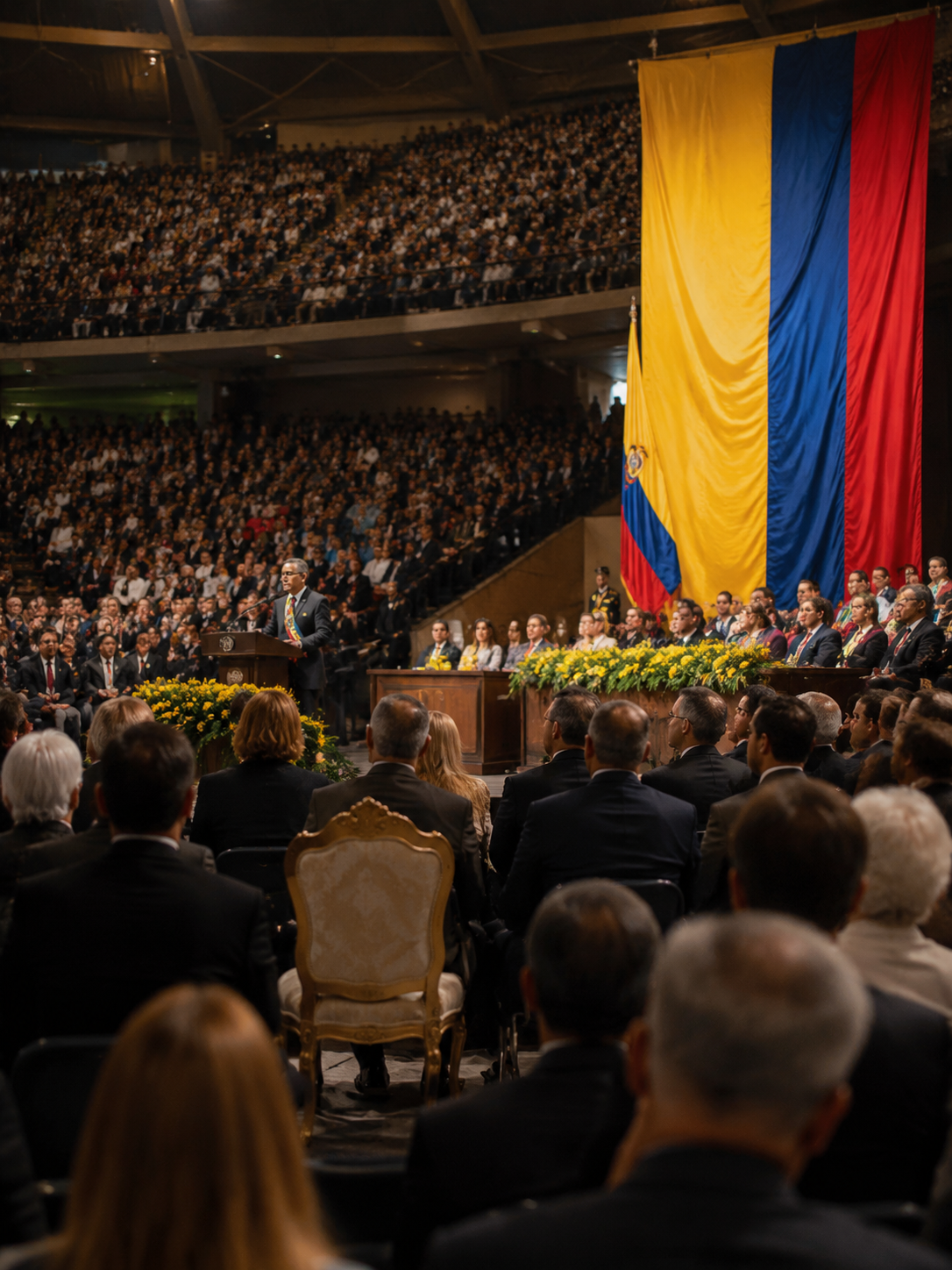
哥伦比亚新总统的宣誓仪式,从首都波哥大改到了卡利。前总统锁了军营,自己也没到场。
Colombia Moves Presidential Inauguration to Cali
About this story
Colombia Moves Presidential Inauguration to Cali. HSK 2 Chinese listening practice.
This is an HSK 2 Chinese listening episode that runs about 3 minutes. The full Mandarin script is shown with tap-for-pinyin and a line-by-line English translation, so you can listen and read at once — comprehensible input in the sense of Stephen Krashen's i+1 theory. It teaches 10 key vocabulary words such as 人口、做法、城市 and walks through 3 grammar patterns, each explained in English with examples. The same news story is retold at 4 difficulty levels — use the level selector above to find the version that is challenging but still understandable for you.
Read at your level
原文Read the complete story in Chinese. Reveal pinyin and English only when you need them.
English transcript reference
Today, Colombia got a new president.
Colombia is in South America, with a population of over fifty million — a big country.
In many countries, changing presidents works the same way.
The new president has to stand in front of a lot of people and say a passage aloud.
Only once he has said it is he really the president.
This is what is called an inauguration.
Colombia's, today, began at three in the afternoon.
For more than a hundred years, Colombia's inaugurations were all in the same city: Bogotá.
Bogotá is the largest city in the country.
But this time, it was not in Bogotá. It was in a city called Cali.
Cali is in the west of Colombia, also a big city, but it is not the capital.
Why change the location?
There is a sizeable problem behind it.
The place the new president first wanted was a military site.
The kind of place with a lot of soldiers, and a lot of guns.
A lot of people heard that and said: this will not do.
In Colombia, the country's big occasions cannot be held inside the army.
People who understand the constitution also said this was wrong.
Because in this country the army has to obey the president, and the president must not stand on the army's side.
The previous president is called Petro.
Petro was extremely angry.
He did one thing: he shut every military site, so the new president could not use them.
He also said a sentence that a lot of people repeated afterwards.
He said: the president obeys the people, not the army.
So now the new president could not go to a military site at all.
Neither side wanted to give way, the matter stalled there, and nobody could move.
People thought about it for a long time, and finally came up with an answer: go to Cali.
Cali has a university, and inside the university there is a very large hall.
At three this afternoon, in that hall, the new president became president.
More than six thousand people came.
Among them were the King of Spain, the President of Argentina, and officials from America.
And Petro?
Petro did not come.
He kept saying he would not come, and in the end he really did not.
Think about it: in your country, where is it usually done when a new leader takes over?
Listen again
Try it without the transcript and notice what sounds clearer.
What vocabulary does this episode teach?
词汇人口五千多万 = a population of over fifty million.
都有一样的做法 = it works the same way.
最大的城市 = the largest city.
想出一个办法 = came up with a solution.
他一直说他不会来 = he kept saying he would not come.
Introduces the reason. Often the clause comes second in Chinese.
The head of state in Colombia.
Glossed in the episode: standing before people and saying the passage aloud.
不能在军队里做 = it cannot be held inside the army.
懂宪法的人 = people who understand the constitution.
* beyond level超纲词
What grammar patterns appear in this episode?
语法这样一来
"as a result of that / that being so" — links a consequence to what was just said.
这样一来,新总统就去不了军队的地方了。
V 不了
"cannot V" because circumstances prevent it, not because of ability.
新总统就去不了军队的地方了。
Proper Nouns
专有名词Sources
来源Free account
Keep learning from this story
Create a free account to keep saved words and your preferred level together.
- Keep words with their story context
- Remember your preferred level
- Build your vocabulary over time