
A Chinese podcast · Same story, 4 levels
达拉斯垃圾车给房屋打“破旧分”
Dallas Trash Trucks Give Homes AI Blight Scores
About this story
Dallas AI cameras flag 21,000 properties from trash trucks, sparking privacy, fairness and cost debates. HSK 5-6 Chinese listening practice.
This is an HSK 5-6 Chinese listening episode that runs about 5 minutes. The full Mandarin script is shown with tap-for-pinyin and a line-by-line English translation, so you can listen and read at once — comprehensible input in the sense of Stephen Krashen's i+1 theory. It teaches 16 key vocabulary words such as 普通、发现、最后 and walks through 5 grammar patterns, each explained in English with examples. The same news story is retold at 4 difficulty levels — use the level selector above to find the version that is challenging but still understandable for you.
Read at your level
原文Read the complete story in Chinese. Reveal pinyin and English only when you need them.
English transcript reference
Every morning, an ordinary garbage truck drives past your front door.
You hear it and know it is time to roll out the trash bin.
But you may not know that the truck now does more than collect trash.
It also takes pictures and scores your house.
That is what Dallas is doing.
Dallas is a large city in the US state of Texas.
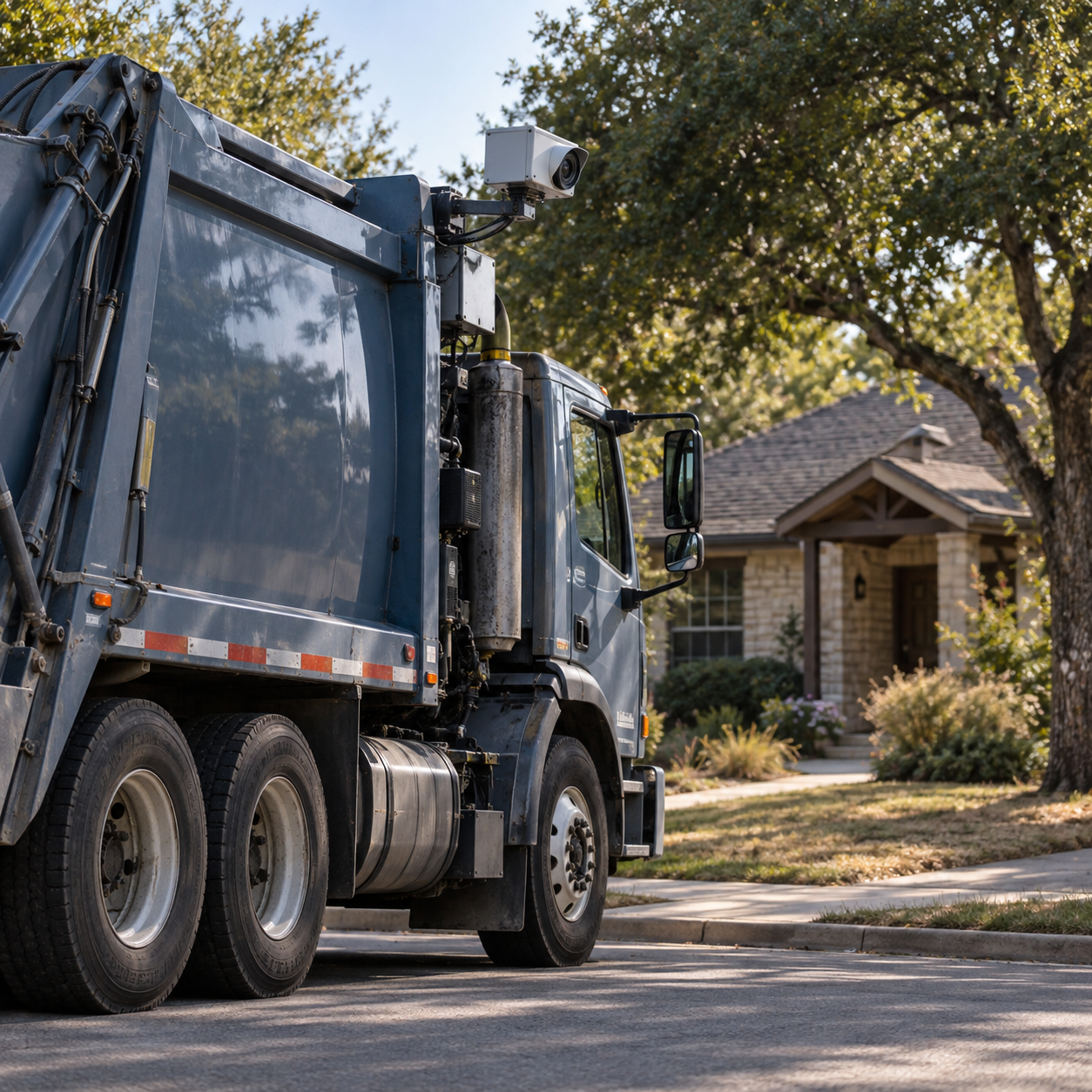
Since April 2026, Dallas has installed cameras on fifty garbage trucks.
Each truck has two cameras, one on the left and one on the right.
Fifty trucks means one hundred cameras in total.
The cameras face houses along the road and take pictures as the trucks move.
Whichever road the truck takes, the cameras photograph that road.
Afterward, computer software examines the photos.
The software looks for problems: tall grass, excess trash, damaged sidewalks, long branches, peeling paint, and discolored chimneys.
When it finds a problem, the software gives the house a score.
The score is called a blight score.
Scores range from one to four, with four being the most serious.
Since April, more than twenty-one thousand properties in Dallas have been flagged.
Twenty-one thousand is no small number.
But being flagged does not mean an immediate fine.
Dallas city officials say the computer only helps find possible problems.
A person makes the final decision.
City employees examine every photo to confirm whether a problem is real.
After confirmation, the city first sends a courtesy notice.
The letter says: there is a problem in front of your home, so please address it.
So far, about eighteen hundred such letters have been sent.
If you receive a letter and do nothing, a fine may come later.
So the computer does not issue tickets directly.
That point matters because many people misunderstood it.
One resident received a letter.
It said his chimney was the wrong color and needed repainting.
The resident believed the chimney had simply aged normally and that the notice made no sense.
He later learned that a garbage truck had photographed his house as it passed.
He felt the inspection resembled surveillance with no advance notice.
He is not alone in feeling this way.
Many Dallas residents share the same concern.
They worry about privacy.
The garbage truck passes your home every day, photographing your house and your yard.
Although the city says faces and license plates are blurred and the system is not linked to police or federal databases,
residents still feel uneasy.
There is another issue: fairness.
Data show that many of the flagged properties are in southern Dallas.
The south has many low-income communities whose residents have less ability to pay for repairs.
Some therefore question whether automated inspections put more pressure on people with less money.
A Dallas city council member is named Chad West.
He proposed removing funding for the camera project.
But he later withdrew the request for the time being.
The city manager promised him a December hearing where residents could speak.
So the matter is not over.
Why does the city want to do this?
Its reason is simple: efficiency.
Previously, finding these problems required sending people to drive around and inspect.
A city is large, staffing is limited, and workers cannot see everything.
Now garbage trucks already travel throughout the city every day.
Taking photos along the way requires no extra staff.
The city says this finds neglected properties faster and helps improve neighborhoods sooner.
Officials also stress that the computer does not issue fines directly and staff still make the final judgment.
Critics argue that efficiency does not answer concerns about privacy and fairness.
Residents want to know how houses are scored, how photos are stored, and how they can challenge a finding.
These questions will be central to the December hearing.
How much does the project cost?
Reports say Dallas signed a three-year contract worth about 2.5 million dollars with a company called City Detect.
The money comes from the city budget, meaning taxpayers pay for it.
Residents therefore have the right to ask: is it worth the money?
Dallas is not the only city using this technology.
Other places in the United States are also testing it.
Dallas flagged more than twenty-one thousand properties at once, drawing widespread attention to its approach.
If you live in Dallas, your garbage truck may already have photographed your home.
Have you received a letter like that?
Do you think government photos from garbage trucks are helpful or invasive?
Think about it: if your city did the same thing, would you agree?
Listen again
Try it without the transcript and notice what sounds clearer.
What vocabulary does this episode teach?
词汇HSK 3. Contrasts the truck’s appearance with its new role.
HSK 3. Used for finding possible code violations.
HSK 3. 最后做决定的是人 stresses human review.
HSK 3. Used for official decisions.
HSK 2. Emphasizes a key distinction.
HSK 4. Used for a proposal to remove funding.
HSK 4. The city’s stated reason for the system.
HSK 4. Introduces the city’s defense of human review.
A side-facing camera mounted on a garbage truck.
The AI score from one to four assigned to a property.
A warning letter sent before a possible fine.
Watching people or property closely.
A computer-assisted process for flagging properties.
A formal meeting where residents can speak.
A person whose taxes fund the city budget.
Used in the question of whether photography invades privacy.
* beyond level超纲词
What grammar patterns appear in this episode?
语法不只是……还……
Adds a second, unexpected function.
这辆垃圾车现在不只是收垃圾。
它还在拍照,在给你的房子打分。
哪……就……
Means that the second action follows whichever option occurs.
垃圾车走哪条路,摄像头就拍哪条路。
不等于……
Distinguishes two ideas that should not be treated as identical.
但被标记不等于马上罚款。
Acknowledges one fact before presenting a contrasting response.
虽然市政府说,人脸和车牌都模糊处理了,系统也不跟警察局或联邦数据库连接。
但居民还是不安心。
会不会……
Forms an embedded yes-or-no question about possibility.
有人因此质疑,自动化检查会不会把更多压力放在钱更少的人身上。
Proper nouns
专有名词Sources
来源Free account
Keep learning from this story
Create a free account to keep saved words and your preferred level together.
- Keep words with their story context
- Remember your preferred level
- Build your vocabulary over time