
A Chinese podcast · Same story, 4 levels
海边来了一条大死鱼
Sperm Whale Carcass Closes Four Sydney Beaches
About this story
A big dead whale at Era Beach in Sydney closes four beaches inside Royal National Park, including Garie. HSK 2 Chinese listening practice.
This is an HSK 2 Chinese listening episode that runs about 6 minutes. The full Mandarin script is shown with tap-for-pinyin and a line-by-line English translation, so you can listen and read at once — comprehensible input in the sense of Stephen Krashen's i+1 theory. It teaches 18 key vocabulary words such as 新闻、重、动物 and walks through 7 grammar patterns, each explained in English with examples. The same news story is retold at 4 difficulty levels — use the level selector above to find the version that is challenging but still understandable for you.
Read at your level
原文Read the complete story in Chinese. Reveal pinyin and English only when you need them.
English transcript reference
Recently in Australia, there's a news story.
The news says: a very big fish has arrived at the beach.
This fish is eight meters long.
It also weighs twenty-five tons.
Twenty-five tons is about as heavy as thirty cars.
Very heavy.
This big fish is called a whale.
A whale is the biggest animal in the ocean.
Actually it's not a fish — it's a mammal.
But it has always lived in the sea.
So everyone calls it a big fish.
This whale is called a "sperm whale."
A sperm whale is one of the biggest kinds of whale.
How did this sperm whale get here?
It died in the ocean.
After it died, seawater carried it to the shore.
Now it's lying on rocks by the beach.
The name of this beach is Era Beach.
Era Beach is south of Sydney.
Sydney is a big city in Australia.
Near Era Beach there's a park.
This park is called "Royal National Park."
Normally, lots of people love going there.
Some go swimming, some go for walks, some go to look at the sea.
But right now, it's closed.
Not just one beach is closed.
All four beaches are closed.
The four beaches are called:
Era, Garie, Wattamolla, and Burning Palms.
They all sound nice.
But right now, none of them can be visited.
Why are they all closed?
Because of the dead whale.
The dead whale has caused two problems.
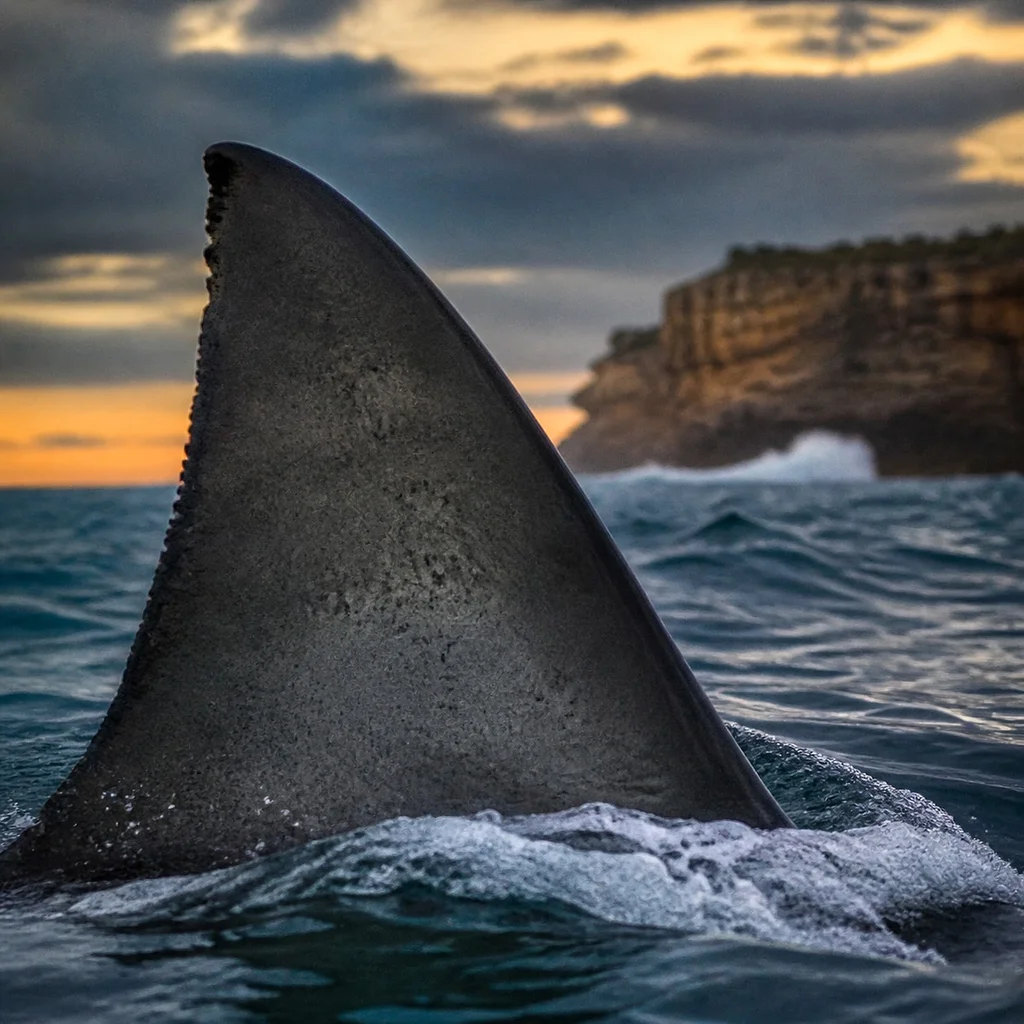
The first problem: sharks have come.
Sharks are a kind of fish in the sea.
Sharks have a lot of teeth.
Sharks are very hungry.
The dead whale has a lot of meat.
So when sharks smell it, they all come.
The sharks swim over and eat this whale.
Quite a few sharks have come.
There are great white sharks.
There are also bull sharks.
All big sharks.
People can't go in the water.
Going in the water would be dangerous.
Sharks bite people.
So everyone says: don't go in the water.
Don't swim.
Don't surf.
Just stand on the shore and watch.
The second problem: the whale will stink.
Dead animals stink.
The whale is huge, so it stinks especially badly.
Inside it, there will also be a lot of gas.
What kind of gas?
You can't see it, but you can smell it.
There's more and more gas.
The whale's belly gets bigger and bigger.
One day, it might "pop" open.
Like one really, really big balloon.
Just imagine — that scene is a bit scary.
So people also can't walk too close.
Not only can't go in the water, but also have to stay back on shore.
What can be done?
Park staff are figuring out a plan.
They want to haul the whale away.
But this whale is too big and too heavy.
Vehicles can't get there.
That rocky spot is hard to walk through.
Staff say: it might take a few days.
Their plan is to first push the whale back into the sea.
Let the seawater carry it away.
Then move it somewhere else.
That place specializes in handling things like this.
The man working on it is named Neilly.
He has worked at the park for many years.
He says: this kind of thing looks scary.
But really, it's a natural event.
The whale dies, sharks eat.
After sharks finish, the whale goes back into nature.
He says, this is just how nature works.
It sounds interesting.
There's another man working on it named Pearce.
He's in charge of beach safety.
He says: these next few days, everyone, don't go in the water.
Listen to the park.
Why can't people go in the water?
Because big sharks really are out there.
Someone saw them, said the sharks are huge.
Right now, every day people go to look.
Not to swim — to look at the whale.
Some people find it interesting.
Some people find it sad.
But everyone stands far away.
No one dares to go too close.
No one dares to go in the water.
Back to today.
Today, the whale is still there.
The four beaches are still closed.
The sharks are still in the water.
The gas is still inside the whale's belly.
Everyone is waiting.
Waiting for the whale to be moved.
Waiting for the sea to get clean again.
Waiting for the beaches to open again.
So what does this news tell us?
First, the world by the sea is huge.
There are things in it we don't see.
Second, a dead whale isn't just dead.
It also has a story.
And there are still problems to solve.
Third, when we see something like this,
we should listen to the staff.
Don't, out of curiosity,
walk too close, go in the water, or take photos up close.
That's bad for yourself.
Bad for the whale too.
Bad for the sharks too.
The best thing to do is: stand back, take a look, and walk away.
That's the news story.
One big whale.
Four beaches.
Many sharks.
And a problem that has been waiting a long time.
Listen again
Try it without the transcript and notice what sounds clearer.
What vocabulary does this episode teach?
词汇HSK 4 but very common. 一个新闻 = one news story. 这个新闻告诉我们什么 = what does this news tell us?
HSK 3. 二十五吨重 = 25 tons heavy. 越来越重 = heavier and heavier. Opposite is 轻 (light).
HSK 3. 海里最大的动物 = the biggest animal in the sea. Whales are 动物, not 鱼.
HSK 3. 一个很大的城市 = a very big city. 悉尼是澳大利亚一个很大的城市.
HSK 3. 国家公园 = national park. The whale is at the edge of one.
HSK 2. 两个问题 = two problems. 解决问题 = solve a problem.
HSK 4. 下水会有危险 = going in the water would be dangerous. Opposite of 安全 (safe).
HSK 2. 不能游泳 = cannot swim. Both verb and noun.
HSK 3. 工作人员 = staff member (literally 'working person'). Both verb and noun.
HSK 4. 大自然 = nature. 自然的事 = a natural event. Neilly's whole point: this is 自然 in action.
Beyond. 鲸 (whale) + 鱼 (fish). Glossed inline: 鲸鱼是海里最大的动物.
Beyond. 鲨 (shark) + 鱼 (fish). 大白鲨 = great white shark, 公牛鲨 = bull shark.
Beyond. 抹香 (a type of fragrance) + 鲸 (whale) — named for the waxy substance in its head. Glossed inline: 抹香鲸是鲸鱼里很大的一种.
Beyond HSK 2. 海 (sea) + 滩 (shore). Four 海滩 are closed in the story.
Beyond HSK 2. 冲 (rush) + 浪 (wave). 不要冲浪 = don't surf. Common at Australian beaches.
HSK 6. The episode mentions but doesn't lean hard on it. 死的鲸鱼会有细菌 = a dead whale has bacteria.
HSK 4-5. 处理这种东西 = handle things like this. The professional verb for dealing with something properly.
HSK 5. 好 (much) + 奇 (strange/curious). 因为好奇 = out of curiosity. The episode warns against being TOO 好奇.
* beyond level超纲词
What grammar patterns appear in this episode?
语法X 是 ...,Y 是 ...
Listing structure for 'A is X, B is Y'. Used here to introduce parallel ideas (one thing, then another).
第一个问题是:鲨鱼来了。
第二个问题是:鲸鱼会臭。
其实它不是鱼,是动物。
因为 ... 所以 ...
Cause-effect connector. Either half can be omitted, but the textbook form uses both.
所以鲨鱼闻到味道,就都来了。
鲸鱼太大,所以它特别臭。
因为那条死鲸鱼。
把 + Object + Verb + Result
Disposal construction. Frontloads the object so the verb can carry a result/disposal.
海水把它送到了海边。
他们想把鲸鱼运走。
他们打算先把鲸鱼推回海里。
X 越来越 + Adj
'More and more X.' Describes a state that keeps changing in one direction.
气越来越多。
鲸鱼的肚子越来越大。
不只是 ... + 也 / 还 ...
'Not only ... also ...' Used to add a parallel point.
不只是一个海滩关了。
不只是不能下水,岸上也要离远一点。
Verb + 来 / 走 (directional complement)
Adding 来 or 走 after a verb tells you the direction. 来 = toward speaker, 走 = away.
海水把它送到了海边。
他们想把鲸鱼运走。
现在它躺在海边的石头上。
对 X 来说
Topicalizer: 'For X, ...' or 'From X's perspective, ...'.
对自己不好。
对鲸鱼也不好。
对鲨鱼也不好。
Proper nouns
专有名词Free account
Keep learning from this story
Create a free account to keep saved words and your preferred level together.
- Keep words with their story context
- Remember your preferred level
- Build your vocabulary over time