
A Chinese podcast · Same story, 4 levels
当鲸鱼变成炸弹:悉尼四个海滩为什么被一头死鲸鱼关了
Sperm Whale Carcass Closes Four Sydney Beaches
About this story
A 25-ton sperm whale carcass at Era Beach closes four Sydney beaches inside Royal National Park, including Garie. HSK 5-6 Chinese listening practice.
This is an HSK 5-6 Chinese listening episode that runs about 7 minutes. The full Mandarin script is shown with tap-for-pinyin and a line-by-line English translation, so you can listen and read at once — comprehensible input in the sense of Stephen Krashen's i+1 theory. It teaches 20 key vocabulary words such as 巨大、估计、嗅觉 and walks through 8 grammar patterns, each explained in English with examples. The same news story is retold at 4 difficulty levels — use the level selector above to find the version that is challenging but still understandable for you.
Read at your level
原文Read the complete story in Chinese. Reveal pinyin and English only when you need them.
English transcript reference
This week in Australia, something happened that sounds like the opening of a movie — but it's real.
Last Saturday, on Era Beach south of Sydney, a giant sperm whale appeared — dead.
Experts estimate it had already been dead in the open ocean for several weeks before the currents pushed it ashore.
Eight meters long, twenty-five tons heavy — about the weight of thirty small cars.
It lay on rocks battered by the waves, strips of flesh hanging down and swaying gently in the wind.
Liquid dripped down nearby, and flies swarmed around it.
The image is unsettling, but the more serious problem isn't the image — it's what happened next.
First, all four beaches of the Royal National Park — Era, Garie, Wattamolla, Burning Palms — were closed.
No swimming, no surfing, no snorkeling.
There are two reasons, and each is hardcore.
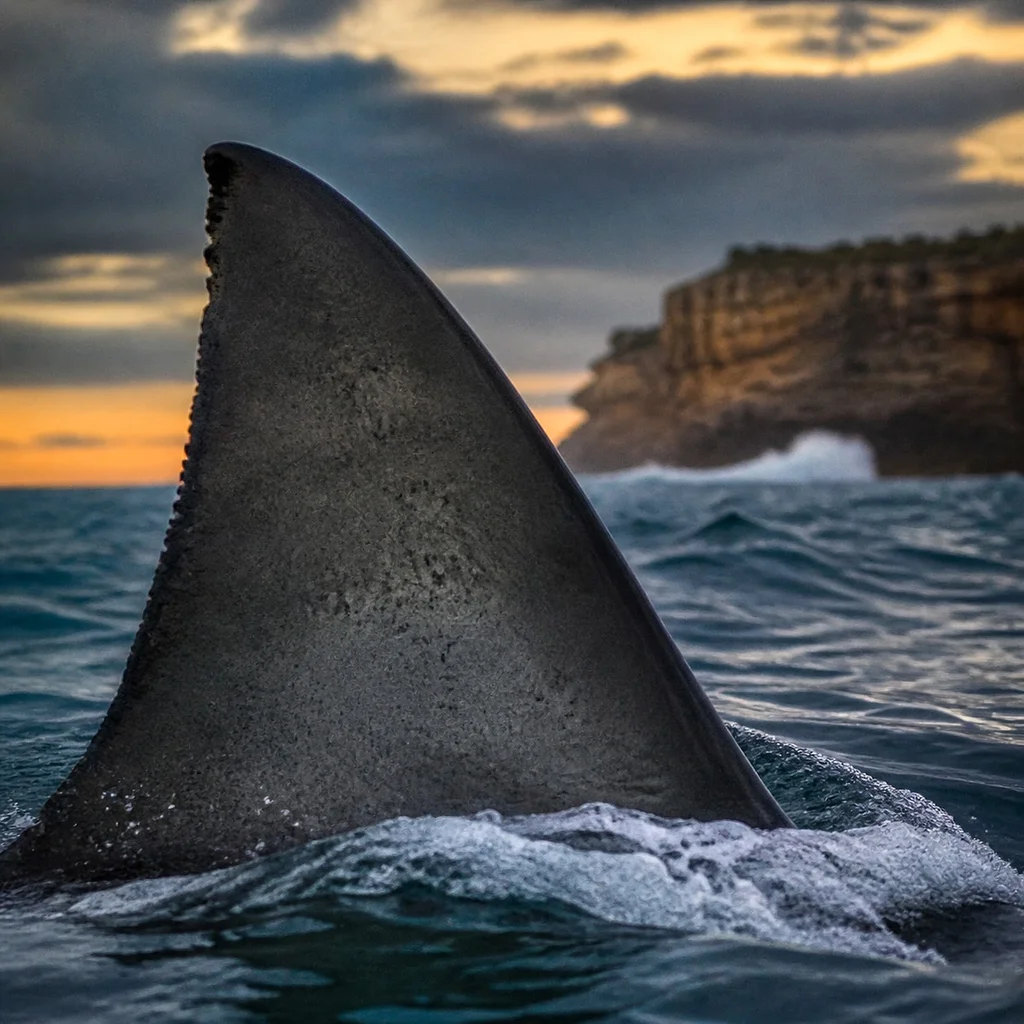
The first reason is sharks.
A dead whale, to a shark, is a banquet laid out on a table.
A shark's sense of smell is extremely keen.
Within a radius of several kilometers, as long as there's a body this size, sharks will follow the smell and swim over.
And the ones that came this time are the species everyone fears most — great whites, bull sharks, tiger sharks.
Pearce, the head of Surf Life Saving NSW, said: "larger white sharks and bull sharks" had appeared in the water.
A fisherman captured video and said the great white he saw was "very large."
So the official stance is blunt: don't go in the water these next few days — risking your life for one photo or one surf isn't worth it.
The second reason is more surprising than sharks, but also more interesting.
It's the whale itself.
A dead whale will explode.
It sounds dramatic, but it's just middle-school biology.
Once a whale dies, the bacteria inside its body start breaking down proteins and fats.
The breakdown process produces large amounts of gas — mainly methane and hydrogen sulfide.
The gas can't escape, and gets trapped inside that already very airtight, big belly.
The belly inflates like a balloon, getting bigger and bigger.
The skin keeps holding, but the pressure inside keeps rising.
At some critical point, "boom," the whole whale ruptures from inside.
This isn't an internet meme — it's a real event that has happened many times.
The most classic example is from 1970 in Oregon, USA.
That time too, a big dead whale washed ashore, and no one knew what to do.
The relevant authorities came up with a "great idea": use dynamite to blow the whale apart, and let the seagulls clean up the rest.
The result: too much dynamite.
The whale was blown into countless pieces of whale meat, flying hundreds of meters.
Several large chunks slammed straight into a distant parking lot, crushing a brand-new car flat.
The half that didn't blow open stayed on the beach, untouched, reeking.
That incident was filmed in full by a TV station, and to this day it's classic internet footage.
2013 in the Faroe Islands, 2004 in Taiwan — similar "whale explosions" have happened.
So today's officials all understand: handling a dead whale is not something to take for granted.
Back to this whale in Sydney.
The park management's current plan is to first push the sperm whale back into the sea.
Let the waves and currents carry it away from the rock platform.
Then a boat will tow it to a dedicated waste-handling site for further processing.
It sounds like a simple logistics problem.
But handling a 25-ton whale is far more complex than it looks.
First, vehicles can't reach that rock platform.
To bring in heavy machinery, you'd need to build a road first, or arrange a boat from the sea.
Second, you have to watch the tide.
At high tide the whale has more buoyancy, so it's easier to push.
At low tide, it sits there heavily and no one can budge it.
You also have to watch the wind, the weather, and the sharks.
The park manager Neilly said something interesting.
He said: this kind of scene certainly is a bit shocking for people.
But from nature's perspective, this is a very natural event —
"The sharks are putting this whale's body back into the food chain."
Meaning: when the whale was alive, it ate fish.
After it died, sharks eat it, and small ocean creatures eat it.
In the end, every gram of its meat returns to the sea.
This is a phenomenon called a "whale fall."
After a whale dies, its body slowly sinks to the deep sea, and finally rests on the seafloor.
For deep-sea ecology, this is an enormous windfall.
Down there, there's almost no food — having a body this big is unimaginable luxury.
First, sharks, octopuses, and other large creatures come to tear at it.
Then crabs, starfish, and small fish come to nibble.
Later still, strange microbes will make a home in its bones, living off the bone oil for decades.
Some scientists say the body of one large whale can sustain a patch of deep sea for decades.
In other words, the death of one whale is the beginning for countless other creatures.
This is rather romantic — but only if it sinks down, instead of washing ashore.
Once it washes ashore, it becomes a problem for human society to solve.
So is this scary?
Yes.
But on a larger scale, it's nature doing what it's always done.
There's one more useful detail to add.
Experts remind us that even if you're standing on shore, it's best not to walk too close.
The reason isn't fear of being blown up.
It's because dead whales carry bacteria, which can travel through tiny droplets in the air to humans.
Some bacteria can also cause zoonotic disease — that is, animal diseases that jump to humans.
So the safest approach is: look from afar — don't reach out to touch, don't climb on it for a photo, and definitely don't let kids touch its skin.
Back to the heart of the matter.
A 25-ton dead whale brought four beaches next to a major city to a simultaneous halt.
Behind it, three things are happening at once: a school of big sharks drawn by the scent, a slowly-expanding pocket of internal gas, and a human society that can't outrun nature's rules and can only respond slowly.
What we can do, in fact, is very little — just stand back, and let the sea digest this on its own rhythm.
Then, when the water is clean again, the sharks have returned to the deep, and the beaches reopen, we can go back into that beautiful water.
This kind of "waiting" is the simplest, and the hardest, lesson nature teaches us.
That's the most interesting news story this week from Australia.
The death of one sperm whale strung together a group of people, a group of sharks, and the rhythm of an entire coastline.
It sounds like an absurd play, but it's a very natural phenomenon.
It sounds disturbing, but it's a cycle the Earth performs every day.
Step back and look — and you'll find this is what the ocean really looks like.
Listen again
Try it without the transcript and notice what sounds clearer.
What vocabulary does this episode teach?
词汇HSK 5. 巨 (giant) + 大 (big). 巨大的抹香鲸 = a huge sperm whale. Stronger than 很大.
HSK 4. 专家估计 = experts estimate. Common in journalism for hedging.
HSK 6. 嗅 (sniff) + 觉 (sense). The shark's 嗅觉极其灵敏 — sets up the whole shark-feeding scene.
HSK 5. Used for senses, instruments, reactions. 嗅觉灵敏 = keen sense of smell.
HSK 6. 一具尸体 = one corpse (measure word 具 specific to bodies). Neutral, journalistic register.
HSK 5. 一个特别的现象 = a special phenomenon. Used for natural or social patterns. 鲸落 is the 现象 here.
HSK 6. 慢慢应对 = respond slowly. Used for handling situations strategically.
HSK 5. 大海按它自己的节奏 = the sea moves at its own pace. The episode's closing motif.
HSK 5-6. 地球每天都在做的循环 = a cycle the Earth performs daily. Used for natural and economic cycles.
HSK 1-4. society.
Beyond. The largest toothed whale, named for the waxy spermaceti in its head. The species at the center of this story.
Specialist term. 鲸 (whale) + 落 (fall). Glossed inline as the whole ecosystem that lives off a sunken whale for decades.
HSK 6. 蛋白 (egg white) + 质 (substance). The first thing bacteria break down inside the carcass.
HSK 6. 脂 (grease) + 肪 (fat). Whale blubber is mostly 脂肪.
Specialist (chemistry). The main flammable gas produced by decomposition.
Specialist (chemistry). The other major decomposition gas — gives the rotten-egg smell.
HSK 6+. 临 (approach) + 界 (boundary) + 点 (point). The moment of explosive change.
Specialist. 礁 (reef) + 石 (stone). The wave-swept rocks where the whale is stuck.
HSK 6+. 食物 (food) + 链 (chain). Neilly's framing: the sharks are returning the whale to the 食物链.
Specialist (medical). Glossed inline by the script. The reason you don't touch a beached carcass.
* beyond level超纲词
What grammar patterns appear in this episode?
语法X 一旦 ... 就 ...
'Once X, then Y.' Stronger and more formal than 一 ... 就 .... Often used for irreversible changes.
鲸鱼一旦死亡,体内的细菌就开始分解蛋白质和脂肪。
一旦冲上岸,它就成了人类社会要解决的麻烦。
X 是 Y, 而是 Z (corrective)
Corrective structure: 'X is not A, but rather B.' Used for emphatic clarification.
更要命的不是这画面,而是接下来发生的事。
这不是网络段子,是真实发生过很多次的事。
其实是另一种生。
被 + (Agent) + Verb (passive)
Mandarin passive marker. The agent can be omitted to depersonalize. Strong association with formal/journalistic register.
被洋流一路推到了岸边。
鲸鱼被炸成无数块鲸鱼肉。
那次事件被电视台全程拍下来。
不是 ... 而是 ... (alternation between two views)
Used to contrast two interpretations of the same event.
原因不是怕被炸。是因为死鲸鱼身上有细菌。
更要命的不是这画面,而是接下来发生的事。
X 听起来 / 看起来 ...,其实 ...
Hedging frame. 'On the surface...' Sets up a reveal that the deeper truth is different.
听起来夸张,其实是初中生物。
听起来像电影开头,但是是真的。
听起来像一个简单的物流问题。
把 + Object + Verb + Result (disposal)
Disposal construction with explicit result.
海水把它推到了海边。
把这头抹香鲸推回海里。
重新送回食物链。
对 X 来说
Topicalizer: 'For X, ...' or 'From X's perspective, ...'.
死鲸鱼对鲨鱼来说,是一桌摆好的盛宴。
对深海生态来说,这是一笔巨大的财富。
他说:这种场面对人来说确实有点冲击。
也就是说 ...
'That is to say' — used to restate or clarify in a more formal, expository register than 就是.
也就是说,鲸鱼活着的时候吃了鱼。
也就是说,一头鲸鱼的死,是无数其他生物的开始。
Proper nouns
专有名词Free account
Keep learning from this story
Create a free account to keep saved words and your preferred level together.
- Keep words with their story context
- Remember your preferred level
- Build your vocabulary over time