
A Chinese podcast · Same story, 4 levels
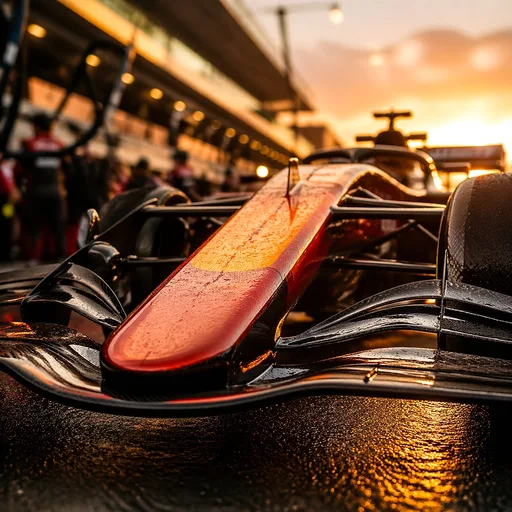
F1大变天:新规则到底改了什么?
F1's 2026 Rules Reshape the Grid
About this story
F1's 2026 rules reset the sport — Audi joins, Honda and Ford return, Red Bull builds its own engine for a new F1 era. HSK 3 Chinese listening practice.
This is an HSK 3-4 Chinese listening episode that runs about 7 minutes. The full Mandarin script is shown with tap-for-pinyin and a line-by-line English translation, so you can listen and read at once — comprehensible input in the sense of Stephen Krashen's i+1 theory. It teaches 14 key vocabulary words such as 环境、情况、结果 and walks through 6 grammar patterns, each explained in English with examples. The same news story is retold at 4 difficulty levels — use the level selector above to find the version that is challenging but still understandable for you.
Read at your level
原文Read the complete story in Chinese. Reveal pinyin and English only when you need them.
English transcript reference
This year's F1 has really had a huge shakeup.
A whole bunch of rules were changed.
The car design changed.
The engine changed.
The way you overtake also changed.
It's probably the biggest change in the last ten years.
Let's talk about what exactly changed.
First, the changes to the cars.
This year's F1 cars are smaller, lighter, and narrower than before.
The wheelbase got shorter.
The wheelbase is the distance between the front and rear wheels.
After getting shorter, the car is more agile.
Better performance in corners.
The tires also got narrower.
Narrower tires have less resistance.
The car can go faster.
And after getting lighter.
There's less wear on the brakes and tires too.
Overall the car has become more agile.
It also looks better.
Now let's talk about the most important change.
That's the power system.
Before, F1 cars got about eighty percent of their power from gasoline.
Twenty percent from electricity.
This year it's completely flipped.
Now it's fifty percent gasoline fifty percent electricity.
Fifty-fifty.
The electric motor's power went from 120 kilowatts to 350 kilowatts.
That's about a three-times increase.
This change is really big.
Why make this change?
There are two reasons.
First is the environment.
Using more electricity means burning less oil.
Less emissions.
Better for the environment.
Second is to attract new manufacturers.
Before, F1 engines were too complicated.
There was something called MGU-H.
It's a device that generates electricity from waste heat.
This thing was very expensive.
Very hard to make.
Many companies didn't want to join F1 because of it.
This year they removed the MGU-H.
The engine got simpler.
So Audi came.
Honda also came back.
Red Bull partnered with Ford.
Now there are five engine manufacturers total.
That's the most in many years.
Speaking of fuel.
This year's fuel is also different.
Before they used regular gasoline.
This year they use sustainable fuel.
What is sustainable fuel?
It's fuel made from garbage, waste, and carbon from the air.
Not petroleum dug from underground.
After burning this fuel, emissions are less.
Better for the environment.
F1 is the first top racing series to use this fuel.
They want to prove that speed and being eco-friendly can exist at the same time.
Now let's talk about another very important change.
That's aerodynamics.
Before, the cars had very long tunnels under them.
Used to create downforce.
Downforce is the force that pushes the car down onto the ground.
This year those tunnels got shorter.
The floor got flatter.
The diffuser got bigger.
The diffuser is that thing under the back of the car.
Total downforce has decreased.
What does this mean?
It means corner speeds will be a little slower.
But straight-line speed will be a little faster.
And the car in front has less effect on the car behind.
Before, when following another car.
The air got all mixed up.
The car behind would lose a lot of downforce.
Very hard to follow closely.
This year that problem is much better.
The car behind can follow the car in front more easily.
Now let's talk about DRS.
DRS used to be for overtaking.
If you were within one second of the car ahead.
You could open the rear wing.
Less resistance.
Faster speed.
Then overtake.
This year DRS is gone.
Replaced by active aerodynamics.
What does that mean?
Both front and rear wings can move.
On straights the wings open.
Less resistance.
In corners the wings close.
More downforce.
And this feature is available to all drivers.
No need to be behind someone else.
But if you're less than one second behind the car in front.
You can use an extra feature called Overtake Mode.
Overtake Mode gives you extra electric power.
Gives you more force to overtake.
This design is fairer than the old DRS.
And more technically interesting.
This year also brought new teams and manufacturers.
Audi makes their own engine.
They build it themselves.
Cadillac joined as a new team.
Using Ferrari's engine.
Honda came back.
Providing engines to Aston Martin.
Red Bull no longer uses Honda engines.
They partnered with Ford to make their own.
Mercedes now provides engines to four teams.
Their own team, Williams, McLaren and Alpine.
Competition is more intense than before.
Lastly let's talk about safety.
Safety is always the most important thing.
This year's safety standards have been raised.
The survival cell where the driver sits has stricter testing.
The roll hoop can handle twenty-three percent more force.
What does that mean?
It can support the weight of nine family cars stacked on top.
The front crash structure also changed.
Now it absorbs impact in two stages.
If there's a second impact after the first crash.
It can still protect the driver.
Yesterday's crash by Bearman at the Japanese Grand Prix is an example.
The impact force reached 50G.
But he only had a minor knee injury.
No fractures.
The new safety design saved him.
To sum up.
This year's F1 has really had a huge transformation.
Smaller cars that are more agile.
Half electric half gas that's more eco-friendly.
Active aerodynamics that's more exciting to watch.
New teams and new rivals making it more competitive.
Higher safety standards giving more peace of mind.
This might be the most anticipated season in F1 history.
By the way, let me tell you about the season so far.
Three races have been completed.
Russell won in Australia.
Antonelli won in China.
Antonelli won again in Japan.
Antonelli is only twenty-one years old.
He now leads the standings with seventy-two points.
Nine points ahead of Russell.
He is the youngest championship leader in history.
What about Verstappen?
He only got eighth in Japan.
Completely different from how he dominated F1 before.
The new rules really have shaken things up.
Teams that were strong before might not be strong now.
Teams that were weak before might have gotten stronger.
This is exactly the effect the new rules wanted.
Making races more unpredictable.
Making results more suspenseful.
The next race isn't until May.
In Miami.
Let's see what surprises these new rules.
Will bring us next.
Listen again
Try it without the transcript and notice what sounds clearer.
What vocabulary does this episode teach?
词汇HSK 1-3. environment.
HSK 1-3. situation / circumstances.
HSK 1-3. result; outcome.
HSK 1-3. reason; cause.
HSK 1-3. technology / technique.
HSK 1-3. match, game.
HSK 1-3. safe / safety.
Everything changed dramatically.
Distance between front and rear wheels.
What makes the car move.
Device using exhaust heat. Removed in 2026.
Eco-friendly fuel from waste.
How air flows around the car.
Force pushing car onto ground.
* beyond level超纲词
What grammar patterns appear in this episode?
语法Proper nouns
专有名词Sources
来源Free account
Keep learning from this story
Create a free account to keep saved words and your preferred level together.
- Keep words with their story context
- Remember your preferred level
- Build your vocabulary over time