
A Chinese podcast · Same story, 4 levels
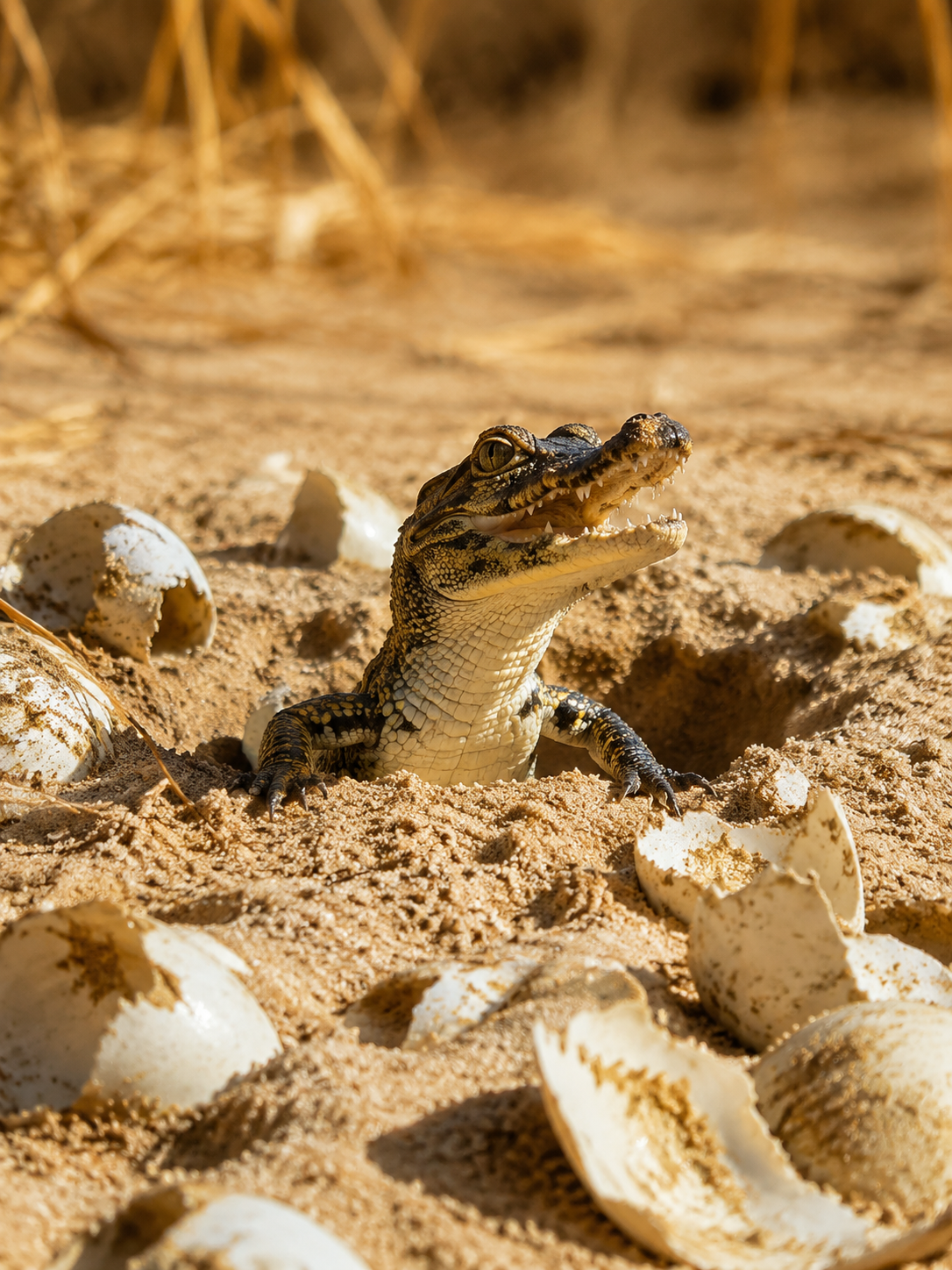
法国的鳄鱼蛋第一次没用保温箱,自己孵出来了——因为沙子整个夏天都够热。
Nile Crocodiles Hatch Without Incubator in France
About this story
Nile Crocodiles Hatch Without Incubator in France. HSK 3 Chinese listening practice.
This is an HSK 3-4 Chinese listening episode that runs about 2 minutes. The full Mandarin script is shown with tap-for-pinyin and a line-by-line English translation, so you can listen and read at once — comprehensible input in the sense of Stephen Krashen's i+1 theory. It teaches 6 key vocabulary words such as 夏天、消息、改变 and walks through 3 grammar patterns, each explained in English with examples. The same news story is retold at 4 difficulty levels — use the level selector above to find the version that is challenging but still understandable for you.
Read at your level
原文Read the complete story in Chinese. Reveal pinyin and English only when you need them.
English transcript reference
In southern France there is a park, and this summer ten crocodile eggs hatched.
No incubator was used, and nobody tended them.
Crocodile eggs need the outside temperature in order to hatch.
The temperature has to stay between thirty and thirty-two degrees the whole time.
Not for a day — for three months, held at that temperature.
A French summer usually does not reach it.
So every year in the past, the staff had to take the eggs out and put them in an incubator.
Three months later, the baby crocodiles came out.
It was a very boring job, and it had been done for many years.
This year, that job was not done.
Because France had three heatwaves this year, and fifty-two days of extreme heat — the most ever recorded.
The heat changed the sand.
By day, the sun baked the sand; at night, the sand slowly let that heat back out.
And so the sand became a natural incubator.
The daytime temperature and the night temperature became the same.
The eggs in the sand stayed above thirty degrees for three months.
And then the baby crocodiles came out — ten of them.
The director said: this is the first time incubation was completed entirely at natural temperatures.
Stop the news there and it is good news.
But he went on: this process is, above all, a marker of climate change.
He did not start with how cute the hatchlings were. He started with the climate having changed.
Because what this shows is much bigger than ten eggs.
Summer in southern France can now let a tropical animal breed outdoors.
Sand does not lie. It recorded the temperature of an entire summer.
Think about it:
Why might something that sounds like good news be bad news at the same time?
Listen again
Try it without the transcript and notice what sounds clearer.
What vocabulary does this episode teach?
词汇今年夏天 — this summer, when the eggs hatched unaided.
是一条好消息 — it is a piece of good news. Counted with 条.
高温改变了沙子 — the heat changed the sand.
一件很无聊的工作 — a very boring job. Used here as praise for a routine that worked.
孵化完全在自然的温度里完成 — incubation was completed at natural temperatures.
沙变成了一个天然的保温箱 — the sand became a natural incubator.
* beyond level超纲词
What grammar patterns appear in this episode?
语法要……才能……
"Needs X in order to be able to Y." 才 marks the condition that unlocks the result.
鳄鱼的蛋,要外面的温度才能孵化。 — Crocodile eggs need the outside temperature in order to hatch.
于是
"And so" — links a cause already given to the outcome it produced.
于是沙,变成了一个天然的保温箱。 — And so the sand became a natural incubator.
比……大得多
"Much bigger than ..." — 得多 after an adjective makes the gap large.
这件事说明的,比十个蛋大得多。 — What this shows is much bigger than ten eggs.
Proper nouns
专有名词Sources
来源Free account
Keep learning from this story
Create a free account to keep saved words and your preferred level together.
- Keep words with their story context
- Remember your preferred level
- Build your vocabulary over time