
A Chinese podcast · Same story, 4 levels
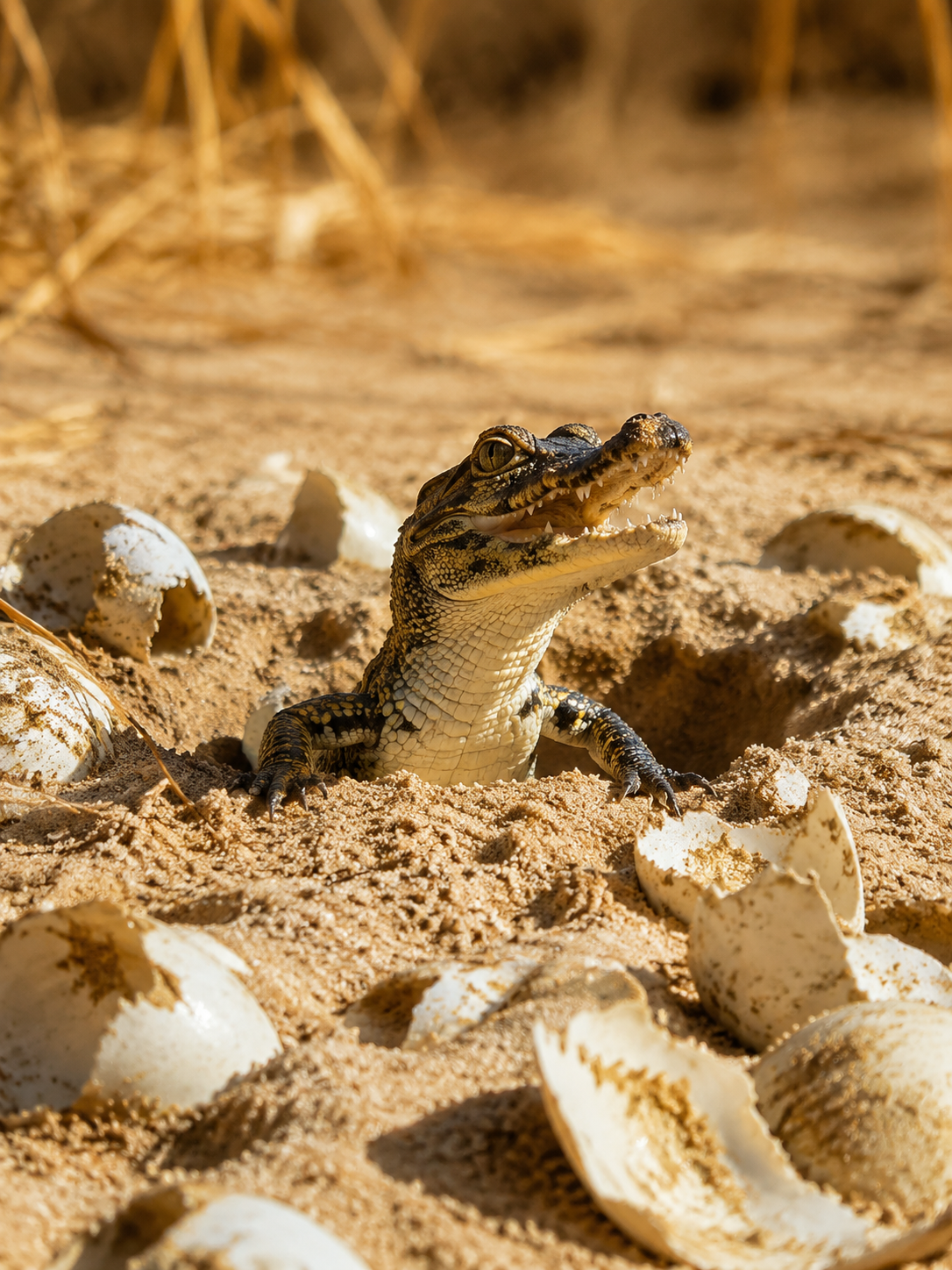
法国的鳄鱼蛋第一次没用保温箱,自己孵出来了——因为沙子整个夏天都够热。
Nile Crocodiles Hatch Without Incubator in France
About this story
Nile Crocodiles Hatch Without Incubator in France. HSK 5-6 Chinese listening practice.
This is an HSK 5-6 Chinese listening episode that runs about 2 minutes. The full Mandarin script is shown with tap-for-pinyin and a line-by-line English translation, so you can listen and read at once — comprehensible input in the sense of Stephen Krashen's i+1 theory. It teaches 6 key vocabulary words such as 温度、气候、关键 and walks through 3 grammar patterns, each explained in English with examples. The same news story is retold at 4 difficulty levels — use the level selector above to find the version that is challenging but still understandable for you.
Read at your level
原文Read the complete story in Chinese. Reveal pinyin and English only when you need them.
English transcript reference
In southern France there is a wildlife park, and this summer ten Nile crocodile eggs hatched on their own.
No incubator was used, and there was no human intervention.
First, why that is not easy: crocodile eggs are not like bird eggs. The mother does not sit on them; they depend entirely on the outside temperature.
Nile crocodile eggs need to be held steady between thirty and thirty-two degrees.
The key word is "steady": for three months, they must stay almost continuously inside that narrow band.
Too cool and the embryo stalls; too warm and there are problems just the same.
A French summer, in a normal year, simply does not get there.
So every year in the past, staff had to take the eggs out, move them into an incubator, and three months later they hatched.
It was a mature, stable, frankly boring routine.
This year, that routine was not carried out.
Because France had three heatwaves, and fifty-two days of extreme heat over the year — the most ever recorded.
Sustained heat changed the sand itself.
By day, the sun baked through the sand layer; after dark, the sand slowly released that heat again.
And so that patch of sand became a natural incubator, with the difference between day and night flattened out.
The eggs buried inside it stayed above thirty degrees for three whole months.
And then they hatched — ten of them.
Director Samuel Martin's exact words were: for the first time, incubation was completed entirely under natural conditions.
Stop the news there and it is a good story.
But he immediately added a second sentence: this process is, above all, a marker of climate change.
He did not lead with how appealing the hatchlings were, and he did not lead with the achievement. He led with the fact that the climate here has changed.
The real meaning of this lands somewhere beyond ten baby crocodiles: summer in southern France is now enough for a subtropical African animal to complete its breeding outdoors.
Whether a species can reproduce on its own in a place is a hard indicator of the local climate — and what it demands is not a peak, but three months of continuity.
Sand does not lie. It simply, faithfully, wrote down the temperature of an entire summer.
Think about it:
Why might something that sounds like good news be a piece of bad news at the same time?
Listen again
Try it without the transcript and notice what sounds clearer.
What vocabulary does this episode teach?
词汇它完全靠外界的温度 — the egg depends entirely on the outside temperature.
气候变化的标志 — a marker of climate change. 气候 is climate, 天气 is weather.
关键词是"恒定" — the key word is "steady".
一项成熟,稳定,甚至无聊的常规操作 — a mature, stable, even boring routine.
孵化完全在自然条件下完成 — incubation completed entirely under natural conditions.
温度偏低,胚胎发育停滞 — if the temperature runs low, the embryo stalls.
* beyond level超纲词
What grammar patterns appear in this episode?
语法偏低……偏高……
偏 + adjective means "leaning too far" in that direction. A neat pair for describing a narrow tolerance.
温度偏低,胚胎发育停滞,偏高,同样出问题。 — Too low and the embryo stalls; too high and there are problems just the same.
能否
A formal, written contraction of 能不能 — "whether or not it can".
一个物种能否在某地自行繁殖 — whether a species can reproduce on its own in a place.
要求的不是 A,是 B
Names the wrong expectation first, then replaces it. Used here to say the climate signal is duration, not a peak.
它要求的不是一个峰值,是三个月的持续。 — What it demands is not a peak, but three months of continuity.
Proper nouns
专有名词Sources
来源Free account
Keep learning from this story
Create a free account to keep saved words and your preferred level together.
- Keep words with their story context
- Remember your preferred level
- Build your vocabulary over time