
A Chinese podcast · Same story, 4 levels
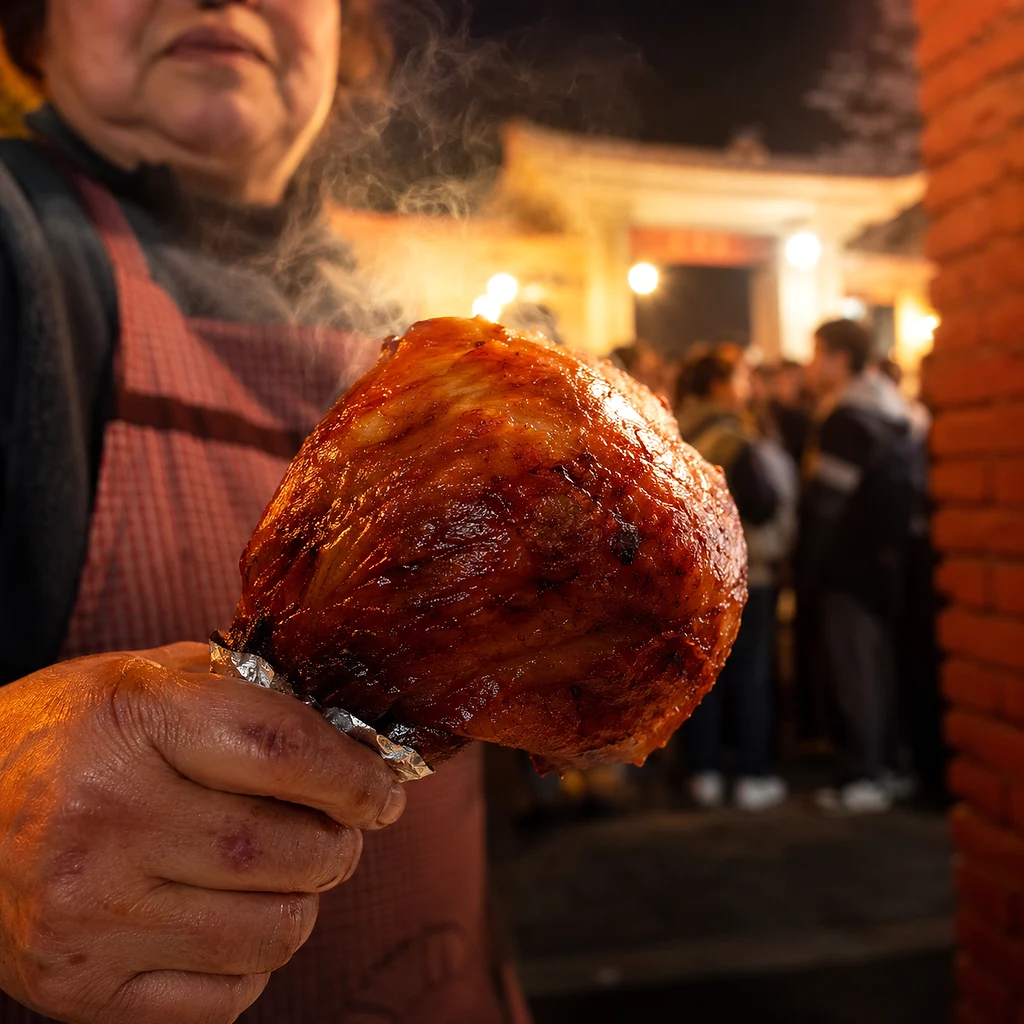
鹅腿阿姨"塌房":当网红故事撞上一只鸭腿
Goose Leg Auntie's Duck-Leg Scandal
About this story
Advanced Chinese listening practice. The inside story of Beijing's 'Goose Leg Auntie' scandal: how Chen Xiufeng went from anonymous street vendor to nationally celebrated 'net-celebrity auntie', the June 9 WeChat group confession, the brutal price-gap math, possible counterfeit-goods criminal liability, and three deeper layers about deification, integrity, and the 'invisible duck legs' hidden across our daily lives. HSK 5-6 Chinese listening practice.
This is an HSK 5-6 Chinese listening episode that runs about 6 minutes. The full Mandarin script is shown with tap-for-pinyin and a line-by-line English translation, so you can listen and read at once — comprehensible input in the sense of Stephen Krashen's i+1 theory. It teaches 14 key vocabulary words such as 诚信、市场、品牌 and walks through 8 grammar patterns, each explained in English with examples. The same news story is retold at 4 difficulty levels — use the level selector above to find the version that is challenging but still understandable for you.
Read at your level
原文Read the complete story in Chinese. Reveal pinyin and English only when you need them.
English transcript reference
Today we're talking about something that has basically flooded the Chinese internet over the past few days — 'Goose Leg Auntie's house has collapsed'.
'House collapse' (塌房) is originally a phrase from fan circles.
It means: someone or some brand you love, follow, and trust suddenly collapses, revealing a side you didn't want to see.
Today we're going to talk about this story, which collapsed in a way that's both heartbreaking and infuriating.
First, a brief recap on 'Goose Leg Auntie'.
Her real name is Chen Xiufeng.
But ordinary people rarely call her by her real name.
Everyone calls her 'Goose Leg Auntie'.
How did that name come about?
It traces back to 2023.
That year, she was at the gates of Beijing's Tsinghua and Peking universities, pushing a small cart to set up shop.
Selling roasted 'goose legs'.
That period happened to coincide with the short-video-platform boom.
A student filmed 'Tsinghua and Peking U students mobbing Goose Leg Auntie'.
The video went viral.
Then the topic went on the trending list.
Media followed up to interview.
CCTV, People's Daily, every major portal site — all of them covered her.
She went from being an ordinary middle-aged street vendor to becoming a nationally known 'net-celebrity auntie' overnight.
Goose Leg Auntie herself was also good at riding the wave.
She registered a trademark.
She started expanding to the gates of other universities.
She even organized multiple customer WeChat groups, making it convenient for repeat customers to do group buys and pre-orders.
At her peak, she could sell hundreds of 'goose legs' in a single night.
Students' feelings toward her were deep too.
Not just simple 'this roast meat is tasty'.
More that they felt this was an ordinary woman who, through her own diligence, had earned the love of Tsinghua and Peking U students.
She carried a kind of plain, inspirational narrative.
Then, this week, things suddenly reversed.
On June 9, Goose Leg Auntie, in one of her own customer WeChat groups.
Sent a voice message.
In the voice message she admitted:
the 'goose legs' she had long been selling were in fact made from duck legs.
She also said she would re-label her menu going forward.
This audio was quickly screenshotted and spread across all of Chinese social media.
To understand the weight of this, we need to look at the price gap between duck legs and goose legs.
According to multiple media outlets' stats.
Frozen duck legs have an average market price of about 1.4 yuan.
Frozen goose legs are close to 10 yuan.
Which is to say, the cost of duck leg is not even one-seventh of goose leg.
And the roasted 'goose legs' Goose Leg Auntie sold went for between twenty and thirty yuan each.
Calculated against the duck-leg cost, the profit margin is shocking.
The student community had the most intense first-wave reaction.
They felt: they had been deceived by someone they trusted.
And not just once or twice.
For multiple full years.
Goose Leg Auntie's own explanation is:
She really did sell goose legs at first; it was 2011.
Later, supply was unstable, and she couldn't find geese that met her standards.
On top of that, other stalls on the same street were also using duck.
So she just switched the raw material.
But she never told her customers.
This explanation produced two camps online.
Some netizens expressed understanding:
Running a small business isn't easy, supply runs out — that's normal, just be clear about pricing.
But more people refused to accept it.
They argued:
What you sell is your business freedom.
But what you call it is a promise to the consumer.
The crux of this whole thing isn't the difference between goose and duck as ingredients.
It's the trust gap between 'name' and 'substance'.
There were also voices from the legal side.
A lawyer pointed out:
If evidence can prove that Goose Leg Auntie deliberately, over a long period, sold duck leg as goose leg.
And if the amount involved reaches a certain threshold.
Then this isn't just a refund-and-apology matter.
If severe enough, it could even fall under 'the crime of selling counterfeit and inferior goods'.
Currently, the relevant Market Regulation department has already stepped in to investigate.
Peking University has also quietly deleted its earlier social posts recommending Goose Leg Auntie.
Several of Goose Leg Auntie's stalls have been temporarily closed.
So, what does this story show us?
I think there are at least three layers.
The first layer is about the 'net-celebrity story' itself.
Our era loves to deify people.
We love taking an ordinary person and quickly elevating them into an 'inspirational symbol'.
But once this kind of narrative is amplified.
It's easy for us to forget: gods are also human.
If they're human, they do the math.
They have their own little calculations.
Under pressure, they make choices that aren't always shining.
The second layer is about 'integrity'.
The word '诚信' may sound a little dated today.
But its essence is simple.
It is: what you say out loud and what you actually do should be as consistent as possible.
You sell duck, price it at duck prices.
No problem.
You sell duck, price it at goose prices.
That's another story.
The third layer is about 'us'.
As consumers.
Of the things we eat, buy, and use every day.
There's actually quite a lot that's 'we think it's A, but it's really B'.
This Goose Leg Auntie story got exposed.
It's because she was just too famous.
More 'invisible duck legs' out there.
Are hidden away in our lives all along.
At the end of the show, I want to ask you three questions.
First, have you bought anything 'not-as-labeled' recently?
How did you handle it at the time?
Second, suppose you've also run a small shop, or done business yourself.
How would you handle this kind of choice?
Third, going back to your own life.
The things you say out there, and the things you do — today, are they consistent?
This question has no standard answer.
But it's worth us, taking our time, thinking it through.
Listen again
Try it without the transcript and notice what sounds clearer.
What vocabulary does this episode teach?
词汇The episode's moral spine. 你说出来的,跟你做的,要尽量一致 = what you say out loud and what you do should be as consistent as possible.
HSK 1-4. market.
HSK 1-4. brand.
HSK 1-4. price.
HSK 1-4. cost.
HSK 1-4. statistics / to count.
HSK 1-4. to prove.
Glossed inline. Originally fan-circle slang; now widely used for any kind of trust-collapse — celebrities, brands, public figures.
事情在这周突然反转了 = things suddenly reversed this week. Common news-narrative term.
话题登上热搜 = the topic climbed the trending list. Standard internet-culture term in China.
我们这个时代,喜欢造神 = our era loves to deify people. Cultural-commentary term.
她身上承载了一种朴素的、励志的叙事 = she carried a plain, inspirational narrative. Common in media-criticism writing.
励志符号 = inspirational symbol / icon. Often used (sometimes ironically) for rags-to-riches stories.
你最近有没有买到过'名不副实'的东西?= Have you bought anything 'not-as-labeled' recently? Common 4-char idiom.
* beyond level超纲词
What grammar patterns appear in this episode?
语法...的话 / ...的事 / ...的故事 (relative-clause structure)
Building rich noun phrases with 的. Used heavily in news and analysis Chinese.
你说出来的,跟你做的,要尽量一致
你最近有没有买到过'名不副实'的东西?
一旦 + Clause, 就 + Clause
'Once X happens, Y follows.'
但是这种叙事一旦放大。就容易让我们忽略:神也是人。
Subject + 不只是 + X,而是 + Y (correction)
Strong correction: 'not merely X, but rather Y'.
这件事的关键,不是'鹅'和'鸭'之间的食材差。而是'名'和'实'之间的信任差。
甚至 + Clause (going further, even)
Climbs the ladder of extremity.
她甚至还组建了多个客户微信群
甚至可能涉及'销售假冒伪劣商品罪'。
Subject + 也好 + Clause (sympathetic concession)
Used to grant a point before disagreeing.
一部分网友表示理解:做小生意不容易
按 + Object + 算 (calculation basis)
'Calculated against / according to X'.
按鸭腿成本算,毛利率惊人
按鸭的价钱卖
所谓的 + X (the so-called X)
Marks a label as questionable / quoted.
她长期所卖的'鹅腿'
'看不到的鸭腿'
Subject + 是因为 + Clause (because)
Marks causation explicitly.
鹅腿阿姨这件事被曝出来。是因为她太有名了。
Proper nouns
专有名词Free account
Keep learning from this story
Create a free account to keep saved words and your preferred level together.
- Keep words with their story context
- Remember your preferred level
- Build your vocabulary over time