
A Chinese podcast · Same story, 4 levels
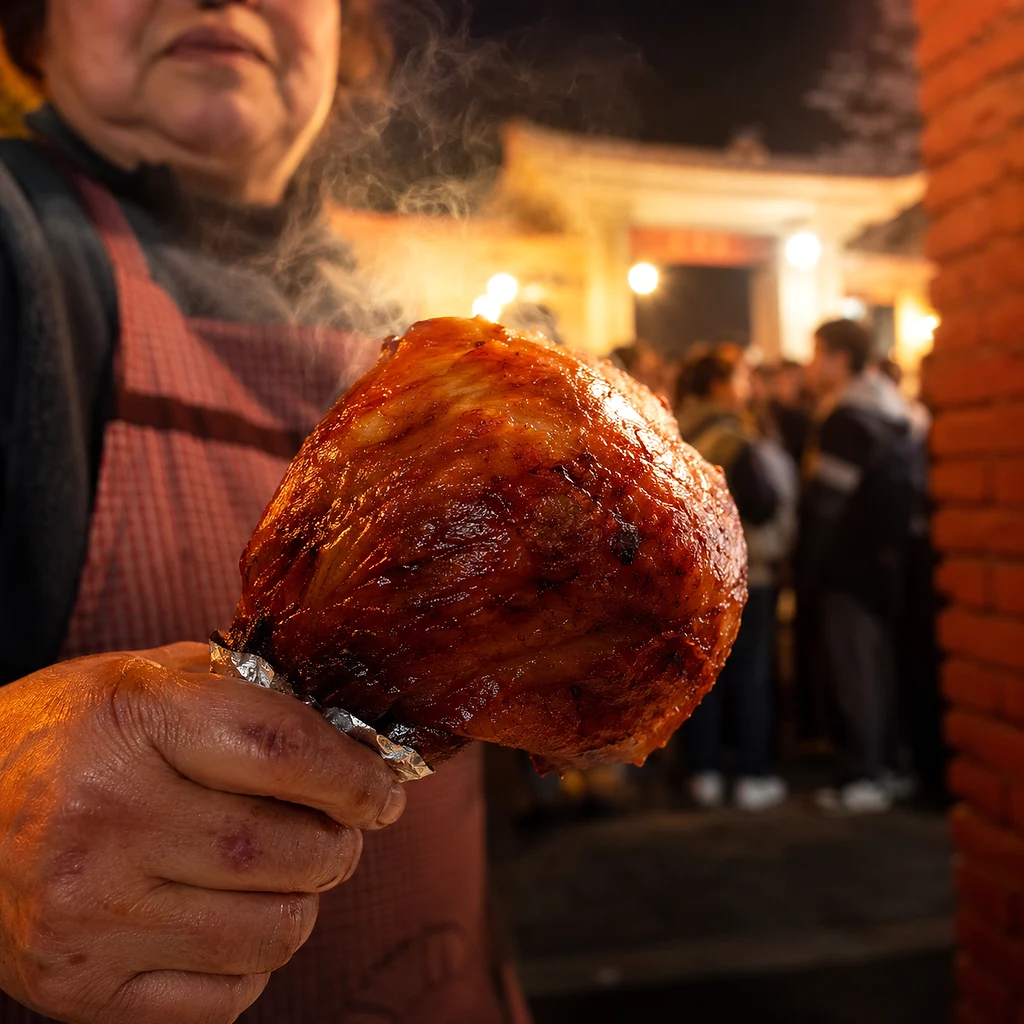
鹅腿阿姨"塌房":火了几年的鹅腿,原来是鸭腿
Goose Leg Auntie's Duck-Leg Scandal
About this story
The full saga of Beijing's 'Goose Leg Auntie' duck-leg scandal: the 2023 viral fame, the trademark, the June 9 WeChat confession, the 7x price gap, lawyer warnings on consumer-fraud liability, and the bigger lesson about trust between brand and consumer. HSK 4 Chinese listening practice.
This is an HSK 4 Chinese listening episode that runs about 5 minutes. The full Mandarin script is shown with tap-for-pinyin and a line-by-line English translation, so you can listen and read at once — comprehensible input in the sense of Stephen Krashen's i+1 theory. It teaches 13 key vocabulary words such as 其实、解释、接受 and walks through 7 grammar patterns, each explained in English with examples. The same news story is retold at 4 difficulty levels — use the level selector above to find the version that is challenging but still understandable for you.
Read at your level
原文Read the complete story in Chinese. Reveal pinyin and English only when you need them.
English transcript reference
Today we'll talk about something extra-popular on the Chinese internet lately.
It's about an ordinary person.
Her surname is Chen; her name is Chen Xiufeng.
But you might not have heard her real name.
Her more famous online name is 'Goose Leg Auntie'.
Let's first go back to about two or three years ago.
Back then, at the gates of Peking U, Tsinghua — Beijing's most famous universities.
Every night at the campus gates, the same scene appeared:
Groups of students standing in line.
Lined up very long.
Sometimes they had to wait an hour.
Who were they all waiting for?
All waiting for Goose Leg Auntie.
Goose Leg Auntie pushed a small cart.
On the cart were roasted 'goose legs'.
Students would buy one and walk-and-eat.
The videos from that time spread all across the Chinese internet.
'Tsinghua and Peking U students mob Goose Leg Auntie's roasted goose legs.'
That kind of headline was visible almost every day.
Goose Leg Auntie became hugely popular as a result.
Newspapers interviewed her.
Television crews filmed her.
Some people even came specifically to her stall to take photos for social media.
Later, she even registered her own trademark.
And opened several new stalls.
You could say Goose Leg Auntie is, on the Chinese internet, a very representative 'ordinary person turns net-celebrity' story.
But, a few days ago, things suddenly reversed.
On June 9, Goose Leg Auntie, in her own customer WeChat group.
Sent a voice message.
What the voice meant was:
'I'm sorry.
I want to admit something to everyone.
What I sold before — the so-called 'goose legs' — were actually mostly duck legs.
I couldn't find any suitable real geese afterward.
So I used duck legs.
But I never told everyone.
Today, I want to say sorry to everyone.'
The moment this message came out.
The whole internet basically exploded.
You have to know, the price gap between duck legs and goose legs is huge.
According to media data.
One frozen duck leg averages just over a yuan.
One frozen goose leg is around ten yuan.
Which means goose legs cost about seven times what duck legs do.
And Goose Leg Auntie's roasted 'goose legs' sold for around twenty-something yuan apiece.
Calculated against the duck-leg cost, the profit margin is actually high.
Students grew even more unhappy.
They said:
'We thought we were eating goose.
Turns out we were eating duck.
The money we spent was for goose.
The meat we ate was duck.
Waited so long, queued so long.
Turns out we were tricked all along.'
Goose Leg Auntie's own explanation was this.
She said she really did sell goose leg at the very beginning.
That started in 2011.
Then, after a few years.
She said she couldn't find suitable geese.
And the nearby stalls were actually also using duck.
So she just kept on using duck.
But many people don't accept this reason.
They said:
'What you sell is your own decision.
But what you call it is something you owe everyone an account for.
You call it goose leg, and you charge goose-leg prices.
This is not a 'can't find geese' problem anymore.
This is an integrity problem.'
A lawyer also spoke up:
'If duck legs were deliberately passed off as goose legs.
And if the amount involved is large enough.
This might no longer just be an apology matter.
It might even involve legal liability.'
Currently, market regulators have already stepped in to investigate.
Goose Leg Auntie's stall has been temporarily shut down.
Finally, let's think together.
What does this story show us?
Really, just two characters: integrity.
What business you run, how you price — there's no problem.
You want to use cheap meat to make a cheap product.
Also no problem.
But, what you call it relates to the most basic trust between you and the user.
What you say is goose.
What you sell should be goose.
What you say is duck.
What you sell is duck.
If you sell duck and price it at duck prices, no one would blame you.
If you sell duck but price it at goose prices.
Then everyone will definitely ask you.
Finally, I want to ask you.
The things you use today, the things you buy, the things you eat.
How much of it do you really 'know what's inside'?
Those brands you trust — what they say and what they do, are they really the same?
This question doesn't have a standard answer today.
But it's worth each of us thinking about.
Listen again
Try it without the transcript and notice what sounds clearer.
What vocabulary does this episode teach?
词汇HSK 3. Marks the reveal: 其实大部分都是鸭腿 = actually mostly duck legs.
HSK 3. 自己的解释是这样的 = her own explanation is like this.
HSK 4. 但是这个理由,很多人不接受 = but many people don't accept this reason.
HSK 1-3. auntie (respectful term for a middle-aged woman).
HSK 1-3. lawyer.
HSK 1-3. relationship; connection.
HSK 1-3. law.
Internet fandom slang. The viral term applied to Goose Leg Auntie's reveal — your trusted figure suddenly collapses.
Central moral theme. 这就不是一个'找不到'的问题了。这是一个诚信的问题 = this isn't a 'can't find' problem anymore — it's an integrity problem.
HSK 4 verb. 我跟大家承认一件事 = I want to admit something to everyone.
事情突然反转了 = the situation suddenly reversed. Common in news/social-media commentary.
鸭腿和鹅腿,差价非常大 = the price gap between duck legs and goose legs is huge.
HSK 4. 报纸采访她 = newspapers interviewed her.
* beyond level超纲词
What grammar patterns appear in this episode?
语法所谓的 + X (the so-called X)
Marks a label as questionable / quoted.
我之前卖的所谓的'鹅腿',其实大部分都是鸭腿。
甚至 + Clause (even, going further)
Marks an extreme example, climbing higher than expected.
她甚至自己注册了商标。
甚至可能会有法律责任。
Subject + 因此 + Verb
'as a result; because of this'. Connective.
鹅腿阿姨也因此火得不行。
按 + Object + Verb / 来算
'according to / calculated by'. Topicalizes the basis of an action.
按鸭腿的成本来算,利润其实很高。
按鸭的价钱卖。
Subject + 让 / 使 + Object + Verb / Adj (causative)
Causative — X makes Y do/feel Z.
这件事让我们看到什么?
你叫它什么,关系到信任。
不是 ... 而是 ... (not X but Y)
Strong contrast / correction.
这件事的关键,不是'鹅'和'鸭'之间的食材差。而是'名'和'实'之间的信任差。
Verb + 起来 / 出来 (resultative)
Direction-resultive complements. Common in spoken narration.
这段话一出来。
整个互联网,几乎是炸了。
Proper nouns
专有名词Free account
Keep learning from this story
Create a free account to keep saved words and your preferred level together.
- Keep words with their story context
- Remember your preferred level
- Build your vocabulary over time