
A Chinese podcast · Same story, 4 levels
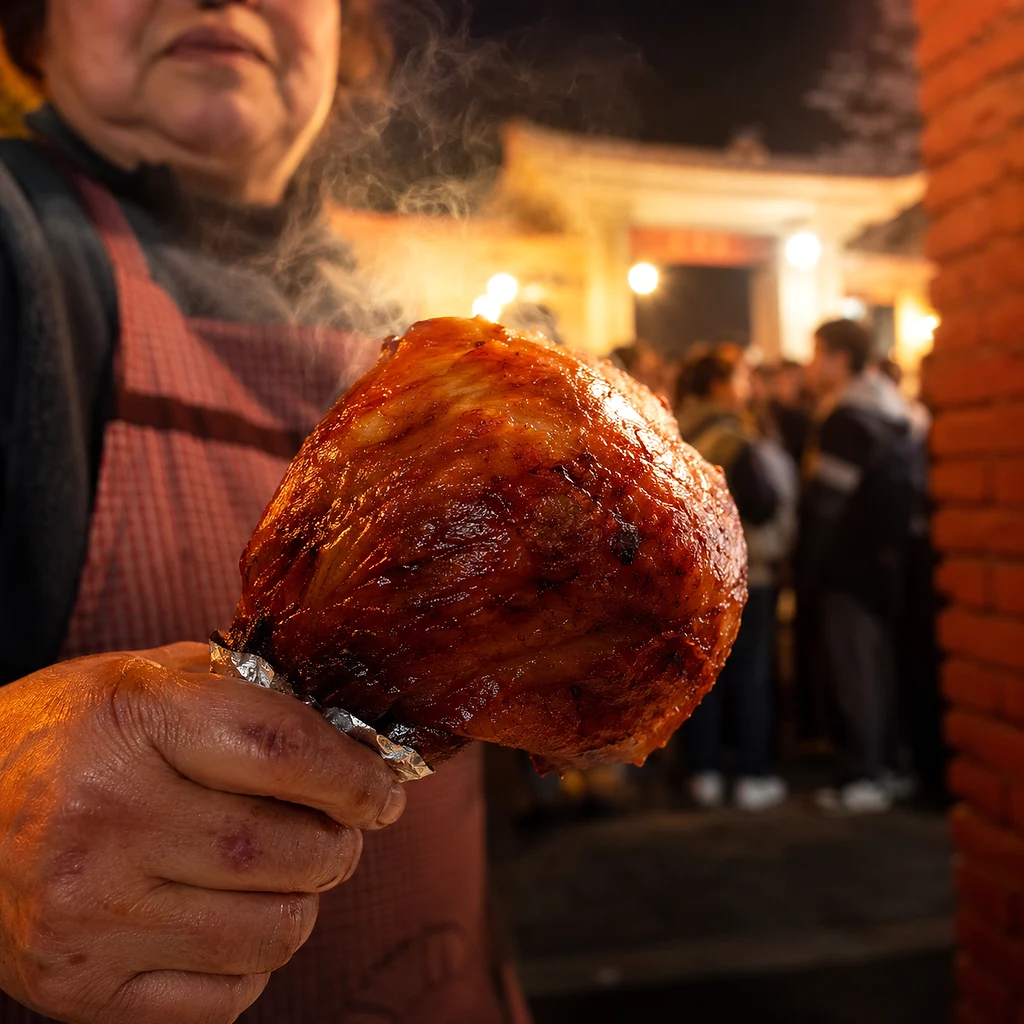
阿姨卖的"鹅腿",其实是鸭腿
Goose Leg Auntie's Duck-Leg Scandal
About this story
The story of Beijing's famous 'Goose Leg Auntie', who told students she was selling roasted goose legs for years — and then admitted they were duck legs all along. Told one slow step at a time using only beginner-level Chinese. HSK 1 Chinese listening practice.
This is an HSK 1 Chinese listening episode that runs about 5 minutes. The full Mandarin script is shown with tap-for-pinyin and a line-by-line English translation, so you can listen and read at once — comprehensible input in the sense of Stephen Krashen's i+1 theory. It teaches 12 key vocabulary words such as 大学、学生、卖 and walks through 7 grammar patterns, each explained in English with examples. The same news story is retold at 4 difficulty levels — use the level selector above to find the version that is challenging but still understandable for you.
Read at your level
原文Read the complete story in Chinese. Reveal pinyin and English only when you need them.
English transcript reference
Today we'll talk about a thing.
Today's thing is about a person.
Let's talk about this person.
She is a woman.
She is not at your home.
She is not at my home.
She is in China.
She is in a place in China.
This place is called Beijing.
Have you heard of Beijing?
Maybe you have.
Maybe you haven't.
It's okay.
Beijing has many people.
Beijing also has many universities.
What is a university?
A university is a big school.
When students are grown up, they go to university.
Beijing has universities.
Universities have students.
There are many students.
They want to eat things.
Outside the universities, some people sell things.
Sell what?
Sell things to eat.
Today's person sells things there.
She sells outside the university.
She has sold for many years.
More than ten years.
So what does she sell?
What she sells is meat.
The meat looks like a leg.
What kind of leg?
She says: 'This is a goose's leg.'
What is a goose?
A goose is a kind of animal.
A goose has two legs.
A goose walks.
A goose also calls out (makes noise).
A goose looks a bit like a chicken.
But bigger than a chicken.
What she sells is the goose's leg.
We say: 'goose leg'.
Her goose legs are very tasty.
Students all like them.
One student ate one and said: 'Tasty!'
He told other students.
Other students came to eat too.
They also said: 'Tasty!'
Then more and more students came.
Many people came to buy.
Sometimes you had to wait an hour.
Sometimes you waited even longer.
But the students were willing to wait.
They said: 'For this goose leg, waiting is worth it.'
Slowly, this auntie became famous.
On the Chinese internet, people were all talking about her.
People called her: 'Goose Leg Auntie'.
Many people liked her.
Just like that, several years passed.
Goose Leg Auntie sold every day.
Students came to buy every day.
She made more and more money.
But, a few days ago.
Goose Leg Auntie said something.
What she said, many people didn't expect.
She said:
'I want to tell everyone something.
What I sell is actually not goose leg.
What I sell is duck leg.
A duck is also a kind of animal.
A duck is smaller than a goose.
A duck's leg is also cheaper than a goose's leg.
I want to say sorry to everyone.'
When everyone heard this, they were all unhappy.
Students were unhappy.
The people who liked her were all unhappy.
They said:
'We thought we were eating goose leg.
Actually we were eating duck leg.
We spent the price of a goose leg.
Not the price of a duck leg.
Goose-leg money is a lot.
Duck-leg money is a little.
The amounts are different.'
So why didn't she say this before?
Auntie said:
'Many years ago, I really sold goose leg.
Really really sold it.
Later, I couldn't find geese anymore.
I wanted to find some.
I also wanted to buy some.
But there were none.
So I used ducks.
Ducks are easy to find.
Ducks are also cheap.
But I didn't tell everyone.
I wanted to say.
But I never said.
I also knew this was not right.
I'm sorry.'
Now, someone is looking into this thing.
Looking at whether Auntie did something wrong.
Also looking at what to do next.
Finally, I want to ask you something.
Have you ever told someone something,
where what you said and what you did were not the same?
Maybe it was a small thing.
Maybe it was a big thing.
What about from now on?
What you tell others and what you do — are they the same?
Say the same thing, do the same thing.
Then your heart feels at peace.
Listen again
Try it without the transcript and notice what sounds clearer.
What vocabulary does this episode teach?
词汇HSK 1, within HSK 1. Glossed inline: 大学就是大的学校 = a university is a big school.
HSK 1. The customers in this story.
HSK 1 verb. Central action of the story: 她在大学外面卖东西.
HSK 1. I'm sorry.
HSK 1. it doesn't matter.
HSK 1. we; us.
HSK 3 noun. In Chinese, used to address any older woman politely. Here it's the news subject's actual public nickname: 鹅腿阿姨 = Goose Leg Auntie.
Glossed inline: 鹅是一种动物。有两条腿。比鸡大。= A goose is a kind of animal, has two legs, bigger than a chicken.
Glossed inline: 鸭比鹅小 = a duck is smaller than a goose. 鸭便宜 = duck is cheap.
HSK 4 noun, but the basic body part. 鹅的腿 = a goose's leg; 鸭的腿 = a duck's leg.
HSK 3 noun. 她卖的是一种肉 = what she sells is a kind of meat.
HSK 2 adjective. 鸭便宜 = duck is cheap. 鸭腿比鹅腿便宜 = duck leg is cheaper than goose leg.
* beyond level超纲词
What grammar patterns appear in this episode?
语法Subject + 是 / 不是 + Noun
Basic identity: 'X is/is not Y'.
她是一个女的。
鹅是一种动物。
我卖的,其实不是鹅腿。
A 比 B + Adj (comparison)
'A is more Adj than B'. HSK 2 comparison structure.
鸭比鹅小。
鸭腿比鹅腿便宜。
鸡比鹅小。
Subject + 也 / 都 + Verb
也 = also; 都 = all. Both come before the verb. Used for parallel statements.
鸭也是一种动物。
学生都喜欢。
喜欢她的人,都不高兴。
V + 了 + 很多 / 几 + Noun + 了
Marks continuing past action up to now.
她卖了很多年。
卖了十几年。
就这样,过了好几年。
Verb + 着 / Verb + 来 (manner)
Various verb markers used here: 越来越多 = more and more.
越来越多的学生来。
钱也越赚越多。
那 / 那么 + Adj / Clause (so / well then)
Discourse connector: 'so, then...' or 'in that case...'.
那为什么以前不说呢?
那以后呢?
其实 + Clause (actually)
Reversal marker — introduces what is actually true.
我卖的,其实不是鹅腿。
其实吃的是鸭腿。
Proper Nouns
专有名词Free account
Keep learning from this story
Create a free account to keep saved words and your preferred level together.
- Keep words with their story context
- Remember your preferred level
- Build your vocabulary over time