
A Chinese podcast · Same story, 4 levels
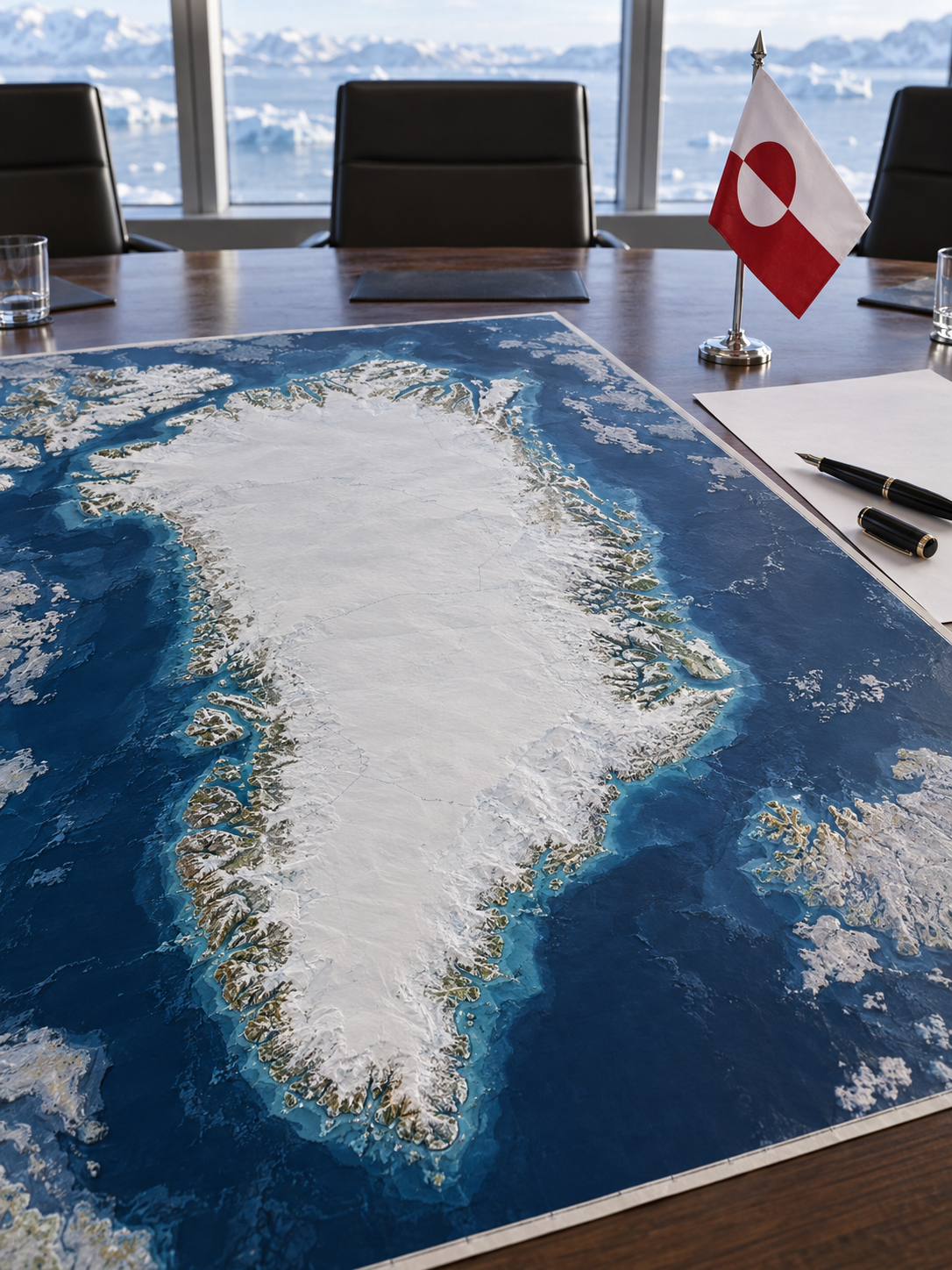
格陵兰安全协议还没签,主权不变
Greenland Deal Unsigned; Sovereignty Stays
About this story
Trump describes a Greenland security arrangement, while Denmark says the three-way accord is only expected to be signed next week and needs parliamentary approval. HSK 5-6 Chinese listening practice.
This is an HSK 5-6 Chinese listening episode that runs about 4 minutes. The full Mandarin script is shown with tap-for-pinyin and a line-by-line English translation, so you can listen and read at once — comprehensible input in the sense of Stephen Krashen's i+1 theory. It teaches 12 key vocabulary words such as 安全、程序、强调 and walks through 2 grammar patterns, each explained in English with examples. The same news story is retold at 4 difficulty levels — use the level selector above to find the version that is challenging but still understandable for you.
Read at your level
原文Read the complete story in Chinese. Reveal pinyin and English only when you need them.
English transcript reference
An unsigned Greenland security agreement has already led people to ask a bigger question: Will the United States use it to gain control of the island?
To answer this question, first look at what the parties said on September 18, and then look at how far the agreement has actually progressed.
On September 18, the Danish Prime Minister's Office issued a statement saying that Greenland, Denmark, and the United States are "expected" to sign an agreement next week to strengthen security in the Arctic and North Atlantic.
According to the statement, the signing may take place during the United Nations General Assembly, because representatives of the three parties will have the opportunity to meet then.
From this statement, the direction of the negotiations is already clear, and it also clearly shows that the document has not yet been signed.
On the U.S. side, President Trump stressed that the United States will obtain a more lasting arrangement for Greenland's security.
However, one party's political description of the agreement does not mean that the three parties have already published a final legally binding text.
If read too quickly, what is easiest to miss in the same news story is precisely the difference in timing and status.
In terms of timing, "expected to sign" is the next step in the plan, "has signed" is a completed action, and "has entered into force" comes even later.
Procedurally, the Danish government clearly stated that the agreement needs to complete each country's parliamentary process before it takes effect.
Even if a signing ceremony really takes place next week, the process will not automatically end after the signing.
Therefore, today an arrangement still awaiting signature and approval cannot be described as a system already being implemented.
In terms of content, security cooperation and territorial sovereignty must also be viewed separately.
According to public explanations, this proposed agreement is about security in the Arctic and North Atlantic region, not about selling Greenland to the United States.
In the statement, Danish Prime Minister Mette Frederiksen emphasized sovereignty, territorial integrity, and the right of the people of Greenland to self-determination.
In this debate, these words are not decorations in a press release: they directly answer the question of who has the right to decide Greenland's future.
On the other hand, Greenland's leader, Jens-Frederik Nielsen, also said that the negotiations recognized Greenland's interests.
From the list of signatories, placing Greenland among the three parties helps make clear that it is not a bystander and cannot be treated as a piece of land to be traded at will.
Of course, emphasizing that sovereignty remains unchanged does not mean that all security arrangements have been made clear.
For example, how the work will be divided specifically, what changes there will be in military activities, and when each country's parliament will complete its review still need to wait for the formal text and subsequent procedures.
If a report only says "the United States controls Greenland," readers may hear security authority, political claims, and territorial belonging all as the same thing.
In this way, what readers hear sounds like a sovereignty transfer that has already been decided, even though the public statement did not announce such a transfer.
Conversely, if it only says "nothing has happened," that would also erase the security negotiations that the three parties are advancing.
As of today, the more accurate statement is that an agreement to strengthen regional security is expected to be signed next week, and afterward it still has to go through each party's domestic procedures.
At the same time, in public statements, both Denmark and Greenland emphasized Greenland's sovereignty and the right of the people of Greenland to self-determination.
By next week, the next truly verifiable checkpoint is whether the formal signing takes place, and what exactly the published text says.
The next checkpoint after that is whether the parliamentary procedures are completed and when the agreement takes effect.
Therefore, before then, any judgment about the specific scope of control or permanent arrangements should indicate whether it is one party's claim or a clause agreed to by all three parties.
In the end, the Greenland story seems to be about an island, but it is actually also testing a basic skill in reading news: distinguishing negotiation, signing, ratification, and implementation.
Tomorrow, if someone tells you "the Greenland agreement has already been completed," will you first look for the signing date, or first look for the parliamentary approval record?
Listen again
Try it without the transcript and notice what sounds clearer.
What vocabulary does this episode teach?
词汇The agreement’s stated subject.
Signing and parliamentary approval follow distinct steps.
Denmark stresses sovereignty and self-determination.
Trump describes a lasting security arrangement.
The episode examines what the headline actually establishes.
A political claim is not the final legal text.
Authority over Greenland remains central.
Greenlanders’ right to shape their future.
Domestic approval is still needed.
Expected next week, not yet done.
A principle emphasized by Denmark.
After parliamentary procedures, not at announcement.
* beyond level超纲词
What grammar patterns appear in this episode?
语法即便……也……
States that signing alone would not end the process.
即便下周真的举行签字仪式,签字以后,程序也不会自动结束。
如果……,……
Introduces the consequence of an oversimplified headline.
如果一篇报道只写“美国控制格陵兰”,读者可能把安全权限、政治主张与领土归属,全听成同一件事。
Proper Nouns
专有名词Sources
来源Free account
Keep learning from this story
Create a free account to keep saved words and your preferred level together.
- Keep words with their story context
- Remember your preferred level
- Build your vocabulary over time