
A Chinese podcast · Same story, 4 levels
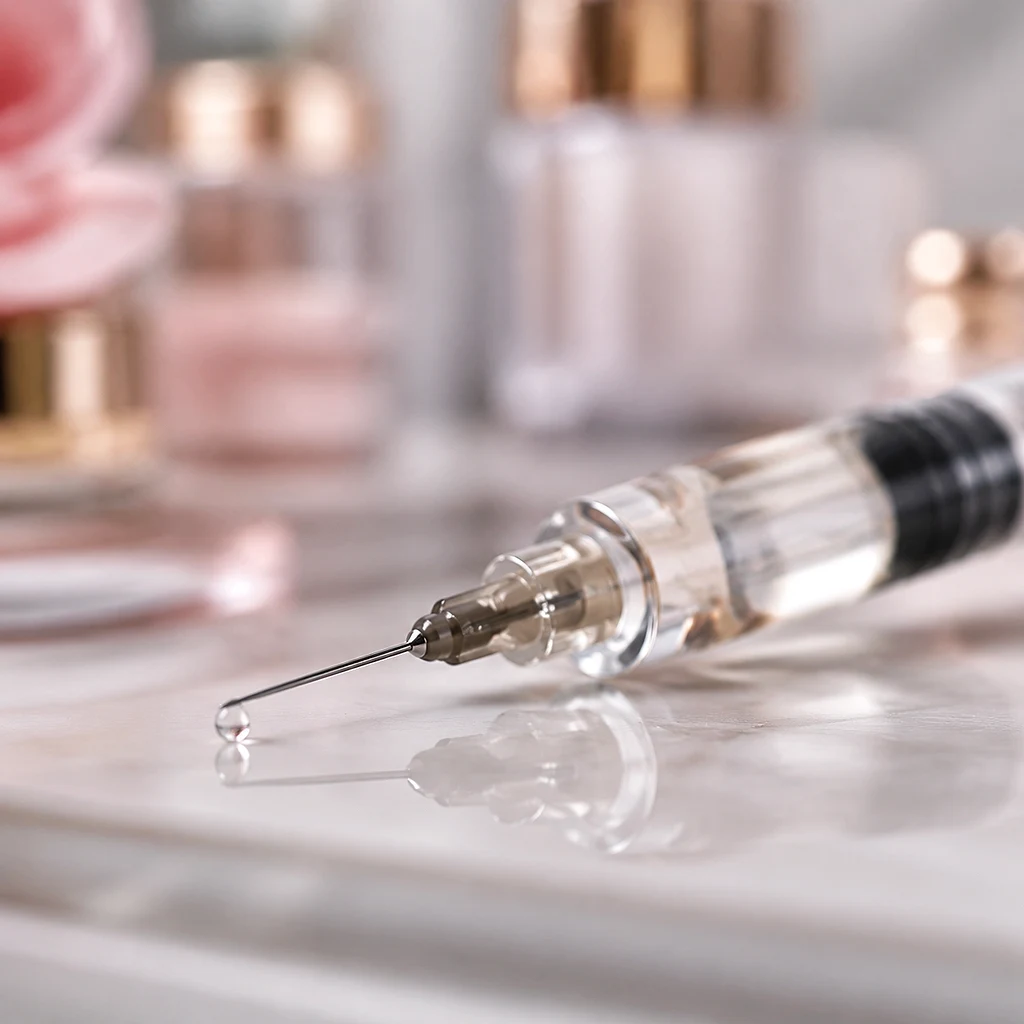
当美的祭司,死于对美的追求:一支美容针背后的时代之问
Kendal Ascher Dies After Cosmetic Injection
About this story
Advanced Chinese listening practice. The full story of Estée Lauder luxury-portfolio executive Kendal Ascher, who died at 56 from a pulmonary embolism of foreign material after a cosmetic filler injection: the irony, the clinical mechanism, the rare-but-real risk (5.5M injections/year), and a meditation on our age's relentless pursuit of beauty. HSK 5-6 Chinese listening practice.
This is an HSK 5-6 Chinese listening episode that runs about 5 minutes. The full Mandarin script is shown with tap-for-pinyin and a line-by-line English translation, so you can listen and read at once — comprehensible input in the sense of Stephen Krashen's i+1 theory. It teaches 14 key vocabulary words such as 百分之、品牌、专业 and walks through 7 grammar patterns, each explained in English with examples. The same news story is retold at 4 difficulty levels — use the level selector above to find the version that is challenging but still understandable for you.
Read at your level
原文Read the complete story in Chinese. Reveal pinyin and English only when you need them.
English transcript reference
Today, we'll talk about
a story about 'beauty'.
But its ending
is not beautiful.
The story's protagonist
was named Kendal Ascher.
He was,
fifty-six.
If you know anything
about the beauty industry,
you'll know
he was no ordinary figure.
He was, at the global beauty giant
the Estée Lauder Companies,
a senior executive,
in charge of
the group's most elite
luxury brands —
La Mer,
Tom Ford Beauty,
Jo Malone,
Frédéric Malle …
brands whose very names
make hearts flutter —
behind them all,
his hand was there.
From an ordinary
sales rep,
to a commanding
group executive,
at Estée Lauder he served
for
twenty-five whole years.
It's no exaggeration to say
his whole life
was devoted to
one word —
'beauty'.
More than almost
anyone else in the world,
he understood
how to become beautiful,
how
to hold on to youth.
And yet,
fate
played
an exceptionally cruel joke.
Such a man,
standing at the summit of beauty's pyramid,
in the end,
fell
in the pursuit
of 'beauty' itself.
Early this year,
with no warning,
he suddenly passed away.
At first,
the cause was a mystery.
Not until this week
did New York's chief medical examiner
officially announce
the conclusion
that shook
the entire industry.
His death
stemmed from
an utterly ordinary
cosmetic injection.
The clinical wording was:
'following a cosmetic injection,
a pulmonary embolism of foreign material,
leading to
acute respiratory failure.'
In plain words,
it means:
he received
what we commonly call a 'beauty injection',
that is,
the kind of filler
injected into the skin.
The filler, which should have rested
safely within the skin,
in a tiny-probability event,
strayed into
his blood vessels.
These minute 'foreign bodies'
thus set out on
a fatal journey.
Carried by the bloodstream,
they surged along,
and finally
lodged
in his lungs,
like so many plugs,
sealing off, dead,
the passages of life.
He first felt
a sudden wave of dizziness,
and then,
his breath
swiftly
left him.
According to reports,
his final moments
were spent in his husband's arms.
Spent there.
Officials
ruled this tragedy
to be
an accident.
At this point,
I must pause
and say,
in all seriousness, one thing.
I am not trying
to scare anyone off.
In fact,
this kind of cosmetic injection,
in the vast majority of cases,
is safe.
In the US alone,
the number of injections each year
exceeds
5.5 million.
Fatal accidents
like his
are the rarest
of the rare.
But 'extremely rare',
after all,
is not the same as 'zero'.
As one plastic surgeon
candidly admitted:
though the risk is rare,
it truly exists,
and at its worst
may even
cause blindness.
Any act
of sending foreign matter
into the body
carries no
one-hundred-percent safety.
Speaking of this,
I want, with you,
to talk about a deeper layer.
We are living
in an age
that exalts 'beauty'
as never before.
On social media,
it's face after
flawless, polished face.
Getting beautiful
seems
to have become
a new 'necessity'.
To pursue beauty,
in itself,
is not wrong at all.
It is humanity's
most instinctive longing
for what is lovely.
But Ascher's story
is like a mirror,
reflecting
the shadow behind
this grand
pursuit:
when we
ceaselessly,
outward,
onto our faces,
keep 'adding',
have we
ever seriously
done the
'subtraction'
of
risk?
Between 'more beautiful'
and 'unharmed',
that
invisible line —
where,
exactly,
should we draw it?
At the end of the show,
I want to leave you
with two questions.
First,
to become more beautiful,
the price
you're willing to pay —
what is its
ceiling?
Second,
if one day
'beauty'
required you
to trade your health,
even your safety,
for it,
would you
still
go without hesitation?
These two questions
have no standard answer.
But they
are worth your
thinking about slowly.
Listen again
Try it without the transcript and notice what sounds clearer.
What vocabulary does this episode teach?
词汇HSK 1-4. percent.
HSK 1-4. brand.
HSK 1-4. major / specialty / field of study.
HSK 1-4. conclusion.
HSK 1-4. media.
HSK 1-4. standard.
HSK 1-4. representative.
他绝非等闲之辈 = he was by no means an ordinary figure.
全球美妆巨头,雅诗兰黛集团 = the global beauty giant, the Estée Lauder Companies.
执掌着,集团最顶级的…奢侈品牌 = in charge of the group's most elite luxury brands.
那一批奢侈品牌 = that set of luxury brands.
他的一生,都奉献给了,一个字——美 = his whole life was devoted to one word — beauty.
如何,留住青春 = how to hold on to youth.
站在美的金字塔顶端的人 = a man at the summit of beauty's pyramid.
* beyond level超纲词
What grammar patterns appear in this episode?
语法绝非 ... (by no means...)
A formal, emphatic negation.
他绝非等闲之辈。
此案绝非偶然。
从 X 做起,到 Y (starting from X, rising to Y)
Traces a trajectory of growth.
从一名普通的,销售代表做起,到执掌一方的,集团高管。
可以毫不夸张地说 ... (it's no exaggeration to say...)
Prefaces a strong but warranted claim.
可以毫不夸张地说,他的一生,都奉献给了,一个字——美。
本应 ... ,却 ... (should have..., yet...)
Contrasts what should have been with what happened.
本应安稳地,停留在皮肤里的填充物,却在极小概率下,误入了,他的血管。
X,终究,不等于 Y (X, after all, is not the same as Y)
Draws a careful, weighty distinction.
但极少数,终究,不等于零。
当 ... 时,是否 ... ?(when..., have we...?)
A reflective conditional question.
当我们…去做加法时,是否,也曾认真地,算过,那道,关于风险的,减法?
这两个问题,没有标准答案。但是它们,值得你慢慢地想。
The channel's signature normal-level close.
这两个问题,没有标准答案。但是它们,值得你,慢慢地想。
Proper Nouns
专有名词Free account
Keep learning from this story
Create a free account to keep saved words and your preferred level together.
- Keep words with their story context
- Remember your preferred level
- Build your vocabulary over time