
A Chinese podcast · Same story, 4 levels
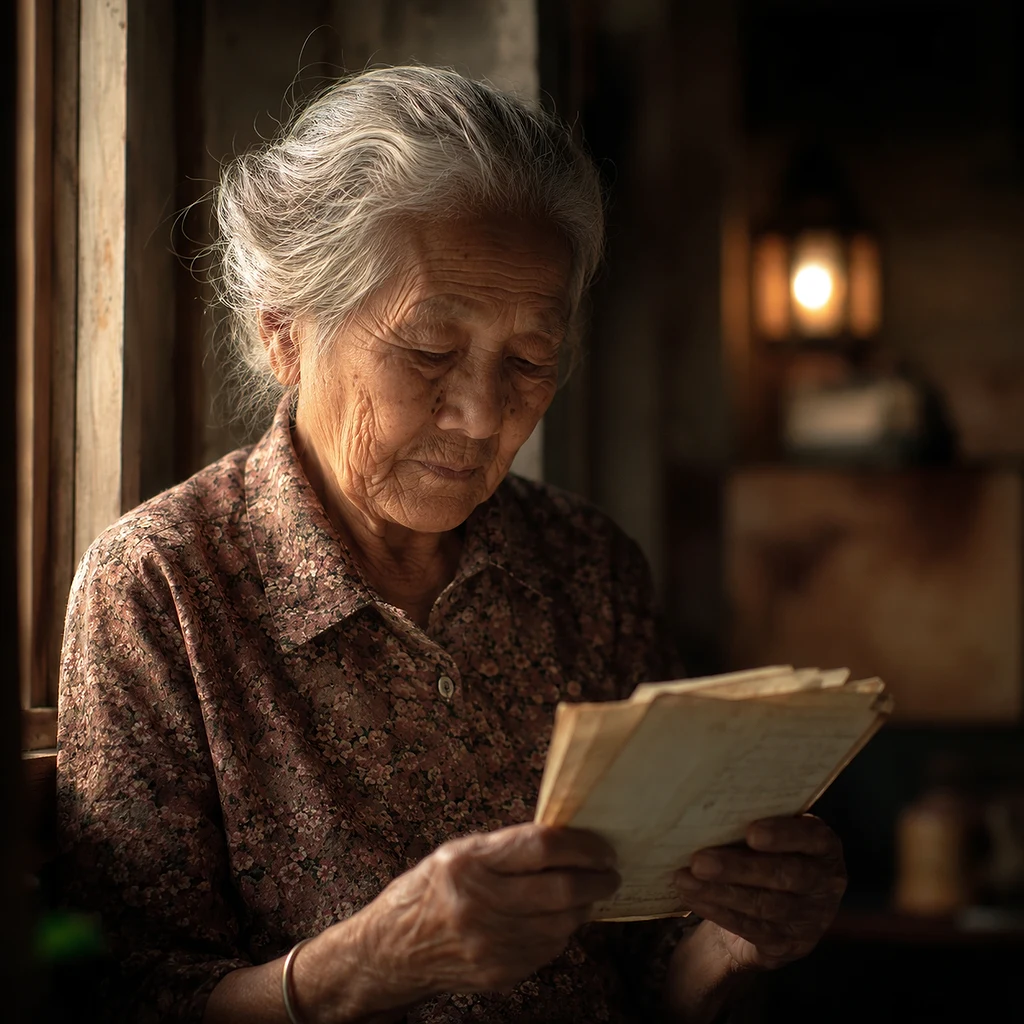
谁在替你写信?《给阿嬷的情书》
Love Letters to Amma: Who Writes the Letters?
About this story
Love Letters to Amma: Who Writes the Letters? HSK 3 Chinese listening practice.
This is an HSK 3-4 Chinese listening episode that runs about 4 minutes. The full Mandarin script is shown with tap-for-pinyin and a line-by-line English translation, so you can listen and read at once — comprehensible input in the sense of Stephen Krashen's i+1 theory. It teaches 12 key vocabulary words such as 信、奶奶、决定 and walks through 4 grammar patterns, each explained in English with examples. The same news story is retold at 4 difficulty levels — use the level selector above to find the version that is challenging but still understandable for you.
Read at your level
原文Read the complete story in Chinese. Reveal pinyin and English only when you need them.
English transcript reference
Recently, there's a movie in China that's especially hot.
It's called Letters to Grandma.
Have you heard of it?
It's okay if you haven't.
Today I'll tell you about it.
This is a grandma's story.
It's also a friend's story.
It's also a story about writing letters.
The grandma in the story is called Shurou.
She lives in southern China, in a place called Chaoshan.
Chaoshan is a region in Guangdong.
Her husband went to Thailand many years ago.
At that time, many people from southern China went to Thailand to find work.
They worked there, then sent the money they earned back to their families in China.
But some of them, they went, and never came back.
Shurou's husband was one of these.
Not long after he reached Thailand, he was gone.
He had passed away.
Nobody told Shurou.
She always thought he was still alive.
Why?
Because someone kept writing her letters.
Someone kept sending her money.
That person used her husband's name.
But in fact, that person was someone else.
It was a friend of her husband in Thailand.
A woman called Nanzhi.
Nanzhi was also of Chinese descent.
She grew up in Thailand from childhood.
She knew: Shurou's husband was already gone.
But she thought:
back in China, there's still grandma.
There's still grandma's child.
How will they manage?
So Nanzhi decided:
I'll do the writing.
I'll write in his name.
I'll send money in his name.
I won't tell the family in China.
And so, Nanzhi wrote for thirty years.
Thirty years, almost one letter every month.
Thirty years, almost some money every month.
Shurou used this money to send her child to school.
The child went to college.
The child got a job.
Things slowly got better at home.
Shurou didn't know:
the man she waited thirty years for had already gone.
She didn't know:
the person writing the letters was actually another woman.
She didn't know:
those words, that money, those "I love you, I miss you"s,
none were her husband's.
They were all Nanzhi's.
Later, grandma's grandson, called Xiaowei,
he had some things going on and needed money.
He went to Thailand, wanting to find his grandfather.
He'd heard grandpa was rich there.
But he didn't find grandpa.
He found Nanzhi.
Nanzhi told him:
your grandpa has been gone for thirty years.
I'm the one who wrote those letters to your grandma.
I'm the one who sent that money.
Xiaowei cried for a long time after hearing this.
He went back to China.
He told grandma.
When I was watching the movie, I really wanted to know:
how would grandma react after hearing all this?
Would she be angry?
Would she cry?
Would she feel those thirty years were wasted?
But in the movie,
grandma didn't do anything.
She just stood up and went to check the food.
She said: if the food gets cold, it won't taste good.
Just that one line.
I cried right then.
Because I suddenly understood:
it's not that she didn't know.
She just didn't care.
She didn't care whether the person writing the letters was her husband.
She said:
Nanzhi is my good friend.
Nanzhi is also my family.
These thirty years of mine,
weren't lived by one person.
They were lived by two people together.
By Shurou and Nanzhi, together.
This movie has no big events.
No fights, no competitions, no important figures.
Just writing letters, sending money, making food.
But it's these small things
that are real love.
Real friendship.
Real family.
So I want to tell you:
if you're looking for a movie to watch lately,
please watch Letters to Grandma.
While you watch, bring extra tissues.
You will definitely cry.
But after crying,
you'll feel:
between people,
it's not only blood relatives who are family.
Thirty years of friendship can also be family.
Even if you've never met in person.
Okay.
That's all for today.
Talk tomorrow.
Listen again
Try it without the transcript and notice what sounds clearer.
What vocabulary does this episode teach?
词汇A letter (written correspondence). The whole story is built around hundreds of letters that traveled between China and Thailand over thirty years.
Standard Mandarin for paternal grandmother. The film uses the regional Teochew word 阿嬷; the narrator uses 奶奶 to keep it clear.
To decide. The story turns on Nanzhi's quiet 决定 — to write letters in a dead man's name for thirty years.
Culture. 侨批 is described in the episode as 'a very special 文化 of the Chaoshan region' — a hundred-year-old culture of money-bearing letters.
Competition, contest, match. The narrator lists what the film lacks: 没有打架,没有比赛, 没有大的人 — no fights, no competitions, no big figures. It's small on purpose.
To accept (a situation, a person, an idea). At the climax, the narrator realizes grandma has 接受 the truth long ago — she just doesn't need to name it.
To send something through the mail. 寄信 (send a letter), 寄钱 (send money). Distinct from 送 (deliver in person) and 发 (send, generic, including electronic).
To do something on someone else's behalf, often because they can't. Nanzhi 替 Musheng writes letters for thirty years.
To care about something deeply. 不在乎 = 'doesn't care.' The film's emotional pivot: grandma doesn't 在乎 who wrote the letters — she cares that someone did.
Actually, in fact (introducing a reveal that contradicts what was previously thought). The narrator: 'Grandma 其实 knew long ago.' A pivot word used to deliver a quiet plot twist.
Story. The narrator frames the film as 'a grandma's 故事, a friend's 故事, a story about writing letters.' Despite being a common everyday word, 故事 is technically HSK 4+ in our reference list.
Suddenly, abruptly. The narrator's moment of realization: '我 突然 懂了' — 'I suddenly understood.'
* beyond level超纲词
What grammar patterns appear in this episode?
语法以为 + clause (mistaken belief)
以为 marks a thought that turned out to be wrong. Distinguished from 觉得 (neutral 'I think / feel'). Grandma 以为 her husband was alive — 觉得 wouldn't carry the irony.
她一直以为,他还在。
我以为你不会来。
不是 A,是 B (correction)
Classic correction structure. The narrator: 'She's not unaware (不是 不知道) — she just doesn't care (是 不在乎).' A precise, restrained way to flip a misunderstanding.
她不是不知道,她是不在乎。
我不是不喜欢,是没时间。
替 + person + Verb
替 marks doing something in another person's place. In the film, an entire life is lived 替 someone else — Nanzhi sends letters 替 the dead Musheng for thirty years.
南枝替木生写信。
我替你去开会。
就是 + (small thing) (downplay structure)
就是 with a small noun or short action de-emphasizes scale. The film's most quoted moment uses it: '就这一句话' — 'just this one line.' Pairs with the film's whole aesthetic: the small thing IS the big thing.
就这一句话。
只有写信,寄钱,做菜。
Proper nouns
专有名词Free account
Keep learning from this story
Create a free account to keep saved words and your preferred level together.
- Keep words with their story context
- Remember your preferred level
- Build your vocabulary over time