
A Chinese podcast · Same story, 4 levels
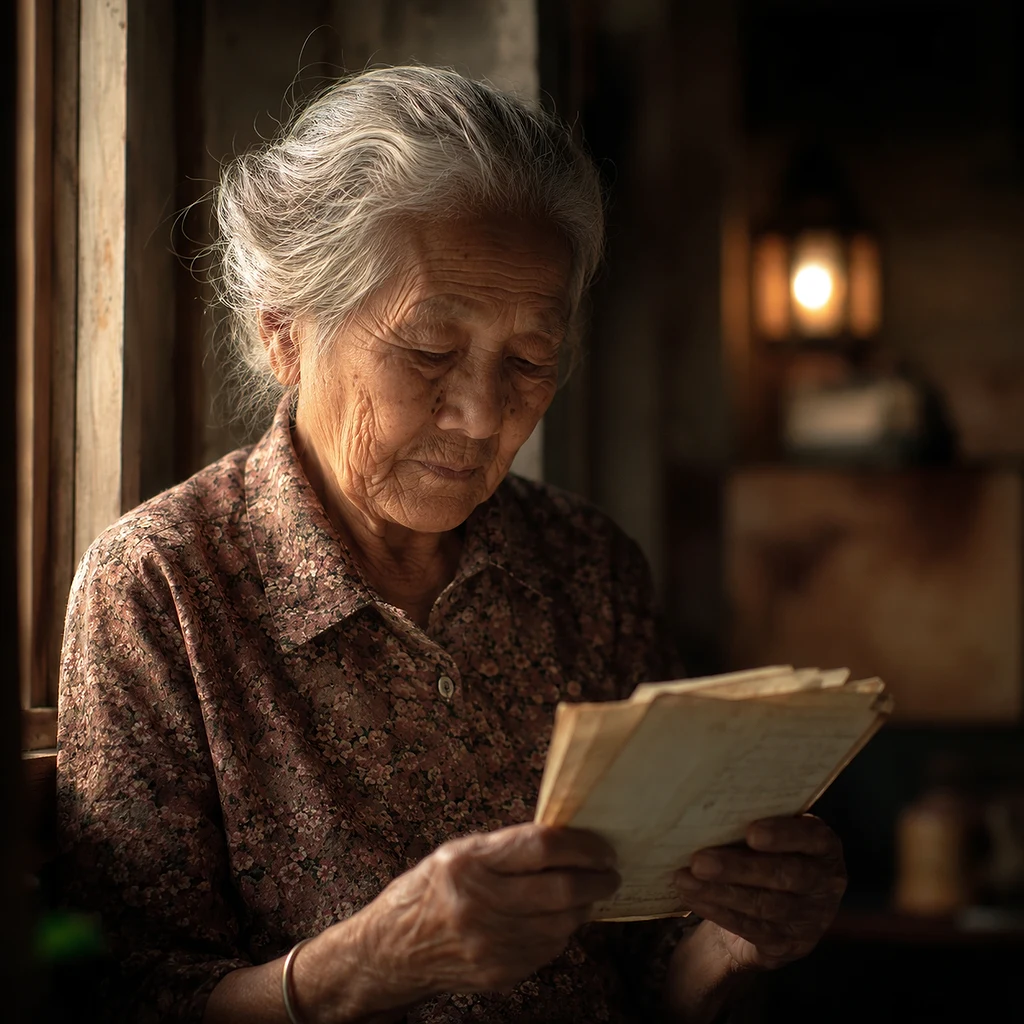
妈妈看了《给阿嬷的情书》
Mom Watched 'Letters to Grandma'
About this story
Mom Watched 'Letters to Grandma'. HSK 1 Chinese listening practice.
This is an HSK 1 Chinese listening episode that runs about 6 minutes. The full Mandarin script is shown with tap-for-pinyin and a line-by-line English translation, so you can listen and read at once — comprehensible input in the sense of Stephen Krashen's i+1 theory. It teaches 12 key vocabulary words such as 电影、朋友、钱 and walks through 4 grammar patterns, each explained in English with examples. The same news story is retold at 4 difficulty levels — use the level selector above to find the version that is challenging but still understandable for you.
Read at your level
原文Read the complete story in Chinese. Reveal pinyin and English only when you need them.
English transcript reference
Today my mom watched a movie.
She came home and told me.
I asked:
"Mom, what movie?"
Mom said:
"It's called Letters to Grandma."
"It's a really good movie."
I asked:
"Who is Amma?"
Mom said:
"Amma is grandma."
"Dad's mom is grandma."
I said:
"I get it."
I asked:
"What's the grandma in the movie called?"
Mom said:
"Her name is Shurou."
"She's very old."
"She lives alone at home."
I asked:
"What about her husband?"
Mom said:
"Her husband isn't home."
I asked:
"What's a husband?"
Mom said:
"The man-dad is a husband."
"My husband is your dad."
I said:
"I get it."
I asked:
"Where is grandma's husband?"
Mom said:
"He's in a faraway place."
"He's in Thailand."
"Thailand is a country."
"Thailand isn't China."
"He went there to work."
"He had money there."
"He sent money home."
I asked:
"How did he send it?"
Mom said:
"He wrote."
"He wrote:"
"'I have money now."
I'll give you money.
"'I love you."
I miss you.
I asked:
"How much did he write?"
Mom said:
"A lot, a lot."
"One year, two years, ten years, thirty years."
I said:
"That's many years."
Mom said:
"Grandma wrote too."
"Grandma wrote:"
"'I love you too."
"'I miss you too."
"'When are you coming home?"
I asked:
"Is he coming home?"
Mom said:
"He's not coming home."
I asked:
"Why?"
Mom said:
"Because he's gone."
"Gone means he's not there anymore."
I asked:
"Does grandma know?"
Mom said:
"Grandma doesn't know."
I asked:
"Then who's writing?"
Mom said:
"A friend of his."
"The friend is a woman."
"Her name is Nanzhi."
"Nanzhi is from Thailand."
"Nanzhi knew: he was gone."
"But Nanzhi didn't want grandma to be sad."
"So Nanzhi wrote to grandma."
I asked:
"What did Nanzhi write?"
Mom said:
"Nanzhi wrote:"
"'I have money now."
I'll give you money.
"'I love you."
I miss you.
I asked:
"Did grandma see them?"
Mom said:
"Grandma saw them."
"Grandma thought: my husband wrote these."
I asked:
"How many years did Nanzhi write?"
Mom said:
"Many years."
"Ten years, twenty years, thirty years."
I said:
"Nanzhi is a good person."
Mom said:
"Nanzhi is a really good person."
"Nanzhi sent money too."
"Lots and lots of money."
"Grandma used the money to send dad to school."
I asked:
"Who is dad?"
Mom said:
"Grandma's child is dad."
"Dad went to college."
I asked:
"Does Nanzhi know dad?"
Mom said:
"Nanzhi doesn't know him."
"Nanzhi has never met dad."
I asked:
"Does grandma know now?"
Mom said:
"Today grandma found out."
"Xiaowei told her."
I asked:
"Who is Xiaowei?"
Mom said:
"Xiaowei is grandma's grandchild."
"Xiaowei went to Thailand."
"Xiaowei wanted to find grandma's husband."
"He didn't find him."
"He found Nanzhi."
I asked:
"What did Nanzhi say?"
Mom said:
"Nanzhi told Xiaowei:"
"'Your grandpa is gone."
"'I'm the one writing to your grandma."
I asked:
"Did Xiaowei come home?"
Mom said:
"Xiaowei came home."
"He told grandma."
I asked:
"Did grandma cry?"
Mom said:
"Grandma didn't cry."
I asked:
"What did she do?"
Mom said:
"She went to check the food."
"She thought: has the food gotten cold?"
I said:
"She thought about food?"
Mom said:
"She thought about food."
"She also thought about Nanzhi."
"She said:"
"'Nanzhi is my good friend."
"'Nanzhi is also my family."
I asked:
"Is grandma alone?"
Mom said:
"Grandma isn't alone."
"She has Nanzhi."
I said:
"The movie is really good."
"I want to see it too."
Mom said:
"Okay."
Tomorrow we'll watch it together.
"Tomorrow we'll watch Letters to Grandma together."
I said:
"Okay."
Listen again
Try it without the transcript and notice what sounds clearer.
What vocabulary does this episode teach?
词汇A film. Used throughout the conversation to refer to the movie 《给阿嬷的情书》 (Letters to Grandma).
A friend. In the story, Nanzhi is grandma's husband's 朋友 — but she becomes more than that over thirty years.
Money. Used to describe what grandma's husband (and later Nanzhi) sent home from Thailand.
To write. In the episode, 写 is used for writing letters — though the simpler phrase 写字 (write characters) is used since 信 is beyond HSK 1.
To love. The letters say 我爱你 (I love you) — the same phrase you'd say to family or a partner.
想 has two senses: 'to think' and 'to miss someone.' In 我想你 (I miss you), it's the second sense. Context tells you which.
Teochew (Chaoshan-dialect) word for grandma — equivalent to standard Mandarin 奶奶. The movie title uses this regional word because the family in the film is Teochew.
Standard Mandarin for paternal grandmother. Mom explains the dialect 阿嬷 as just 奶奶.
Husband. Mom explains it as '男的爸爸' — 'the man-dad' — using only HSK 1 words she knows the child already understands.
To tell (someone something). In the film, Nanzhi 告诉 Xiaowei the truth; Xiaowei 告诉 grandma; grandma listens.
To cry. The most striking moment: grandma 没有哭 (didn't cry) — she went to check the food instead.
Why? Common question word. HSK 1 has 怎么 (how) but 为什么 (why) is HSK 2.
* beyond level超纲词
What grammar patterns appear in this episode?
语法Subject + 不在了
他不在了 literally means 'he is no longer here' — but in Chinese this is the gentle, indirect way to say someone has died. The episode never uses 死 (die); it uses 不在了 throughout, matching how Chinese families actually talk about loss.
他不在了。
奶奶的丈夫不在了。
X 就是 Y
就是 is a beginner-friendly way to define one word in terms of another. The mom uses it constantly to explain unfamiliar words: '阿嬷就是奶奶' — 'Amma is exactly grandma.'
阿嬷就是奶奶。
奶奶的孩子,就是爸爸。
X 给 Y 钱
Basic 给 (give) sentence: subject + 给 + recipient + object. Note that 给 here is HSK 2 but appears so often in HSK 1 daily life it's introduced early.
他给家里钱。
南枝给奶奶钱。
S + 没有 + Verb (past negation)
To say 'didn't do something' in the past, use 没有 + verb. The most famous line: '奶奶没有哭' — 'Grandma didn't cry.' Not 不哭, which would mean 'doesn't cry' (general).
奶奶没有哭。
南枝没有见过爸爸。
Proper nouns
专有名词Free account
Keep learning from this story
Create a free account to keep saved words and your preferred level together.
- Keep words with their story context
- Remember your preferred level
- Build your vocabulary over time