
A Chinese podcast · Same story, 4 levels
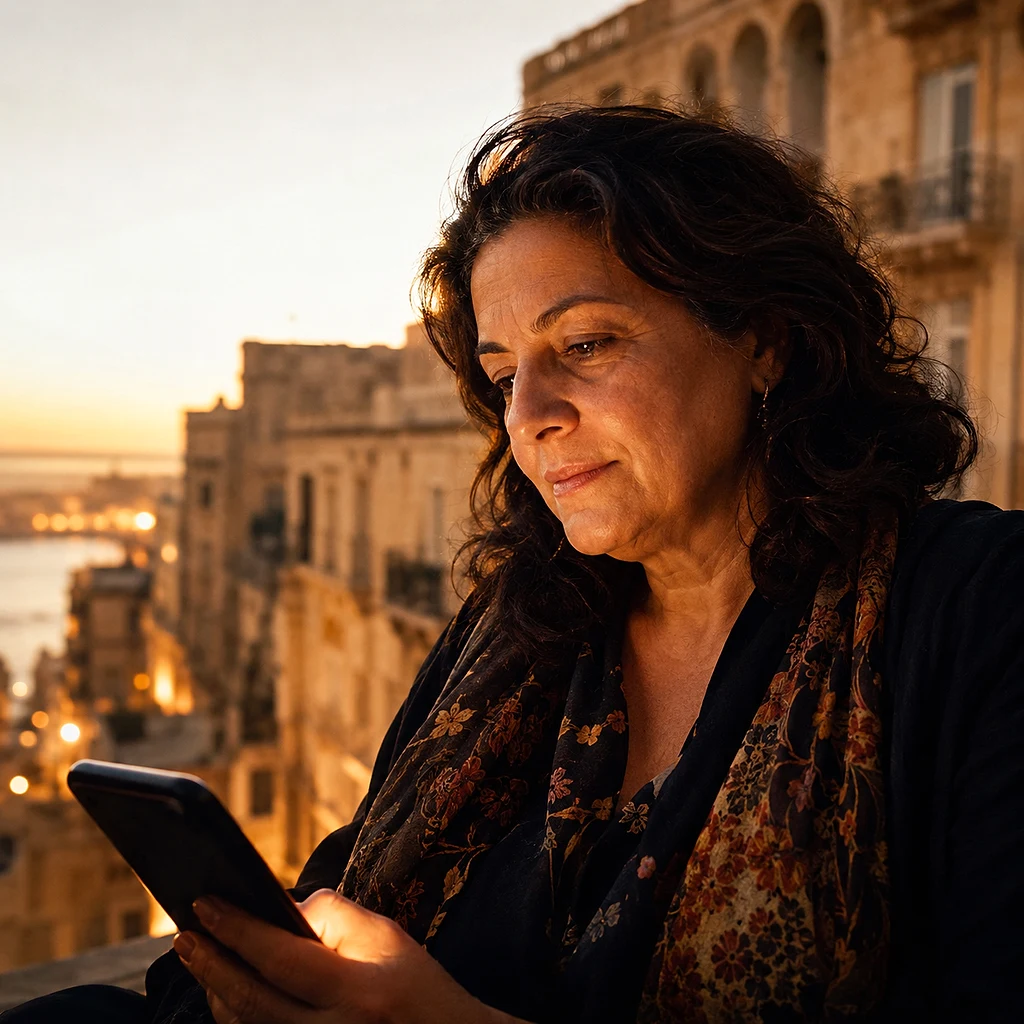
一个小国家的大新闻:所有人都能用 AI
A Tiny Country, a Big AI Deal: Free ChatGPT in Malta
About this story
A Tiny Country, a Big AI Deal: Free ChatGPT in Malta. HSK 1 Chinese listening practice.
This is an HSK 1 Chinese listening episode that runs about 4 minutes. The full Mandarin script is shown with tap-for-pinyin and a line-by-line English translation, so you can listen and read at once — comprehensible input in the sense of Stephen Krashen's i+1 theory. It teaches 12 key vocabulary words such as 电脑、中国、漂亮 and walks through 4 grammar patterns, each explained in English with examples. The same news story is retold at 4 difficulty levels — use the level selector above to find the version that is challenging but still understandable for you.
Read at your level
原文Read the complete story in Chinese. Reveal pinyin and English only when you need them.
English transcript reference
Today I'll tell you about a news story.
It's about a small country.
This country is called Malta.
Where is Malta?
Malta is in the sea.
It's a tiny place.
Malta isn't big.
China is big.
The US is big.
Malta is small.
Malta also has few people.
China has lots and lots of people.
The US also has many people.
Malta doesn't have many people.
What is new in this country?
In Malta, everyone can use a thing.
For free.
What is it?
It's a thing inside a computer.
We call it AI.
What is AI?
AI is in the computer.
You write to AI.
AI writes back to you.
You ask AI,
AI tells you.
Can AI speak?
AI can.
AI can speak.
AI can write.
Who made AI?
A company in the US made it.
What is the company called?
The company is called OpenAI.
The AI OpenAI made is called ChatGPT.
Can China use ChatGPT?
China cannot use ChatGPT.
In China we use other AI.
What about Malta?
Malta can use ChatGPT.
Today's news is this:
OpenAI and Malta are doing something new together.
OpenAI said:
"All your people can use ChatGPT.
"For one year, free of charge.
Malta said:
"OK.
"Our people can learn this thing.
Do we have it in China?
No.
Right now only Malta has it.
Malta is the first.
Why Malta?
Malta is very small.
Few people.
For doing new things,
a small country can move faster.
Are Malta's people happy?
Many are happy.
Some are not.
Why not?
Some people think:
"There's too much AI.
"Our children might stop studying.
Will AI make children stop studying?
I'm thinking about that too.
You can think about it too.
AI is new.
Many people are thinking:
What's the best way to use AI?
What should AI not do?
Can children use AI?
They can.
But don't let AI do your work.
You have to study yourself.
You have to think yourself.
AI can help you a little.
Do Malta's children also learn Chinese?
Malta's schools teach English.
They also teach Maltese.
Some schools teach Chinese too.
I want to go to Malta.
Do you want to go?
Malta is very far.
In the sea.
You'd have to take a long plane ride.
But Malta is beautiful.
There's the sea.
There are old buildings.
Finally I'll ask you one question:
Does your country want to do this?
Everyone uses AI,
for free.
Think about it.
Okay,
that's all for today.
Talk tomorrow.
Listen again
Try it without the transcript and notice what sounds clearer.
What vocabulary does this episode teach?
词汇Computer. The narrator introduces AI as 'something inside a 电脑' — anchoring an abstract idea to a familiar HSK 1 object.
China. The episode contrasts 中国 (lots of people) with 马耳他 (very few people) to show scale.
Beautiful, pretty. The narrator's pitch at the end: '马耳他很漂亮' — Malta is beautiful, with the sea and old buildings. One of the most useful HSK 1 adjectives.
Money. The headline phrase 不用钱 ('don't need money', i.e. free) is built from HSK 1 pieces — and is exactly the news.
Small. The whole story hinges on Malta being 小 — small population, small country, small enough to move fast.
To study. Two senses appear: (1) the Maltese have to 学习 before using ChatGPT; (2) some worry children will stop 学习 because of AI.
News (the kind on TV or a website). The opening line '今天我给你说一个新闻' — today I'll tell you a piece of news.
A company / firm. OpenAI is introduced as '美国的一个公司' (a company from the US) — a HSK 2 word every learner meets in modern news.
A country (as a political unit). 马耳他 is described as '一个小国家'. Built from 国 (state) + 家 (household) — country-as-household.
The first (one). The whole story is that 马耳他 is 第一个 — the first country in the world to do this. 第 is the ordinal marker; 第一 = number one.
To tell (someone something). Construction: 告诉 + person + content. 'AI 告诉你' = 'AI tells you.'
To help. The narrator's caution: 'AI 可以帮你一点点' — AI can help you a little, but it shouldn't do your work for you.
* beyond level超纲词
What grammar patterns appear in this episode?
语法不用 + Verb
不用 = 'no need to.' The whole headline lives in this pattern: 不用钱 ('no need for money' = free). Distinct from 不要 (don't want to) and 不能 (can't). 不用 means the option is there but not required.
不用钱。
一年都不用钱。
所有 + N + 都...
所有 means 'all / every.' Usually paired with 都 (also/all): 所有人都 = everyone. The whole news depends on this — 所有人都可以用 = 'all people can use.'
所有人都可以用。
马耳他所有的人都可以用。
在 + place introduces location. The episode uses it for both physical places (在马耳他, 在大海里) and metaphorical 'places' (在电脑里 = inside a computer). One particle, two uses, both HSK 1.
马耳他在大海里。
AI 在电脑里。
可以 / 不可以
可以 marks permission/possibility. The story uses both: 'AI 可以帮你' (AI is allowed/able to help) and 'AI 不可以做你的工作' (AI shouldn't do your work). Distinct from 会 (capability) and 要 (want).
所有人都可以用 ChatGPT。
不可以让 AI 做你的工作。
Proper nouns
专有名词Free account
Keep learning from this story
Create a free account to keep saved words and your preferred level together.
- Keep words with their story context
- Remember your preferred level
- Build your vocabulary over time