
A Chinese podcast · Same story, 4 levels
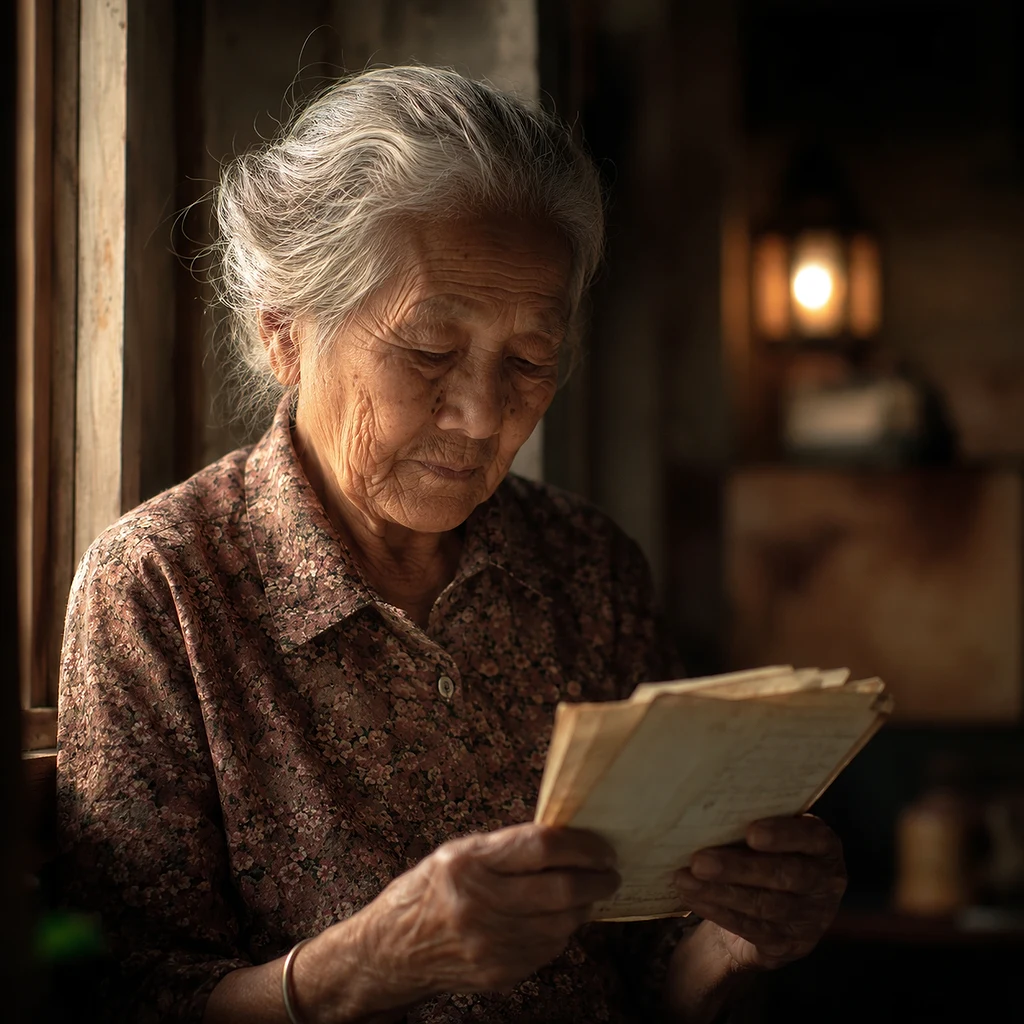
一封侨批写了三十年:《给阿嬷的情书》
Thirty Years of Letters: How a Stranger Became Family
About this story
Thirty Years of Letters: How a Stranger Became Family. HSK 5-6 Chinese listening practice.
This is an HSK 5-6 Chinese listening episode that runs about 6 minutes. The full Mandarin script is shown with tap-for-pinyin and a line-by-line English translation, so you can listen and read at once — comprehensible input in the sense of Stephen Krashen's i+1 theory. It teaches 12 key vocabulary words such as 历史、文化、决定 and walks through 4 grammar patterns, each explained in English with examples. The same news story is retold at 4 difficulty levels — use the level selector above to find the version that is challenging but still understandable for you.
Read at your level
原文Read the complete story in Chinese. Reveal pinyin and English only when you need them.
English transcript reference
Recently, something special happened in Chinese cinema.
A film shot entirely in the Teochew dialect
has earned over four hundred million yuan nationwide.
The film is called Letters to Grandma.
No big stars.
No big advertising campaign.
No big money behind it.
But within three weeks of its release,
it cracked the top eight of the 2026 box office.
Why?
Today I want to tell you about this film,
and also tell you about the thing behind the film,
called "qiao pi."
First, the story.
The grandma in the film is called Shurou.
She lives in southern China, in Chaoshan, Guangdong.
Her husband went to Thailand for work decades ago.
In that era,
many Teochew men went down to Nanyang.
"Going down to Nanyang"
means taking a boat from southern China to Southeast Asia to find work.
Thailand was one of the most common destinations.
They went there to do the hardest labor,
then sent the money they earned back to their families in China.
At that time, there were no telephones, no WeChat.
How did they send money?
How did they write letters?
They used something called "qiao pi."
"Qiao" is the qiao in 'huaqiao' (overseas Chinese),
meaning Chinese people living abroad.
"Pi," in Teochew, means "letter."
So "qiao pi" is the letter an overseas Chinese sends home from abroad.
But it isn't just a letter.
It also carries money.
The letter and money, sent home together.
This is a very special culture of the Chaoshan region.
For over a hundred years,
each qiao pi
was the most important connection
between the wives in Chaoshan
and the husbands in Nanyang.
But some of these men,
not long after arriving, were gone.
They had died over there.
The Teochew compatriots who'd traveled with them
didn't want to tell the wives and children back in China.
They decided:
we'll write in his place.
They used his name.
They wrote:
I have money now.
I'll send you money.
I love you.
I miss you.
Sometimes, they wrote in his place for five years.
Sometimes, for thirty years.
The story of Letters to Grandma
begins from one of these fake qiao pi.
There are three main characters in the film.
The first is grandma Shurou.
She waited for many years in her home in China.
She thought her husband was still in Thailand.
She thought he was sending letters every month.
She thought he was sending money every month.
She didn't know:
he had been gone for thirty years.
The second is her husband, Musheng.
He went down to Nanyang,
and never came back.
The third is Nanzhi.
Nanzhi was of Chinese descent.
She grew up in Thailand from childhood.
She and Musheng were good friends.
After Musheng was gone,
Nanzhi decided:
she would write in Musheng's place.
She would send money in Musheng's place.
She wouldn't tell the family in China.
She wrote for thirty years.
Nanzhi, in Thailand,
never married.
She didn't have children.
She ran small businesses,
and the money she earned,
about half of it,
she sent to Shurou in China.
She had never met Shurou.
She didn't know Shurou's child.
She didn't know Shurou's grandchild.
She got nothing in return.
But she kept it up for thirty years.
Now in the film, grandma is old.
Nanzhi is old too.
Musheng has been gone for a long time.
Grandma's grandson, Xiaowei,
has some problems of his own,
and he goes to Thailand
to find his grandfather and ask for money.
He'd heard his grandpa was a wealthy man in Thailand.
But what he finds
is not his grandfather.
It's Nanzhi.
The moment Nanzhi sees Xiaowei,
she knows he is Shurou's grandson.
She finally tells him the thirty-year truth.
She says:
your grandpa has been gone for thirty years.
I'm the one who wrote those letters in his place.
I'm the one who sent that money in his place.
Xiaowei, after hearing this,
cried for a long, long time.
He went back to China,
and he told grandma.
What moved me most
was what grandma did next.
Grandma didn't cry.
Grandma wasn't angry.
Grandma stood up,
and went to check the food she'd been cooking.
She said:
if the food gets cold, it won't taste good.
Just that one line.
When I got to this scene,
I cried for a long time too.
Because I suddenly understood:
grandma actually knew long ago.
Or, at the very least, she had accepted it.
She didn't care whether the person writing was her husband.
What she cared about was:
that someone, in those thirty years,
hadn't let her be alone.
She said:
Nanzhi is my good friend.
Nanzhi is also my family.
She said:
my thirty years
weren't lived by one person.
They were lived by two women, together.
This is the power of the film.
It doesn't loudly proclaim any great event.
It just slowly tells you:
real love
doesn't have to be marriage.
Real love
doesn't have to have ever met face to face.
Real family
isn't always blood.
Real family
is the person who, in those thirty years, didn't let you be alone.
Outside the film,
director Lan Hongchun said:
to make this film,
he visited three hundred families,
and read one hundred and twenty thousand real qiao pi.
He spent over twenty years preparing this story.
He said:
every village in Chaoshan
has a woman like Shurou.
Their husbands went to Nanyang,
and never came back.
They waited for many years.
They only learned at the end:
the one they were waiting for was actually someone else.
So this film
is more than just a film.
It is a piece of history.
It is the history of Chaoshan.
It is the history of southern China going down to Nanyang.
It is the story of women
left behind in China by that era,
who then, one letter at a time,
lived through many years.
Finally, I want to ask you a question:
in your family,
is there a person like this?
She might not be your grandma.
She might not be your mom.
She might be someone else.
But in those long years,
she didn't let you be alone.
If there is,
please today,
give her a call.
Tell her:
I remember.
Thank you for listening this far.
See you in the next story.
Listen again
Try it without the transcript and notice what sounds clearer.
What vocabulary does this episode teach?
词汇History. The narrator argues the film is more than a film — '它是一段历史', a slice of the history of Chaoshan and the southern Chinese diaspora to Southeast Asia.
Culture. 侨批 is described as 'a very special culture of the Chaoshan region' — a hundred-year tradition of money-bearing letters home.
To decide. The story turns on Nanzhi's quiet 决定 — choosing to write in the dead Musheng's name and never tell the family in China.
To accept (an idea, a person, a hard truth). The narrator's quiet insight: '至少她已经接受了' — at the very least, grandma has accepted the truth long ago.
Trust. The thematic core: Nanzhi's whole life-as-substitute-husband only works because she silently chose to be worthy of a 信任 that Shurou never knew she was extending.
Finally, at long last. Used at climactic moments when something long-held breaks open: 'Nanzhi 终于 told Xiaowei the thirty-year truth.'
A 'remittance-letter' — a single mailing that combines a family letter with a money transfer. Unique to the Teochew/southern Chinese diaspora. 侨 = overseas Chinese; 批 (in Teochew) = letter. UNESCO Memory of the World since 2013.
A historical idiom: 'to go down (south) to Nanyang.' Refers to the 18th–20th century waves of Chinese, especially from Fujian and Guangdong, emigrating by ship to Southeast Asia for work. Often one-way.
Box-office revenue. The film's surprise: a Teochew-dialect indie film cracked the top eight of 2026 box office — over 4 billion RMB in three weeks.
Someone from your hometown or home region — a powerful relational category in old Chinese society. When 同乡 went down to Nanyang together and one died, the other 同乡 would often hide it from the family back home.
The truth, the actual state of affairs (usually hidden until revealed). Distinguished from 真的 (really, genuinely). 真相 is a noun — what Nanzhi has held alone for thirty years and finally tells Xiaowei.
Power, strength, force. The narrator's verdict on the film: '这就是电影的力量' — this is the film's power. Not loud power. Quiet power.
* beyond level超纲词
What grammar patterns appear in this episode?
语法替 + person + Verb (sustained substitution)
替 marks substitution. In this film it carries a much heavier load than the dictionary suggests: a person can be 替'd not just for an afternoon's errand but for a whole life. Nanzhi 替 Musheng wrote letters for thirty years. The grammar is simple; the moral weight is enormous.
南枝替木生写了三十年。
他们决定替他寄钱。
以为 vs 知道 vs 在乎
Three closely-spaced verbs the film hinges on. 以为 = thought (but wrongly). 知道 = knew (factually). 在乎 = cared. The narrator's epiphany — 'she's not unaware (不是不知道), she just doesn't care (是不在乎)' — only works if you can feel the difference.
她一直以为他还活着。
她其实早就知道。
她不在乎是谁写的。
不一定 + clause (challenging an assumption)
不一定 is a soft but devastating tool for re-framing accepted definitions. The film stacks them in a row: real love doesn't have to be marriage. Real love doesn't have to have ever met. Real family isn't always blood. Each 不一定 chips at a default.
真正的爱,不一定是夫妻。
真正的家人,不一定是有血关系的人。
就是 + (concrete small detail) (downplay-reveal)
就是 followed by something small is a quiet rhetorical move: the small thing carries the big weight. The film's most famous moment uses it twice — '就这一句话' (just this one line) and '只有写信,寄钱,做菜' (just writing letters, sending money, making food).
就这一句话。
只有写信,寄钱,做菜。
Proper nouns
专有名词Free account
Keep learning from this story
Create a free account to keep saved words and your preferred level together.
- Keep words with their story context
- Remember your preferred level
- Build your vocabulary over time