
A Chinese podcast · Same story, 4 levels
没有一只帝王蝶能飞完整趟迁徙:这段路要四代接力才能走完
No Monarch Butterfly Ever Finishes Its Own Migration — the Trip Takes Four Generations
About this story
A monarch butterfly weighs about a gram, yet monarchs cross North America every year — and no single butterfly finishes the trip. Mothers lay eggs on poisonous milkweed and die; it takes three or four generations to fly nearly 5,000 km from Mexico to Canada. Then a special autumn generation that doesn't breed lives seven to nine months and flies 4,000 km back to a Mexico it has never seen, navigating by the sun. The milkweed's poison, stored in their bodies, is why birds learn to leave them alone. Chinese listening practice at four levels. HSK 3 Chinese listening practice.
This is an HSK 3-4 Chinese listening episode that runs about 4 minutes. The full Mandarin script is shown with tap-for-pinyin and a line-by-line English translation, so you can listen and read at once — comprehensible input in the sense of Stephen Krashen's i+1 theory. It teaches 12 key vocabulary words such as 方向、太阳、奇怪 and walks through 3 grammar patterns, each explained in English with examples. The same news story is retold at 4 difficulty levels — use the level selector above to find the version that is challenging but still understandable for you.
Read at your level
原文Read the complete story in Chinese. Reveal pinyin and English only when you need them.
English transcript reference
There's a butterfly that makes a long migration across North America every year.
The strange thing is that no single butterfly ever completes the whole journey from start to finish.
This butterfly is the monarch: orange wings with black stripes, each one weighing only about a gram.
Let's start with what it eats.
North America has a wild plant called milkweed; its leaves contain a toxin that makes people and many animals nauseous and sick.
Yet the monarch's whole life depends on this poisonous plant.
Females lay hundreds of eggs, spread out on the undersides of milkweed leaves.
A few days later, the larvae hatch and eat only milkweed leaves.
As they grow, the larvae molt several times, going from a few millimeters to about five centimeters long.
At the same time, the toxin slowly builds up in their bodies.
Later, the larvae become pupae and then butterflies, and the toxin stays in their bodies the whole time.
So the monarch's bright orange and black is actually a warning.
An associate professor at Beijing Forestry University says blue jays that have eaten a monarch avoid orange-and-black butterflies 97% of the time.
One American writer has even called the monarch a genius chemist.
But what monarchs are most famous for is their migration.
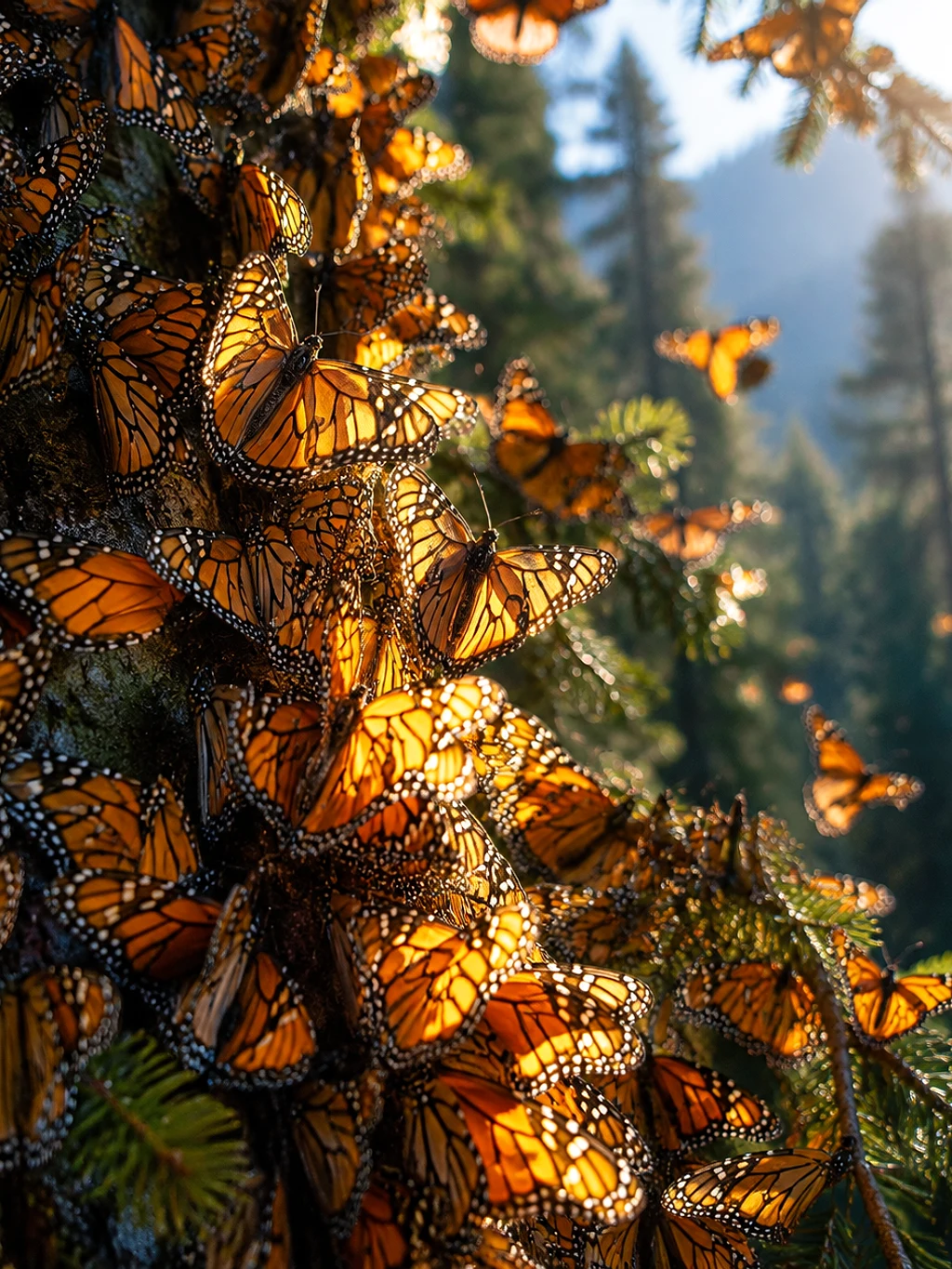
Every spring, in the forests of central Mexico, millions of monarchs rest in layers on the trunks of firs and pines.
As temperatures rise, they wake up and start flying north.
Along the way they can fly over a hundred kilometers a day — and in good weather with rising air currents, even three or four hundred.
As they fly, they sip nectar to refuel, and in the evening they rest in the woods.
On the way they mate; then the males die, and the females find milkweed, lay their eggs, and die too.
About a month later, a new generation emerges as butterflies and carries on north, repeating the same process.
After a relay of three or four generations, monarchs finally reach the northern US and southern Canada — almost five thousand kilometers from where they started.
When autumn comes and temperatures drop, the last generation born in the north is completely different from the ones before.
Their reproductive systems pause; they don't mate or lay eggs, and they save all their energy.
That way they can live seven to nine months, while earlier generations usually live only a month or so.
Some call this generation Methuselah, after a man in the Bible who lived to 969.
These long-lived monarchs start flying south.
They use the sun to find their direction and can also sense Earth's magnetic field; over two months they fly four thousand kilometers back to Mexico.
Remember, they've never been to Mexico — it's where their ancestors set out from.
Once in Mexico, they pack together in layers on the tree trunks again, huddling for warmth through the winter.
Four months or so later, when it warms up, they wake and become the first leg of the next journey.
Many animals return to where they were born — Chinese sturgeon go back to the upper Yangtze to spawn, and green sea turtles return to the beaches where they hatched.
But monarchs are different: no monarch can return to the place it was truly born, and none can complete the whole journey.
Generation after generation, this migration relay has gone on for tens of thousands of years.
If you knew you could never finish something in your lifetime, would you still start it?
Listen again
Try it without the transcript and notice what sounds clearer.
What vocabulary does this episode teach?
词汇HSK 3. 它们靠太阳来判断方向.
HSK 3. The monarch's compass.
HSK 2. 奇怪的是,没有任何一只蝴蝶,能从头到尾走完这段旅程.
HSK 3. 雌蝶……也离开了这个世界 — a gentle way to say died.
HSK 2. 每年都要完成一次横跨北美洲的长途迁徙.
HSK 2. 傍晚就在树林里休息.
The word for animal migration; 移民 is for people.
毒素也在它们身体里慢慢积累.
那身鲜艳的橙黑色,其实是一种警告.
幼 (young) + 虫 (bug).
经过三到四代的接力 — like a relay race.
还能感知地球的磁场.
* beyond level超纲词
What grammar patterns appear in this episode?
语法偏偏
Of all things — stresses a surprising contrast.
可是,帝王蝶的一生,偏偏离不开这种有毒的草。
经过……,才……
Only after going through X does Y happen.
经过三到四代的接力,帝王蝶才能到达美国北部和加拿大南部,这时离出发的地方,已经将近五千公里。
靠……
To rely on — here, how they navigate and survive winter.
它们靠太阳来判断方向,还能感知地球的磁场,花两个月飞四千公里,回到墨西哥。
Proper Nouns
专有名词Free account
Keep learning from this story
Create a free account to keep saved words and your preferred level together.
- Keep words with their story context
- Remember your preferred level
- Build your vocabulary over time