
A Chinese podcast · Same story, 4 levels
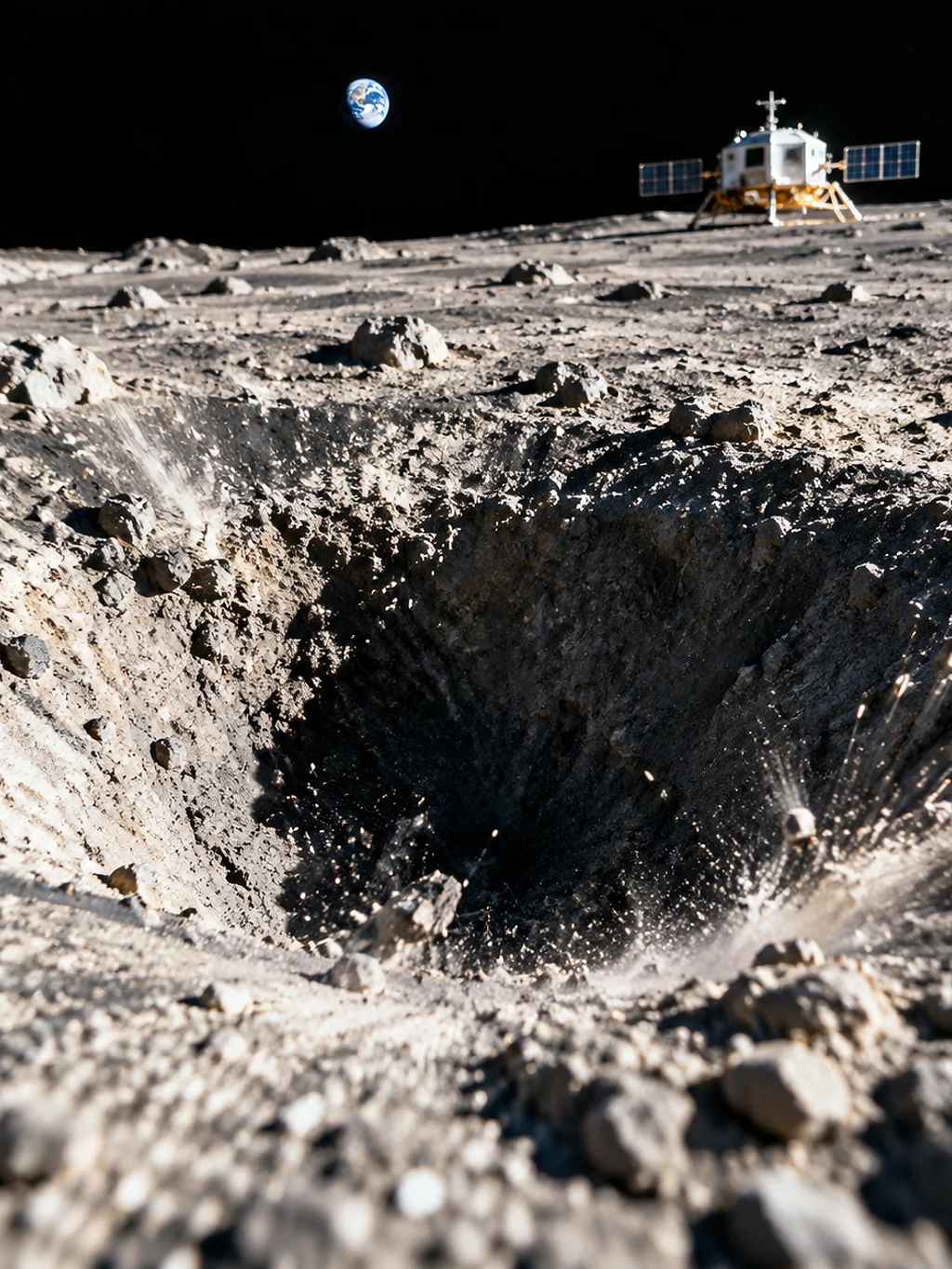
美国航天局发现月球多年来最大的新坑:未来的月球基地要小心了
NASA Spots the Moon's Biggest New Crater in Years — a Warning for Future Moon Bases
About this story
NASA's Lunar Reconnaissance Orbiter has found the largest fresh crater seen on the Moon since at least 2009: McGetchin crater, 222 meters wide, punched in spring 2024 by an object only 9 to 21 meters across. Impacts that big come about once every 132 years, but with the US and China planning bases at the lunar south pole in the 2030s, the crater's 100-kilometer spray of debris shows why small, hard-to-spot rocks are a real risk. Chinese listening practice at four levels. HSK 1 Chinese listening practice.
This is an HSK 1 Chinese listening episode that runs about 3 minutes. The full Mandarin script is shown with tap-for-pinyin and a line-by-line English translation, so you can listen and read at once — comprehensible input in the sense of Stephen Krashen's i+1 theory. It teaches 12 key vocabulary words such as 漂亮、看见、工作 and walks through 3 grammar patterns, each explained in English with examples. The same news story is retold at 4 difficulty levels — use the level selector above to find the version that is challenging but still understandable for you.
Read at your level
原文Read the complete story in Chinese. Reveal pinyin and English only when you need them.
English transcript reference
Do you like looking at the moon?
The moon is beautiful.
Did you know?
Up on the moon, lots of rocks come crashing down.
These rocks fly very fast.
Big rocks, small rocks — there are all kinds.
When a rock hits the moon, the moon gets a crater.
What is a crater?
When a rock hits, a piece of the moon's ground is gone.
That missing piece is called a crater.
The moon has lots and lots of craters.
Many of the craters are from many years ago.
But now, some people have spotted a new crater.
These people's job is looking at photos of the moon.
They look at old photos, and they look at new photos.
In the old photos, this crater isn't there.
In the new photos, this crater is there.
So this is a new crater.
This new crater is very, very big.
How big?
More than two hundred meters.
None of the new craters from these years is as big as this one.
The rock that hit came in 2024.
How big was this rock?
Just over ten meters.
A rock of a dozen or so meters made a crater of more than two hundred meters.
A new crater over two hundred meters wide comes along about once in a hundred-odd years.
Why does everyone want to know about this crater?
Because in the future, people want to go and live on the moon.
America wants to go, and China wants to go too.
They want to build a place to live on the moon.
People would live there for a few weeks, maybe a few months.
So when rocks come crashing down, what happens to the people living on the moon?
Where we live, there is air above us.
Many rocks never make it down — they vanish in the air.
But the moon has no air.
So on the moon, big rocks can crash down, and small rocks can crash down too.
Also, when one big rock hits, lots of small rocks fly off.
These small rocks can fly very, very far.
So even if the big rock doesn't hit the place you live, the small rocks might.
And small rocks are so small that people can't see them coming.
One American said: this is a very big problem.
The moon is beautiful, but living on the moon isn't very safe.
If one day you could go live on the moon for a few months, would you want to go?
Listen again
Try it without the transcript and notice what sounds clearer.
What vocabulary does this episode teach?
词汇HSK 1. 月亮很漂亮 — the calm picture the story then complicates.
HSK 1. 有人看见了一个新的坑 — and at the end, 人看不见它们来.
HSK 1. 这些人的工作,是看月亮的照片 — how the crater was found.
HSK 1. 人想去月亮上住 — the reason a crater suddenly matters.
HSK 1. 住几个星期,也可能住几个月 — how long astronauts would stay.
HSK 1. 你知道吗? — the spoken way to open a surprise.
HSK 3. The everyday word for the Moon; 月球 is the scientific name used at higher levels.
天上的石头 — the story never needs the word "asteroid" at this level.
Defined in the episode: 石头打下来,月亮上少了一块。少了的那一块,叫坑。
以前的照片上没有,现在的照片上有 — the before/after comparison.
我们住的地方,上面有空气 — why Earth is safer than the Moon.
HSK 3. 在月亮上住,不太安全 — the episode's conclusion.
* beyond level超纲词
What grammar patterns appear in this episode?
语法A 没有 B + adjective
A is not as [adjective] as B. The simplest comparison in Chinese.
这些年的新坑,都没有它大。
V + 得 + 很 + adjective
Describes how an action is done: flies fast, flies far.
这些石头飞得很快。
这些小石头能飞很远很远。
……,也可能……
Offers a second possibility: a few weeks, or maybe a few months.
人会在那里住几个星期,也可能住几个月。
小石头也可能打在你住的地方。
Proper nouns
专有名词Free account
Keep learning from this story
Create a free account to keep saved words and your preferred level together.
- Keep words with their story context
- Remember your preferred level
- Build your vocabulary over time