
A Chinese podcast · Same story, 4 levels
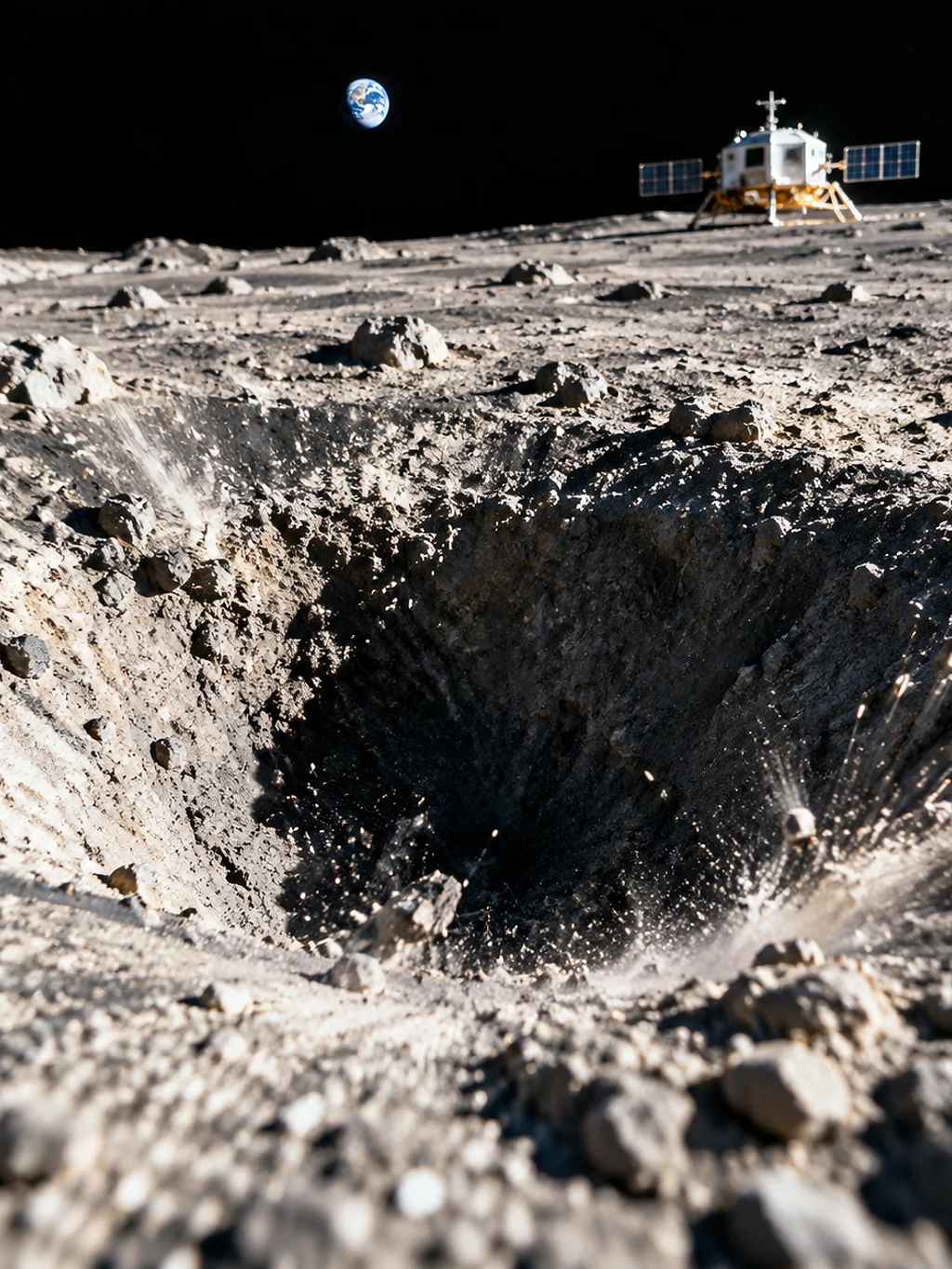
美国航天局发现月球多年来最大的新坑:未来的月球基地要小心了
NASA Spots the Moon's Biggest New Crater in Years — a Warning for Future Moon Bases
About this story
NASA's Lunar Reconnaissance Orbiter has found the largest fresh crater seen on the Moon since at least 2009: McGetchin crater, 222 meters wide, punched in spring 2024 by an object only 9 to 21 meters across. Impacts that big come about once every 132 years, but with the US and China planning bases at the lunar south pole in the 2030s, the crater's 100-kilometer spray of debris shows why small, hard-to-spot rocks are a real risk. Chinese listening practice at four levels. HSK 2 Chinese listening practice.
This is an HSK 2 Chinese listening episode that runs about 3 minutes. The full Mandarin script is shown with tap-for-pinyin and a line-by-line English translation, so you can listen and read at once — comprehensible input in the sense of Stephen Krashen's i+1 theory. It teaches 12 key vocabulary words such as 准备、非常、问题 and walks through 3 grammar patterns, each explained in English with examples. The same news story is retold at 4 difficulty levels — use the level selector above to find the version that is challenging but still understandable for you.
Read at your level
原文Read the complete story in Chinese. Reveal pinyin and English only when you need them.
English transcript reference
When you look at the moon at night, it looks very calm.
But did you know?
Rocks are always crashing down onto the moon.
There are many rocks in the sky, big and small.
They fly very fast, and when they hit the moon, the moon gets a crater.
A crater is the piece of ground that goes missing after a rock hits.
The moon has an incredible number of craters.
Most of them are from long, long ago.
But this month, NASA said it had found a big new crater.
NASA has a small spacecraft that keeps flying above the moon, taking photos of it every day.
Its team put the old photos and the new photos side by side.
In the old photos, there was nothing at that spot.
In the new photos, that spot had a big crater.
How big is this crater?
More than two hundred and twenty meters.
That's about the length of two football fields.
It's the biggest new crater they have seen since 2009.
One person who studies the moon said: this is a really huge crater.
So how big was the rock that made it?
Only ten to twenty meters.
Because it was flying so fast, a rock of a dozen or so meters could make a crater of more than two hundred meters.
The team also knows this rock hit in the spring of 2024.
A new crater this big only happens about once every hundred and thirty years.
So why does everyone care so much about this crater?
Because humans are getting ready to go back to the moon.
America and China both want to send people to the moon.
Later on, they also want to live there.
People would live there for a few weeks, maybe a few months.
If you live on the moon, rocks become a big problem.
On Earth, why aren't we very afraid of these rocks?
Because there is air above the Earth.
Many rocks smaller than ten meters burn up in the air before they reach the ground.
But the moon has almost no air.
So on the moon, big rocks can crash down, and small rocks can crash down too.
There's another problem many people haven't thought of.
When a rock crashes down, it knocks loose lots of smaller rocks.
Around this new crater, small rocks flew out more than a hundred kilometers.
So a big rock doesn't have to hit your home directly.
The small rocks that fly out could hit you too.
And while we can spot big rocks ahead of time, rocks a dozen meters wide are very hard to see coming.
One person who studies this problem said: the danger from small rocks is real.
The moon looks calm, but living on the moon is not simple at all.
If one day you had the chance to live on the moon for a few months, would you go?
Listen again
Try it without the transcript and notice what sounds clearer.
What vocabulary does this episode teach?
词汇HSK 2. 人类准备回到月亮上去 — the reason anyone cares.
HSK 2. 飞得非常快 — speed is why a small rock makes a huge crater.
HSK 2. 住在月亮上,石头就成了一个大问题。
HSK 2. 大坑旁边,小石头飞出去一百多公里。
HSK 2. 飞出来的小石头,也可能打到你。
HSK 2. 这是他们看到的最大的新坑 — the headline fact.
HSK 3. 地球上面有空气 — the contrast with the Moon.
Rocks under ten meters 在空气里烧没了 before reaching the ground on Earth.
HSK 3. 一个研究月亮的人 — how the episode introduces scientists without the word 科学家.
HSK 3. 小石头的危险,是真的。
大石头我们能提前看到 — small ones we can't.
人类准备回到月亮上去 — the whole species, not one country.
* beyond level超纲词
What grammar patterns appear in this episode?
语法差不多是……那么 + adjective
Gives size by comparison: about as long as two football fields.
差不多是两个足球场那么长。
还没……,就……
Something happens before another thing can: burns up before it even reaches the ground.
很多十米以下的石头,还没到地上,就在空气里烧没了。
……才会……
才 marks something rare or late: only once in about 130 years.
这么大的新坑,差不多一百三十年才会有一次。
Proper Nouns
专有名词Free account
Keep learning from this story
Create a free account to keep saved words and your preferred level together.
- Keep words with their story context
- Remember your preferred level
- Build your vocabulary over time