
A Chinese podcast · Same story, 4 levels
鱼子酱便宜到可以喂两岁的小孩了:一个很大的原因是中国的养鱼场
Caviar Got Cheap Enough to Feed a Toddler — and a Big Reason Is Chinese Fish Farms
About this story
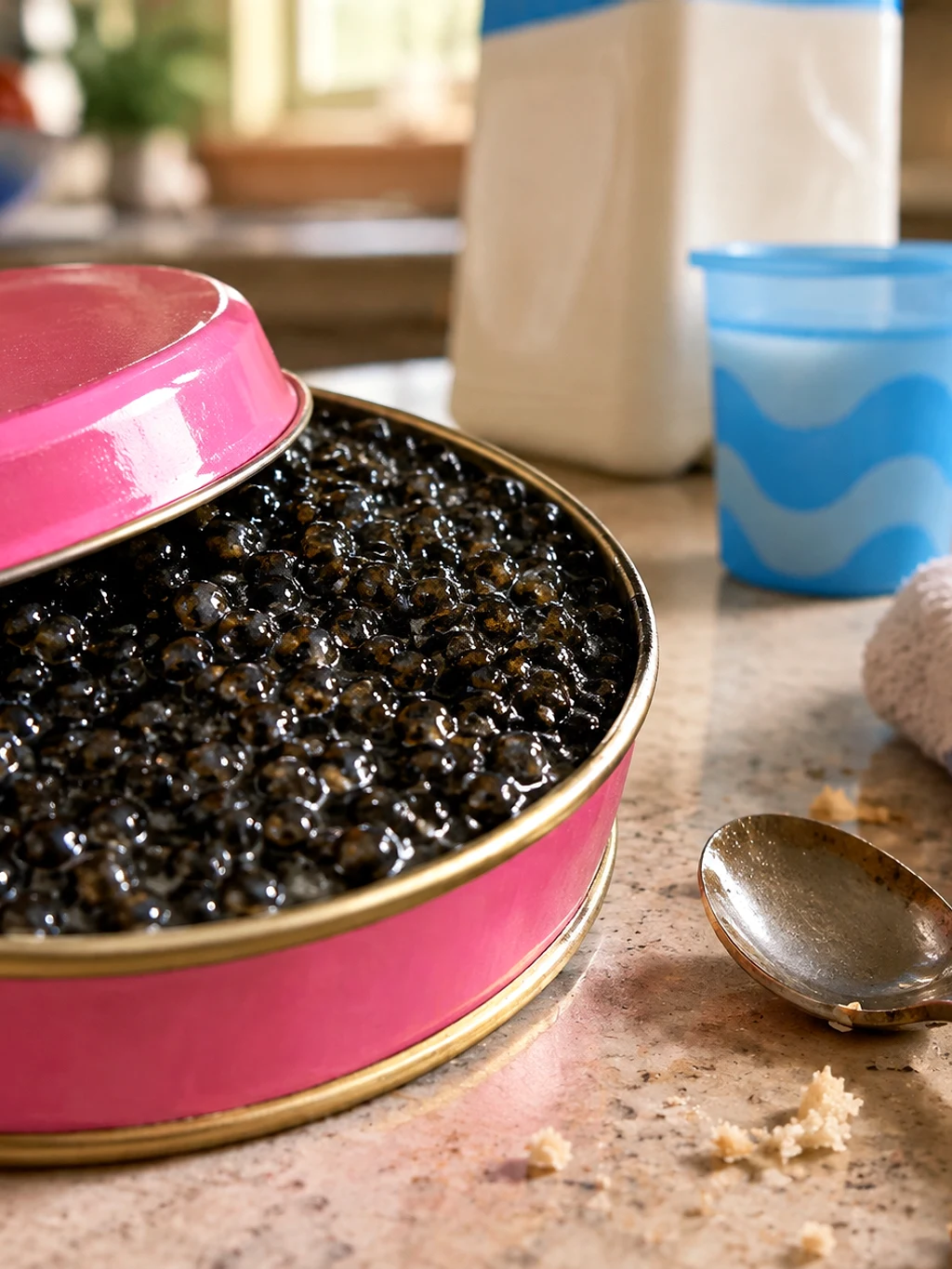
A 125g tin of classic Osetra costs $495 at a Manhattan caviar house; new direct-to-consumer brands sell comparable roe for $125 to $138, in pink tins, with promo codes. The reason is supply: sturgeon predate the dinosaurs and take years to produce roe, wild catches were banned after the Soviet collapse, and over the past decade Chinese sturgeon farms have matured — giant Chinese producers now supply both the discount brands and Michelin-starred kitchens. One luxury-strategy professor says the old prices were simply convention, and the newcomers called the bluff. Chinese listening practice at four levels. HSK 2 Chinese listening practice.
This is an HSK 2 Chinese listening episode that runs about 4 minutes. The full Mandarin script is shown with tap-for-pinyin and a line-by-line English translation, so you can listen and read at once — comprehensible input in the sense of Stephen Krashen's i+1 theory. It teaches 12 key vocabulary words such as 便宜、贵、饭馆 and walks through 3 grammar patterns, each explained in English with examples. The same news story is retold at 4 difficulty levels — use the level selector above to find the version that is challenging but still understandable for you.
Read at your level
原文Read the complete story in Chinese. Reveal pinyin and English only when you need them.
English transcript reference
Let's start with a price change you have probably never thought about.
Caviar.
It used to be an expensive thing.
In America, a small tin of good caviar cost over four hundred dollars.
The very best kind cost almost three thousand dollars for a small tin.
Three thousand dollars for one small tin of caviar.
So for many years, caviar only appeared in two places.
One was very expensive restaurants, the other was the homes of very rich people.
But now it is not the same.
Now there are new brands selling to you directly online.
One of them charges a hundred and twenty-five dollars, far cheaper than before.
Another, when it runs a promotion, drops from three hundred and forty-six dollars to a hundred and thirty-eight.
The tins these new brands use are different too.
The old tins were black and gold, and looked very formal.
The new brands' tins are pink and yellow, and look relaxed.
The customers they want are different as well.
One new brand says its customers are mainly women between twenty-five and forty-five.
Some people who used to drink have stopped, and buy caviar as a small treat instead.
Why is this happening?
The main reason is in China.
Caviar is the eggs of a fish, and that fish is called the sturgeon.
The sturgeon is ancient — older than the dinosaurs.
It grows slowly and needs many years before it produces eggs.
So caviar was always scarce.
When a thing is scarce, the price is high.
Over the past ten years, China began farming sturgeon on a large scale.
Now those fish have grown up and are starting to produce eggs.
China has one very large caviar company.
It supplies the new online brands on one hand, and starred fine-dining restaurants on the other.
A woman who has written a book about caviar puts it very directly.
She says: there is an enormous amount of Chinese caviar on the market now, much of it very cheap, and much of it very good.
When there is more of a thing, the price comes down.
Not everyone is pleased.
A shop that sells expensive caviar says: caviar that cheap should make you careful.
But there is another way of seeing it.
A professor who studies luxury goods says many brands set prices that high simply because that is how the trade has always set them.
What the new brands have done is call that bluff.
Finally, two people.
One is a thirty-three-year-old woman living in a very small town in America.
She says: caviar used to belong only to people in the know.
I live somewhere small, and there are no shops near me that sell this.
Now she can eat it at home, and she likes having a little on an ordinary evening.
The other is a thirty-four-year-old woman.
She used to eat caviar only in restaurants.
Now she eats it at home, and has even given her two-year-old a taste.
The child's reaction was three words: more, more, more.
Now have a think.
Something that has always been expensive suddenly becomes affordable to you.
Would you go and buy it?
Listen again
Try it without the transcript and notice what sounds clearer.
What vocabulary does this episode teach?
词汇HSK 2. 比以前便宜很多 — the comparison is the news.
HSK 2. 最好的那种,一小盒要差不多三千美元 — the top of the old market.
HSK 1. One of only two places caviar used to appear.
HSK 3. 最主要的原因,在中国 — the turn of the episode.
HSK 3. 它们要的客人也不一样 — the new brands chase a different buyer entirely.
HSK 2. 还给她两岁的孩子吃过一点 — the image the whole story is known by.
The subject; the episode starts with it as a one-word line.
比恐龙还老 — the one fact that makes this fish memorable.
东西少,价钱就高 — the everyday word for price.
新牌子 vs 老牌子 — the two sides of this market.
二十五岁到四十五岁的女性 — the new target customer.
太便宜的鱼子酱,你要小心一点 — the counter-argument, kept in.
* beyond level超纲词
What grammar patterns appear in this episode?
语法一边……,一边……
On one side X, on the other Y. Here it shows one Chinese producer supplying both ends of the market at once.
它一边供给网上的新牌子,一边供给拿过星的高级饭馆。
比……还……
Even more X than Y. 还 pushes the comparison further than expected.
鲟鱼很老,比恐龙还老。
……买得起
The potential complement 得起 means you can afford it. Its negative 买不起 is the old state of affairs.
一个一直很贵的东西,忽然变得你也买得起了。
Proper Nouns
专有名词Free account
Keep learning from this story
Create a free account to keep saved words and your preferred level together.
- Keep words with their story context
- Remember your preferred level
- Build your vocabulary over time