
A Chinese podcast · Same story, 4 levels
鱼子酱便宜到可以喂两岁的小孩了:一个很大的原因是中国的养鱼场
Caviar Got Cheap Enough to Feed a Toddler — and a Big Reason Is Chinese Fish Farms
About this story
A 125g tin of classic Osetra costs $495 at a Manhattan caviar house; new direct-to-consumer brands sell comparable roe for $125 to $138, in pink tins, with promo codes. The reason is supply: sturgeon predate the dinosaurs and take years to produce roe, wild catches were banned after the Soviet collapse, and over the past decade Chinese sturgeon farms have matured — giant Chinese producers now supply both the discount brands and Michelin-starred kitchens. One luxury-strategy professor says the old prices were simply convention, and the newcomers called the bluff. Chinese listening practice at four levels. HSK 3 Chinese listening practice.
This is an HSK 3-4 Chinese listening episode that runs about 5 minutes. The full Mandarin script is shown with tap-for-pinyin and a line-by-line English translation, so you can listen and read at once — comprehensible input in the sense of Stephen Krashen's i+1 theory. It teaches 12 key vocabulary words such as 原因、道理、情况 and walks through 3 grammar patterns, each explained in English with examples. The same news story is retold at 4 difficulty levels — use the level selector above to find the version that is challenging but still understandable for you.
Read at your level
原文Read the complete story in Chinese. Reveal pinyin and English only when you need them.
English transcript reference
Start with two prices.
At an expensive caviar shop in New York, a small tin of classic caviar costs four hundred and ninety-five dollars.
The best grade at the same shop is close to three thousand dollars for a small tin.
Now look at another price.
A new brand selling direct online charges a hundred and twenty-five dollars for the same quantity.
Another, running a promotion, drops from three hundred and forty-six dollars to a hundred and thirty-eight.
The same product, and the prices differ by more than tenfold.
More than tenfold is not a small gap.
This is currently reshaping the caviar trade.
First, what caviar actually is.
It is the roe of a fish, cured with salt.
The fish is called the sturgeon, an extremely ancient fish that appeared before the dinosaurs.
Sturgeon grow slowly.
A single sturgeon needs many years before it can produce roe.
So caviar was always something that could not be produced quickly.
When a thing is scarce, the price is naturally high.
The logic is very simple.
That said, caviar has not always been expensive.
In nineteenth-century America, bars would sometimes hand it out free as a snack.
Later the situation changed.
And it changed more than once.
In the 1990s the Soviet Union ceased to exist, and caviar prices in that region fell sharply for a time.
Once the price fell, more people fished for it, and wild sturgeon grew scarcer and scarcer.
Later, many countries banned catching wild sturgeon.
If you cannot catch them, the only option is to farm them.
So almost all the caviar on the American market today comes from farmed fish.
The real change has come in the last ten years.
China began farming sturgeon on a large scale.
Fish farming is not a one or two year business; you have to wait for the fish to mature.
Now that generation of fish has matured and begun producing roe.
The fish put in the water ten years ago are starting to yield.
China has one enormous caviar producer.
It supplies the new online brands on one side and the very finest restaurants on the other.
An author who has written specifically about caviar puts it very directly.
She says: there is an enormous amount of Chinese caviar on the market now, much of it very cheap, and much of it very well made.
Once supply rises, the price cannot hold.
When there is more of a thing, the price comes down.
The way these new brands sell is completely different too.
They advertise online, run discounts, offer free delivery, and even do holiday gift sets.
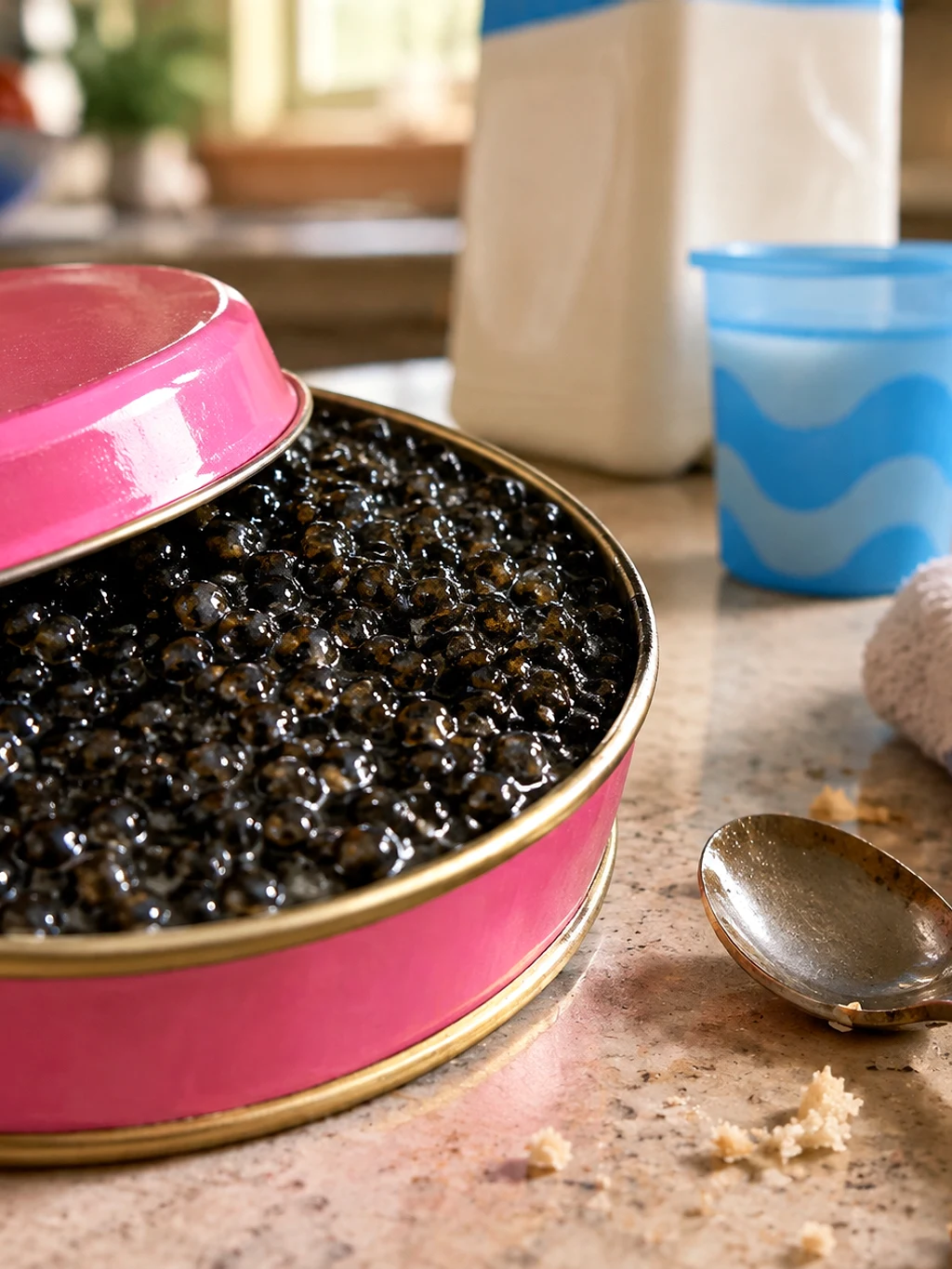
The colour of the tin has changed as well.
It used to be black and gold, looking formal and expensive.
Now it is pink and yellow, looking relaxed.
The customers they aim at are women aged twenty-five to forty-five.
That is completely different from the old customer.
The founder of a Boston brand has noticed something.
Some young women who used to drink are drinking less, and buy caviar as a small reward instead.
The founder of a Miami brand says some customers have bought again six, seven, eight times in a year.
The name that brand gave itself is very direct: the People's Caviar.
Of course, not everyone welcomes this change.
The head of that expensive New York shop has a warning for buyers.
He says: if caviar is abnormally cheap, you should be careful — it may be too good to be true.
But there is a completely opposite reading.
A professor who studies high-end brands points out that many brands set prices that high simply because the trade has always set them that way.
His phrase is: these new brands have called the trade's bluff.
Finally, two specific people.
A thirty-three-year-old woman lives in a very small town in the American south.
She says: for a long time, caviar belonged only to people inside the circle.
I live in the countryside, and there are no shops near me that sell this.
Now she can eat it at home, and she likes a little of it on an ordinary evening.
A thirty-four-year-old woman used to eat caviar only in restaurants.
Now she eats it at home, and has even given her two-year-old a spoonful.
The child's reaction was three words: more, more, more.
A two-year-old is eating caviar.
Look at the whole thing and it is not really only about caviar.
Sometimes a thing is expensive because it genuinely is hard to come by.
Sometimes it is expensive only because everyone has got used to the idea that it should be.
Those two kinds of expensive look identical, until somebody brings the price down.
Now have a think.
Something that has always been expensive suddenly becomes affordable to you.
Do you go and buy it, or do you doubt it first?
Listen again
Try it without the transcript and notice what sounds clearer.
What vocabulary does this episode teach?
词汇HSK 3. The episode separates two kinds of expensive by their cause.
HSK 3. 这个道理很简单 — scarcity pricing, stated plainly.
HSK 3. 后来情况变了。而且不止变了一次。
HSK 3. 只是因为大家都习惯了它应该贵 — the second kind of expensive.
HSK 3. 这和以前的客人完全不同。
HSK 3. 最后说两个具体的人 — the story ends on people, not prices.
一条鲟鱼要很多年才能产子 — note 条, the measure word for fish.
野生鲟鱼越来越少 — why farming became the only option.
绝大部分来自养殖的鱼 — the formal word for fish farming.
供给一多,价钱就撑不住了 — the economics in one clause.
把这一行的虚架子拆穿了 — the professor's point, in idiom.
HSK 4. 你会去买,还是会先怀疑它? — the closing choice.
* beyond level超纲词
What grammar patterns appear in this episode?
语法一 A,就 B
As soon as A, B follows. Compresses a whole market reaction into one sentence.
价钱一低,抓的人就多,野生鲟鱼越来越少。
不能 A,就只能 B
If A is not allowed, B is the only option left. Explains a forced choice.
不能抓,就只能养。
有时候……,有时候只是……
Sometimes it is X; sometimes it is merely Y. Separates two causes that look identical from the outside.
一样东西贵,有时候是因为它真的难得。
有时候只是因为大家都习惯了它应该贵。
Proper Nouns
专有名词Free account
Keep learning from this story
Create a free account to keep saved words and your preferred level together.
- Keep words with their story context
- Remember your preferred level
- Build your vocabulary over time