
A Chinese podcast · Same story, 4 levels
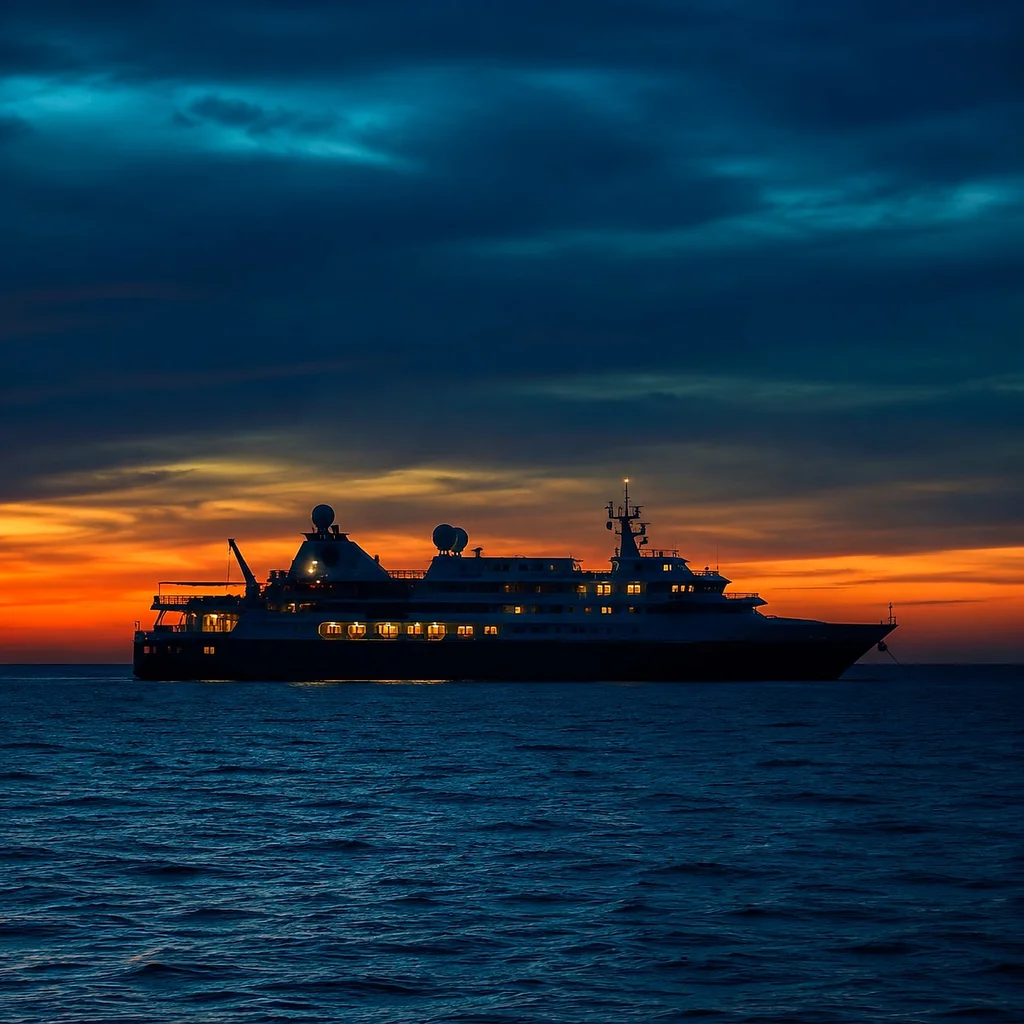
海上的"幽灵船":147人困在邮轮上,世界在追一个稀有病毒
MV Hondius Hantavirus Outbreak Strands 147
About this story
MV Hondius hantavirus outbreak — 147 passengers from 23 countries stranded as the Andes hantavirus is confirmed. HSK 5-6 Chinese listening practice.
This is an HSK 5-6 Chinese listening episode that runs about 9 minutes. The full Mandarin script is shown with tap-for-pinyin and a line-by-line English translation, so you can listen and read at once — comprehensible input in the sense of Stephen Krashen's i+1 theory. It teaches 20 key vocabulary words such as 诡异、症状、感染 and walks through 8 grammar patterns, each explained in English with examples. The same news story is retold at 4 difficulty levels — use the level selector above to find the version that is challenging but still understandable for you.
Read at your level
原文Read the complete story in Chinese. Reveal pinyin and English only when you need them.
English transcript reference
Today we're talking about an eerie and very serious story from the past week's news — a Dutch cruise ship called the MV Hondius, infected by a rare virus, is drifting in the Atlantic, almost unable to enter any port.
The timeline is simple, but every step makes your scalp prickle.
On April 1, 2026, the MV Hondius set off from Ushuaia at the southern tip of Argentina, bound for Antarctica.
There were 147 people on board, including tourists and crew, from 23 countries — this is a standard "high-end expedition cruise," and every spot is expensive.
On April 6, the first passenger showed symptoms: fever, cough, difficulty breathing.
On April 11, he died on board, initially recorded as a "natural cause" — no one realized this was only the beginning.
On April 24, his body was offloaded at Saint Helena Island, and his widow disembarked with him.
On April 26, his widow boarded a KLM flight from Johannesburg headed home, and only 45 minutes after takeoff, she suddenly died at cruising altitude.
This is an extraordinarily dramatic detail — and it was the turning point at which the international health system began to take alarm.
After this, more crew and passengers showed similar symptoms.
Doctors took samples and sent them in, and the final conclusion stunned everyone: this is a hantavirus, and the most dangerous strain — the "Andes type."
For most people, "hantavirus" is an unfamiliar word, so let me give some quick background.
Hantavirus isn't a new virus — it normally lives in wild rodents, meaning rats, voles, and similar animals.
Humans aren't infected by being bitten; they're infected by inhaling tiny aerosolized droplets of the rodents' urine, droppings, or saliva, through the respiratory tract.
So traditionally, hantavirus has been a "farm disease," a "grain-store disease," a "wilderness disease."
Symptoms include fever and muscle pain, and severe cases trigger an acute pulmonary edema called "hantavirus pulmonary syndrome," with mortality of 30 to 40 percent.
But there's one critical feature — the vast majority of hantaviruses do not pass between humans, so if you catch it, the people around you are safe.
For this reason it has long been classified in public health as "dangerous but contained."
But the Andes type is different.
It is currently the only known hantavirus that can spread between humans.
Transmission efficiency is low and requires close contact, but it does happen.
In 2018, Argentina had a small cluster outbreak of human-to-human transmission, the first time the medical community formally confirmed this property.
So this MV Hondius incident is especially sensitive.
A sealed, air-recirculating cruise ship is itself a "virus-friendly" environment — 147 people living in close quarters, sharing elevators, dining halls, gyms, and theaters.
For any respiratory virus, those conditions are a natural laboratory.
So how did the virus get on board?
The WHO's current view is: it's likely that one passenger was already infected before boarding.
He himself didn't feel sick, the medical screening showed nothing, and once at sea, after the incubation period, symptoms appeared.
By the time people on board began getting sick one after another, he had already passed the virus to at least a few of his closest contacts.
You could say this was an almost impossible-to-prevent infection event.
No one is to blame — except, perhaps, the rat that first left the virus in the air somewhere.
Now let's talk about the ship's situation.
On May 3, the MV Hondius arrived at the port of Praia in Cape Verde, but local authorities refused to let all passengers disembark, agreeing only to evacuate the most critically ill patients.
On May 6, three severe patients were flown directly back to the Netherlands by air ambulance, while the rest stayed aboard.
After that, the ship began heading north toward the Canary Islands of Spain — better medical conditions there, more suited to large-scale handling.
But the political reaction in the Canary Islands was also very interesting.
The president of the islands publicly refused docking, citing "protecting local residents."
Then the central Spanish government's health ministry stepped in directly and ordered the ship to be allowed to dock.
Their language was very firm: this is in line with "international law and humanitarian principles," and is also any country's "moral obligation" in the face of a maritime health emergency.
Suddenly, what had been a medical problem became a political one — and a test of whether a country has the courage and capacity to take in this ship.
Now let's look at daily life on the ship.
Reporters from CNN and BBC reached several passengers on board by satellite phone, and their descriptions sound like a slow-paced film.
Everyone wears masks, meals come in shifts, and rooms are kept apart.
The parties are gone, the pool is closed, the theater is closed.
Some people walk alone on deck for half an hour each day, watching the Atlantic waves.
Some have rewatched the same Netflix series three times in their cabin.
Some families are scattered across different cabins, afraid of infection, only able to call each other.
One person said: "This ship right now is like an island at sea — we have food, water, Wi-Fi, but no direction."
This state of affairs has lasted nearly a month.
Just think about that feeling of "collective suspension" — you don't have the drama of "trapped," and you don't have the relaxation of "vacation."
You're in some middle state you can't control — all you can do is wait: wait for the shore's permission, wait for governments to coordinate, wait to see if your next temperature reading is abnormal.
Meanwhile, on the other side of the world, a much larger sprint is underway.
According to current information, at least the Netherlands, Germany, the UK, Switzerland, South Africa, Spain, Cape Verde, and Argentina are all involved.
Every country is doing the same thing — searching: searching for people who already left the ship, searching for people who had close contact with them, searching for the flights, trains, taxis, and hotels they used.
In other words, the MV Hondius has become a map — a contact-tracing map leading into every corner of the world.
On Tuesday, the WHO held a meeting and said: there is risk, but it's manageable.
Their assessment: because the Andes type itself has low transmission efficiency, there's no sign of large-scale community spread.
That sounds reassuring, but we all know — we've heard similar things several times in the past few years.
We heard it during SARS, we heard it at the start of COVID, we heard it at the start of monkeypox.
So this time, everyone is unusually cautious — and unusually practiced.
Global response speed, compared with the storm six years ago, is markedly faster.
Tracing, isolation, cross-border medical transport, transparent information — every step is mostly in place.
This is a strange kind of "maturity" — not because we've gotten cleverer, but because we've been taught.
A virus isn't a story in the news; it's a real organism that travels from a rat to a person to a ship to twenty-three countries.
Finally, let's think — what does this story really tell us?
I think there are three things worth remembering.
First, globalization is real.
One ship connects 23 countries, one flight connects multiple continents.
A small rodent in the mountains of Argentina can keep a doctor in a Swiss hospital working overtime — in the past, this would have been almost unthinkable; today, it's the norm.
Second, public health is real.
We don't think about it much in normal times — we assume hospitals are there, vaccines are there, the WHO is there, that should be enough.
But every crisis brings a first reaction like the Canary Islands president's — "shut the doors first."
And it brings a counter-position like Spain's health ministry — "we must let them dock."
A society's true maturity isn't measured by how many hospitals or test kits it has, but by whether it can stretch out a hand at the most frightened moment.
Third, the "invisible" things are always the most dangerous.
The things our eyes can see — car accidents, earthquakes, fires — are actually easier to deal with.
What's truly hard to deal with is the kind of thing only an electron microscope can see.
Viruses are like this; emotions are like this; information flows are like this.
So this story isn't just about one ship,
it's a reminder: today's humans are connected through air, sea, flight routes, and data — no one can run.
For now, the MV Hondius is still slowly approaching the Canary Islands.
The people on board are still waiting; doctors are still running; relatives are still on the phone; the whole world is still watching this ship.
The moment it docks may end up being a small news item — only a few lines.
But that moment will be one when dozens of countries, hundreds of doctors, thousands of samples, and over a hundred hearts all exhale together.
We hope that moment comes soon.
Listen again
Try it without the transcript and notice what sounds clearer.
What vocabulary does this episode teach?
词汇HSK 6. 诡 (strange) + 异 (unusual). Stronger than 奇怪. Used here to set the gothic tone.
HSK 5. 症 (illness) + 状 (condition). The clinical word.
HSK 5. 感 (feel) + 染 (contaminate). The whole episode revolves around 感染.
HSK 5. 传 (transmit) + 播 (broadcast). 传播效率 = transmission efficiency.
HSK 6. 猝 (sudden) + 死 (die). Glossed inline. The word that triggered the international alarm.
Beyond HSK 5. The central political verb of the episode.
HSK 6. 应 (respond) + 对 (face). Used for managing crises.
HSK 6. 追 (chase) + 踪 (trace). 疫情追踪 = outbreak tracing.
HSK 6+. 悬 (hang) + 浮 (float). 集体悬浮的感觉 = the feeling of collective suspension.
HSK 4. 真正的成熟 = true maturity. Used as the episode's editorial frame.
Specialist (medical). 汉坦 transliterates 'Hanta' (Korean river). Glossed throughout.
Specialist (biology). 啮 (gnaw) + 齿 (tooth). The natural reservoir.
Specialist. 雾 (mist) + 化 (-ize). Key to how dried rodent droppings infect humans.
Specialist (medical). 肺 (lung) + 水肿 (edema). The fatal complication of severe hantavirus.
Specialist. 潜 (hidden) + 伏 (lurk) + 期 (period). The window between infection and symptoms.
HSK 5. Universal post-COVID vocabulary.
HSK 4. 公共卫生 = public health. 卫生部 = health ministry. Central political vocabulary.
HSK 6+. 人道 (humanity) + 主义 (-ism). Spain cited this to force docking.
HSK 5+. 孤 (alone) + 岛 (island). Used as a metaphor for the ship's isolation.
Specialist. The instrument used to image viruses, used here as an editorial metaphor.
* beyond level超纲词
What grammar patterns appear in this episode?
语法X 不是 ... 而是 Y
Corrective structure central to argumentative prose.
不是被咬才感染,而是吸入它们的尿液、粪便、唾液雾化后的小水滴,从呼吸道感染。
不是因为我们变厉害了,而是因为我们已经被教育了。
病毒不是新闻里的故事,是会从一只老鼠,跑到一个人,跑到一艘船,跑到二十三个国家的真实生物。
也就是说 ...
Apposition: 'that is to say' — used to restate in a more formal, expository register.
也就是说,洪迪斯号变成了一张地图——一张通向全球每一个角落的疫情追踪地图。
可以说,这是一次几乎不可能预防的感染事件。
把 + Object + Verb + Result (disposal)
Disposal construction with explicit result.
把汉坦病毒带到了世界各地。
我们眼睛能看到的,比如车祸、地震、火灾,反而好处理。
他已经把病毒传给了至少几个最近的接触者。
对 X 来说
Topicalizer: 'For X / from X's perspective.'
对很多人来说,'汉坦病毒'是一个陌生的词。
这种条件,对任何呼吸道病毒来说,都是天然的实验场。
不仅 / 不只 ... 也 / 还 ...
'Not only X, also Y.' Adds parallel points.
原本是医学问题,瞬间变成了政治问题。
也变成了对一个国家'我们有没有勇气和能力收下这艘船'的考验。
X 一旦 ... 就 ...
'Once X, then Y.' Often used for irreversible changes.
等到出了海,他才开始病。
等到病毒在船上传开了。
你想一想,X 有多 Y
Rhetorical hook: 'just think how X this is.' Pulls the listener in.
你想一想,这种'集体悬浮'的感觉。
你想一想,这有多巧。
X 是这样 / 这是真的 / 这是常态
Editorial tag: closing the argument with a definitional sentence.
病毒是这样,情绪是这样,信息流也是这样。
今天,是常态。
全球化是真的。
Proper nouns
专有名词Free account
Keep learning from this story
Create a free account to keep saved words and your preferred level together.
- Keep words with their story context
- Remember your preferred level
- Build your vocabulary over time