
A Chinese podcast · Same story, 4 levels
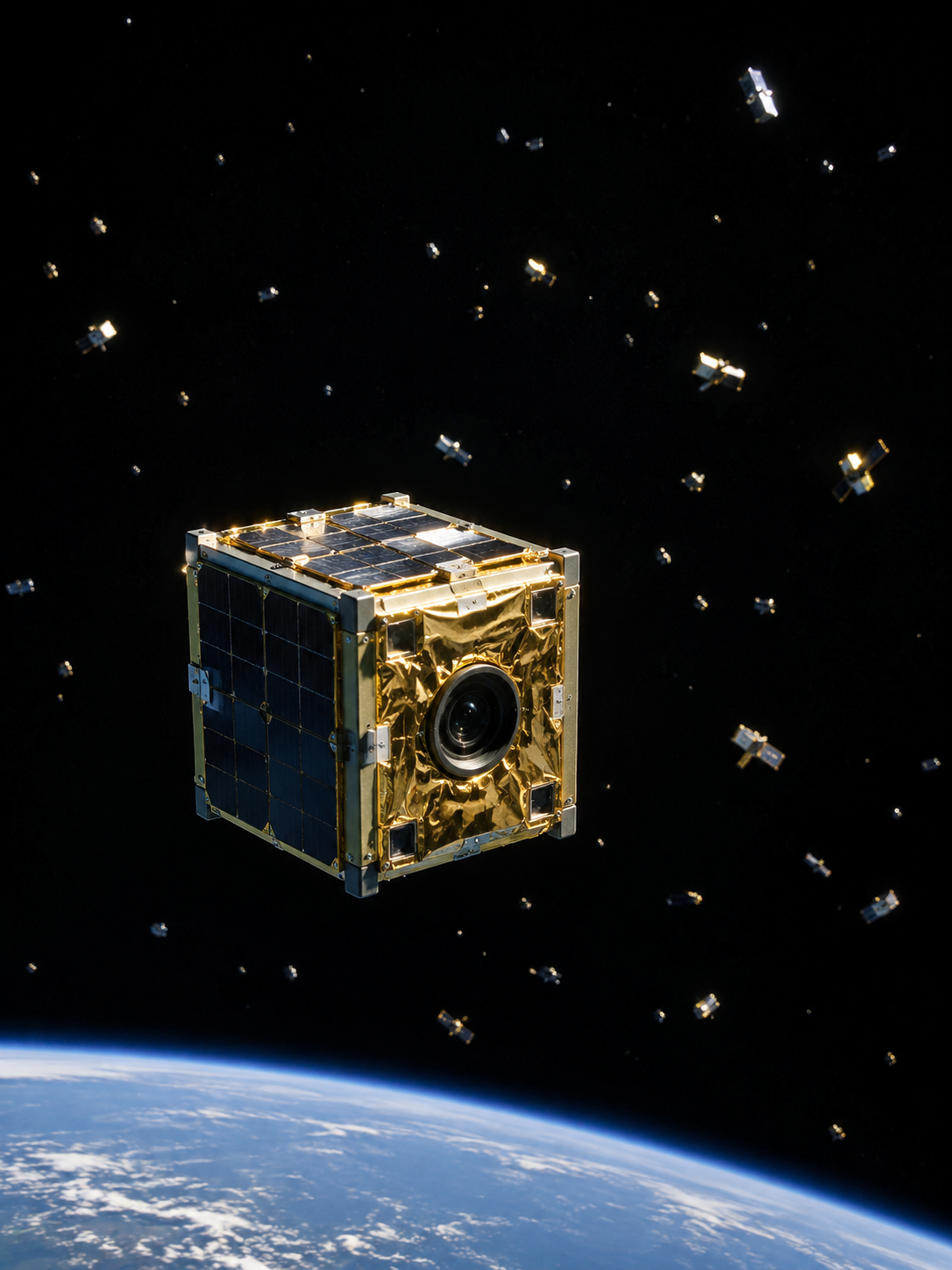
NASA 让卫星靠拍太空垃圾找到了自己。大家都嫌碎片危险,它成了天上唯一免费的路标。
NASA Satellite Navigates by Photographing Space Junk
About this story
NASA Satellite Navigates by Photographing Space Junk. HSK 5-6 Chinese listening practice.
This is an HSK 5-6 Chinese listening episode that runs about 3 minutes. The full Mandarin script is shown with tap-for-pinyin and a line-by-line English translation, so you can listen and read at once — comprehensible input in the sense of Stephen Krashen's i+1 theory. It teaches 6 key vocabulary words such as 同时、实验、结果 and walks through 3 grammar patterns, each explained in English with examples. The same news story is retold at 4 difficulty levels — use the level selector above to find the version that is challenging but still understandable for you.
Read at your level
原文Read the complete story in Chinese. Reveal pinyin and English only when you need them.
English transcript reference
Start with a question most people have never once thought about.
How does a satellite know where it is?
On the ground this is easy to answer: a glance at your phone will do it.
Your phone has navigation, and navigation relies on twenty-odd dedicated satellites constantly beaming signals down at the ground.
Your phone picks up several of those signals at once, compares the difference in when they arrive, and works out where you are standing.
But that system was designed for the ground in the first place.
Its signals point downward, like an umbrella, covering the whole Earth.
A satellite flying under that umbrella can still catch a signal.
Once you fly higher — out toward the Moon — the umbrella no longer reaches.
So in deep space a satellite has only two roads: wait for people on the ground to tell it where it is, or work it out itself.
Last week the American space agency published the result of an experiment that took the second road.
It ran on a group of small satellites, with a partner company spun out of a university.
The method, stripped down, is plain to the point of being charming.
The satellite already had cameras on board.
In the past those cameras were used to photograph the ground, or the companions in its formation.
This time, they had it look up and photograph something else.
Photograph what?
Everything up there that can be seen.
Other satellites — and space junk.
Humans have left tens of thousands of pieces of rubbish in low Earth orbit: dead satellites, rocket debris, fragments from collisions.
They are not drifting at random.
Every piece sits obediently on its own orbit, and its position can be calculated.
The ground has long had a catalogue, recording item by item roughly where these things are.
And so the logic falls out.
The camera photographs a bright point, the satellite checks the catalogue, and guesses which piece it is.
It photographs a second and a third, and the combinations that fit all of them at once get fewer and fewer.
Once enough reference points match, the satellite can work backwards to which orbit it is on, and where on that orbit.
The principle is exactly the same as finding your way in an unfamiliar city.
You do not know where you are, but you recognise three buildings, and then you do.
Except here the buildings are rubbish humans threw into the sky themselves.
The result was better than expected.
In three days, that satellite worked out the orbits of more than two hundred space objects more accurately than before, on its own.
For the whole run, nobody on the ground was directing it.
It found itself — and along the way it made that catalogue slightly more accurate too.
Finally, the layer of this I find most elegant.
Space junk has always been purely bad news.
Every so often a report says the debris in low Earth orbit is increasing, getting more dangerous, and could smash a working satellite at any moment.
All of that holds. Not one word of it is exaggerated.
But in this experiment, that same pile of fragments turned into markers by the roadside.
The things did not change. What changed is the angle you look at them from.
A heap of rubbish nobody wanted became, when it was needed, the only free coordinate system in the sky.
Think about it:
Something everyone treats as a nuisance — could it, at the same time, be an answer?
Listen again
Try it without the transcript and notice what sounds clearer.
What vocabulary does this episode teach?
词汇你的手机同时收到好几颗的信号 — your phone receives several signals at once.
公布了一个实验结果 — published the result of an experiment.
结果,比预期好 — the result was better than expected.
和你在一座陌生的城市里认路,完全一样 — exactly the same as finding your way in a strange city.
近地轨道 — low Earth orbit.
对上的参照物足够多之后 — once enough reference points match.
* beyond level超纲词
What grammar patterns appear in this episode?
语法……的时候
When / at the time that. The clause comes first.
在需要它的时候 — at the moment it was needed.
不是……而是……的变体:A 没有变,变的是 B
A did not change; what changed is B. A clean way to relocate the real difference.
东西没有变,变的是看它的角度。 — The things did not change; what changed is the angle.
足够……之后
"After enough ..." — a threshold clause.
对上的参照物足够多之后 — once enough reference points match.
Proper nouns
专有名词Sources
来源Free account
Keep learning from this story
Create a free account to keep saved words and your preferred level together.
- Keep words with their story context
- Remember your preferred level
- Build your vocabulary over time