
A Chinese podcast · Same story, 4 levels
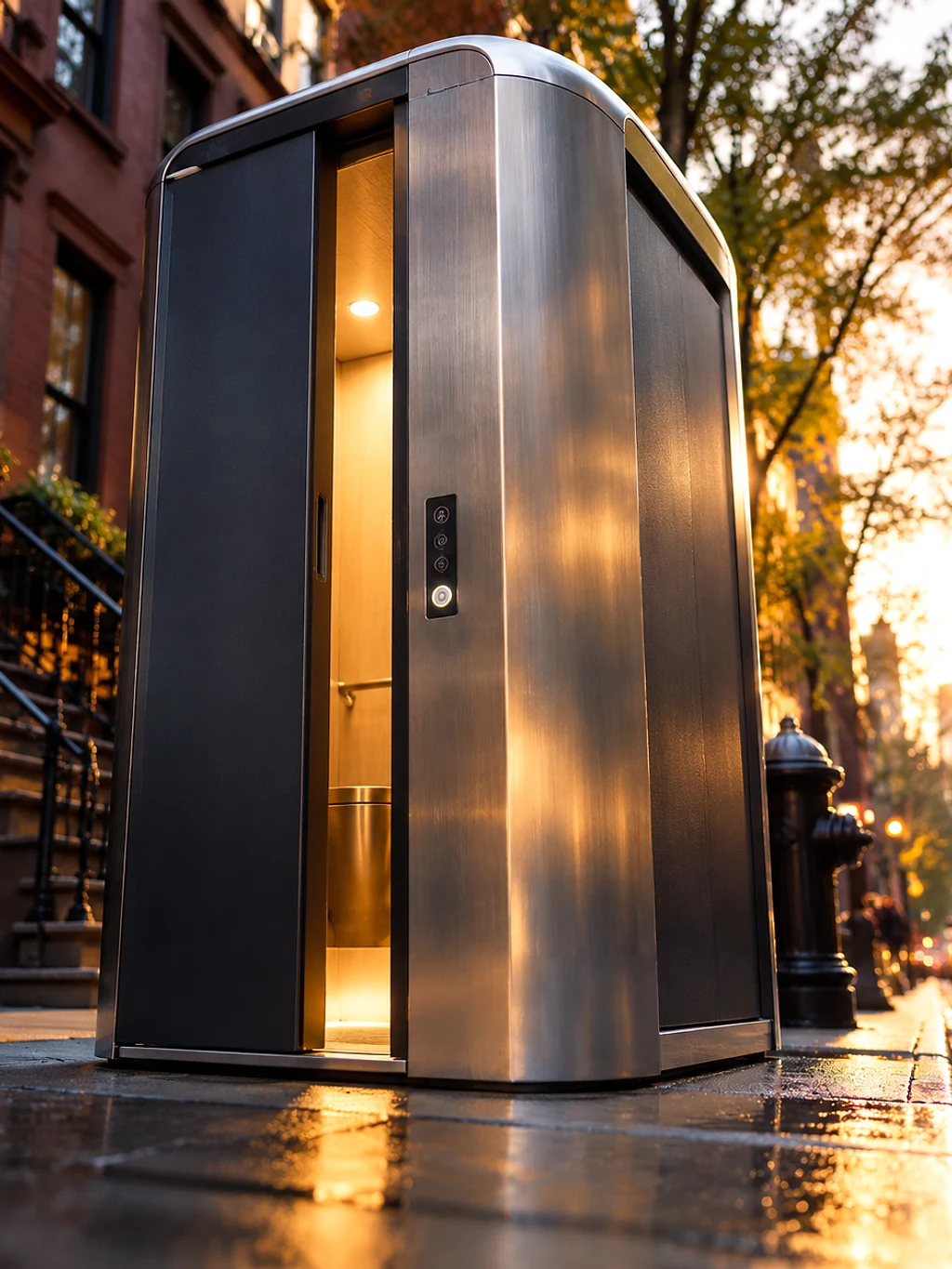
纽约街头的免费机器人厕所:十分钟一到,门自己打开,不管你好了没有
New York Put Free Toilets on the Street, and the Door Slides Open by Itself After Exactly Ten Minutes — Finished or Not
About this story
New York City has roughly 1,000 public toilets for more than eight million residents, and issued over 10,000 public-urination summonses last year. In September 2026 it put the first of a new kind on the sidewalk: free, unlocked by a text message or a tap card, and hard-capped at ten minutes, after which the door slides open on its own. Two are live in Brooklyn and Queens; seventeen more are coming on a $4 million pilot. Chinese listening practice at four levels. HSK 3 Chinese listening practice.
This is an HSK 3-4 Chinese listening episode that runs about 3 minutes. The full Mandarin script is shown with tap-for-pinyin and a line-by-line English translation, so you can listen and read at once — comprehensible input in the sense of Stephen Krashen's i+1 theory. It teaches 12 key vocabulary words such as 结果、问题、公司 and walks through 3 grammar patterns, each explained in English with examples. The same news story is retold at 4 difficulty levels — use the level selector above to find the version that is challenging but still understandable for you.
Read at your level
原文Read the complete story in Chinese. Reveal pinyin and English only when you need them.
English transcript reference
Start with one number: a thousand.
That is roughly how many public toilets the whole of New York City has.
New York has over eight million residents, and several hundred thousand more come into the city every day.
A thousand toilets have to go around all of those people.
The result is easy to guess.
Last year alone, New York issued more than ten thousand tickets for public urination.
More than ten thousand tickets punish people — but the problem is not in the people.
This September, the city put a new kind of toilet on the street.
It is a free-standing little cabin, set directly on the sidewalk.
The first batch was two: one in Brooklyn, one in Queens.
Seventeen more will follow.
The whole pilot cost four million dollars.
This toilet has three features worth taking one at a time.
First, it is completely free.
Second, the door is locked, but the way you open it is unusual.
You text a number from your phone, and the door opens.
People without a phone can use a tap card handed out by the city and touch it to the door.
Third, and this is the part that surprises people most: you only get ten minutes.
As the ten minutes runs down, a speaker inside warns you once.
The moment the time is up, the speaker says the same sentence twice, once in English and once in Spanish.
It says: your use time has expired, the door is opening now.
Then the door slides open on its own.
Whether you are finished, it does not know, and it will not ask.
And if somebody digs in and refuses to leave?
The company operating the toilets gets an alert.
If it goes on too long, they may notify the police.
It sounds a little heartless.
But behind that rule sits a very practical piece of arithmetic.
There are only a handful of toilets, and a great many people waiting.
All it takes is one person staying inside for an hour, and nobody behind them gets to use it.
The answer New York arrived at is ten minutes.
That number was not picked at random, and it could never satisfy everyone.
On one side is letting every person keep their dignity; on the other is letting more people get in at all.
Ten minutes is the line drawn between those two things.
When the mayor introduced the plan, he said one sentence.
He said: too many New Yorkers know that feeling — you are already out on the street, and there is nowhere you can go.
For the past several decades, most American cities did exactly the opposite.
Public toilets were shut down one after another, because they cost money and because of what might happen in them.
Now New York is trying to run that backwards for once.
Only this time, it brings a new problem along with it.
Suppose you are in there, the speaker sounds, and the door begins to slide aside.
Those ten minutes — how would you use them?
Listen again
Try it without the transcript and notice what sounds clearer.
What vocabulary does this episode teach?
词汇HSK 3. 结果很好猜 — the episode states the outcome before giving the number.
HSK 2. 罚的是人,可是问题不在人身上 — punishment and cause pointed at different targets.
HSK 2. 运营这些厕所的公司 — a private operator with an alert system, on a public sidewalk.
HSK 2. 开门的方式很特别 — flagged before the mechanism is explained.
HSK 3. 他们可能会通知警察 — the quiet last line of the enforcement chain.
HSK 3. 太多纽约人都知道那种感觉 — the mayor names the experience rather than the policy.
一万多张罚单 — takes 张, and the episode uses the count as evidence, not as a verdict.
整个试点计划,花了四百万美元 — nineteen units is a test, not a policy.
里面的喇叭会先提醒一次 — the only thing in the room that talks to you.
直接放在人行道上 — attached to no building, which is the whole design.
在门上碰一下 — the answer to "what if you have no phone", and a real accessibility decision.
一边是让每个人都有尊严 — one end of the line the ten minutes is drawn on.
* beyond level超纲词
What grammar patterns appear in this episode?
语法只要……,……就……
All it takes is X, and Y follows. 只要 sets a minimum sufficient condition, which is exactly how a queue fails.
只要有一个人在里面待上一个小时,后面所有人都用不上。
既不……,也不……
Neither the one nor the other. Used to fence off two wrong readings of a number at once before offering the right one.
这个数字既不是随便定的,也不可能让所有人满意。
一边是……,一边是……
On one side X, on the other Y. Lays out a genuine trade-off without ranking the sides — the grammatical shape of a policy decision.
一边是让每个人都有尊严,一边是让更多人用得上。
Proper Nouns
专有名词Free account
Keep learning from this story
Create a free account to keep saved words and your preferred level together.
- Keep words with their story context
- Remember your preferred level
- Build your vocabulary over time