
A Chinese podcast · Same story, 4 levels
《经济学人》的玩笑邮件:一家公司想让员工睡好觉,结果全乱套了
The Economist's Joke Memo: A Company Tries to Fix Its Staff's Sleep, and Everything Goes Wrong
About this story
The Economist's Bartleby column wrote a satirical company memo about a sleep program gone wrong: staff woken at 2 a.m. for "pre-industrial" segmented sleep, bosses' 3 a.m. messages that got everyone up earlier, sleep trackers that made people anxious, and a weighted blanket that needed the fire brigade. The episode says plainly that the memo is a joke — then shows the two real things behind it: historian Roger Ekirch's evidence for "first sleep" and "second sleep", and the 2017 finding that tracker scores can make sleep worse. Chinese listening practice at four levels. HSK 5-6 Chinese listening practice.
This is an HSK 5-6 Chinese listening episode that runs about 5 minutes. The full Mandarin script is shown with tap-for-pinyin and a line-by-line English translation, so you can listen and read at once — comprehensible input in the sense of Stephen Krashen's i+1 theory. It teaches 12 key vocabulary words such as 质量、效果、建议 and walks through 3 grammar patterns, each explained in English with examples. The same news story is retold at 4 difficulty levels — use the level selector above to find the version that is challenging but still understandable for you.
Read at your level
原文Read the complete story in Chinese. Reveal pinyin and English only when you need them.
English transcript reference
Let's be clear up front: today's story is a satirical piece, but quite a lot of what it pokes fun at is real.
Britain's Economist has a workplace column called Bartleby that chronicles the many torments of office life.
This week's column took the form of a fictional internal company email, titled "Sleep like a pro".
It's written in the voice of an earnest, slightly overconfident manager reporting to colleagues on the results of a sleep project.
The background: a senior executive named Stew is passionate about his own sleep routine and is always telling people how important rest is.
On top of that, research from other industries has long shown that lack of sleep has many negative effects.
So the company rolled out a series of pilot projects for its team in Canada and its global legal function, aiming to leave every colleague energized.
The first project, called "Waking Hours", had volunteers try pre-industrial sleep patterns.
They got up at two in the morning, worked for two hours, then went back for a second sleep.
This premise wasn't invented out of thin air.
Virginia Tech historian Roger Ekirch found more than five hundred references in diaries, court records and medical texts.
These records show that before industrialization, people often slept a "first sleep", woke for about an hour in the middle of the night to pray, chat or do some chores, then slept a "second sleep".
He argues that as home and street lighting spread, this segmented sleep gradually disappeared, and by the 1920s almost nobody mentioned it any more.
But at the company in the column, history was far less romantic.
Some employees adapted to the new rhythm; others could never get back to sleep and were so exhausted their brains stopped working.
One salesperson began his second sleep halfway through a client meeting, and a big order was lost just like that.
Even more unexpected was the chain reaction.
Senior people started sending emails and work messages at 3am, so younger employees who weren't in the trial began getting up earlier to reply promptly.
They got busy before dawn, which in turn pushed even more colleagues to start work early.
Once that cascade effect is taken into account, sleep quality across the company went down, not up.
The idea was to help everyone sleep more; instead, everyone slept less.
The second project sent participants all kinds of sleep trackers: rings, wristbands, watches — you name it.
One-fifth of colleagues couldn't get the devices to work at all; the email said this showed a worrying level of tech skills, and the company is launching a separate training course to fix it.
The real problem was the data.
Many people felt perfectly rested — until their device told them last night had been terrible.
Others were told they'd slept like a baby, when in fact they'd lain awake all night worrying about the quality of their sleep.
This part, too, has a basis in reality.
In 2017, sleep researchers at Rush University Medical Center in Chicago described several patients in the Journal of Clinical Sleep Medicine.
They were so fixated on the scores from their trackers that the anxiety kept them awake, and they even distrusted normal results from hospital sleep studies.
The researchers gave the condition a name, which in Chinese you could render as "perfect-sleep anxiety disorder".
Back to the column.
The data also showed that many employees were sleeping during the day, and that the entire senior leadership team seemed to have nodded off together in a recent meeting.
The email's only comment: of course that cannot be true.
Other small interventions had mixed results.
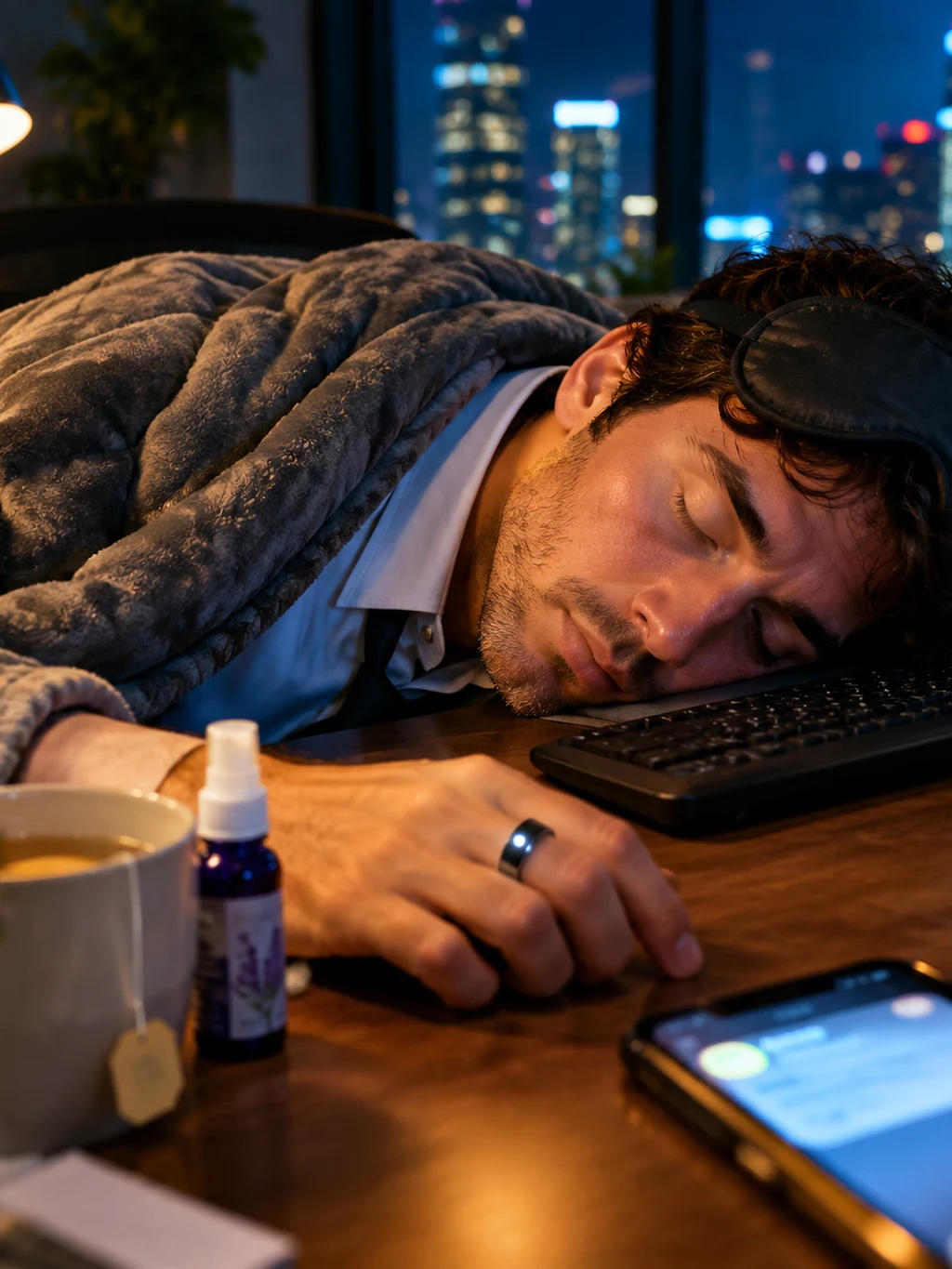
Several colleagues wearing eye masks woke in the night thinking they had been kidnapped, and got a terrible fright.
One petite colleague was pinned under a weighted blanket, couldn't crawl out, and in the end had to be freed by the fire brigade.
The magnesium trial went worse: due to an error, people were told to take far more than the recommended dose, and since magnesium works as a laxative, the trial had to be voided.
People found lavender spray and herbal tea pleasant enough, but they didn't noticeably help sleep.
A colleague in the legal team accidentally sprayed lavender in his own face and went to hospital for a check-up; related litigation is ongoing.
So the email solemnly recommends: never again use lawyers as guinea pigs in any pilot project.
The sleep tips colleagues shared on their own, however, were very practical — like listening to audio versions of World Bank publications, athletes' post-match interviews, and every investor conference call ever recorded.
Finally, the conclusion.
Don't force people to take part in this kind of thing; provide sleep aids to whoever needs them, and letting colleagues swap sleep advice informally is a good idea too.
But tracking employees' behavior in the dead of night invades their privacy, and imposing a one-size-fits-all solution on everyone doesn't work.
As for rolling it out across the company, the email's final line is: this is something we should definitely sleep on first.
Once you've stopped laughing, think about it: if your company started caring about your sleep, would you be glad, or nervous?
Listen again
Try it without the transcript and notice what sounds clearer.
What vocabulary does this episode teach?
词汇HSK 4. 整个公司的睡眠质量不升反降.
HSK 4. 其他小措施的效果有好有坏.
HSK 4. 邮件因此郑重建议 — never use lawyers as guinea pigs.
HSK 3. 睡眠不足会带来很多负面影响.
HSK 3. 对自己的睡眠习惯非常热情 — Stew, the true believer.
HSK 3. 不相信医院睡眠检查给出的正常结果.
今天这个故事是一篇讽刺文章 — said in the first line so no joke is taken as fact.
一封虚构的公司内部邮件 — the column's format.
让志愿者尝试工业化以前的睡眠方式.
睡眠追踪设备 / 在深夜追踪员工的行为.
焦虑到失眠 — the patients in the 2017 study.
侵犯隐私 — invading privacy.
* beyond level超纲词
What grammar patterns appear in this episode?
语法不升反降
Instead of rising, it fell — a four-character pattern (不A反B) for an outcome that went the wrong way.
把这种扩散效应算进去,整个公司的睡眠质量不升反降。
随着……,……逐渐……
As X changed, Y gradually… — formal cause over time.
他认为,随着家庭照明和街道照明越来越普及,这种分段睡眠逐渐消失,到二十世纪二十年代几乎没人再提。
由于……,……
Formal "due to": gives the cause first.
镁片试验更惨,由于一个失误,公司让大家服用了远超推荐量的剂量,而镁有通便作用,这项试验只好作废。
Proper nouns
专有名词Free account
Keep learning from this story
Create a free account to keep saved words and your preferred level together.
- Keep words with their story context
- Remember your preferred level
- Build your vocabulary over time