
A Chinese podcast · Same story, 4 levels
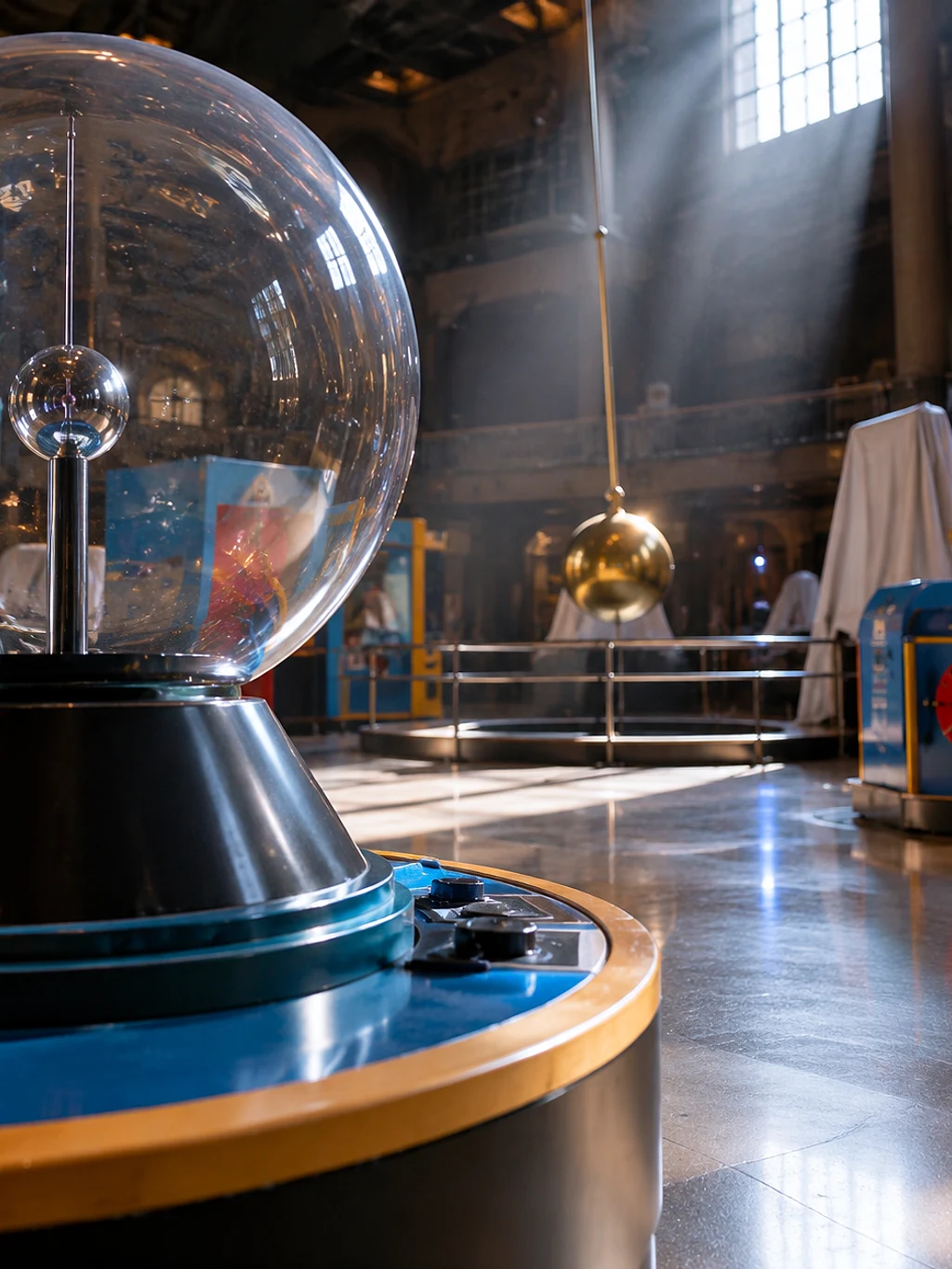
「一个没有科学部门的科学馆,还能叫科学馆吗?」安大略科学馆裁掉三十人,整个科学部门一个不留
Ontario Science Centre Cuts Science
About this story
On 10 September 2026 the Ontario Science Centre laid off 30 people including its entire science department, along with live exhibits, business development and security. The union says that is over 540 combined years of service. The building has been shut since 2024 over a roof report, and a $1-billion replacement is being built. Chinese listening practice at four levels. HSK 5-6 Chinese listening practice.
This is an HSK 5-6 Chinese listening episode that runs about 5 minutes. The full Mandarin script is shown with tap-for-pinyin and a line-by-line English translation, so you can listen and read at once — comprehensible input in the sense of Stephen Krashen's i+1 theory. It teaches 12 key vocabulary words such as 资产、职能、框架 and walks through 3 grammar patterns, each explained in English with examples. The same news story is retold at 4 difficulty levels — use the level selector above to find the version that is challenging but still understandable for you.
Read at your level
原文Read the complete story in Chinese. Reveal pinyin and English only when you need them.
English transcript reference
This episode is about a layoff announcement in Canada last week, and a more general management question: when an institution's core asset is its people, what does "pausing" it actually mean?
The facts first.
The Ontario Science Centre opened in 1969 in the east end of Toronto, among the first generation of interactive science centres in Canada.
Its positioning differs from a traditional museum's.
A traditional museum is built around its collection; its function is preservation and display, and the object behind the glass is itself the content.
An interactive science centre is built around exhibits and interpretation; the content is not in the object but in the process of designing, operating and explaining it.
That difference makes the cost structures of the two entirely different.
A collection needs custody and environmental control. Interactive exhibits need continuous design, maintenance and updating, plus live interpretation and demonstration.
In other words, the core asset of this kind of institution is its people; the building and the equipment are only the vehicle.
The turn came in the summer of 2024.
The provincial government, citing an engineering assessment, announced the centre's closure.
The report found structural deficiencies in several sections of the roof and deemed continued use unsuitable.
The closure was executed quickly, it has not reopened since, and that is now more than two years.
The government's plan is new construction on a different site: a new centre at Ontario Place, with a published budget of about a billion Canadian dollars. The original site will not be repaired.
Until the new building is complete, the old one stays closed.
Last week's announcement was layoffs: thirty positions cut.
What matters is not the figure but the composition.
Those cut include the entire science department, along with the live experiments team, business development and security.
This is elimination of whole units, not proportional downsizing.
The union offered a number that makes it legible: those thirty people have accumulated more than five hundred and forty years of service at the centre.
Management characterises this as a restructuring.
"Restructuring" is a neutral term in management language; it describes structural adjustment and carries no judgement in itself.
Whether a given restructuring is sound depends on what capability set survives the adjustment.
A science centre with no science department retains a site, display cases and administrative functions.
Several functions lose their owner simultaneously: concept design and scientific review for new exhibits; periodic re-checking of the scientific claims on existing exhibits; operation and safety oversight of live experiments; and teaching for visiting school groups.
The second of those is particularly easy to overlook.
A science exhibit is not a one-time asset; the scientific claims inside it go out of date as research advances, and need periodic review by specialists.
A science centre with no scientific staff sees the accuracy of its exhibit content decay in one direction over time.
At this point the structure of the thing can be stated.
The government is pursuing two things in the same window: shutting down an old facility and building a replacement.
The problem is that these two things act on objects with completely different temporal properties.
A building is capital expenditure.
Construction can be halted and restarted; the money already committed sits as work in progress, and in a few years it is still there, with its book value broadly intact.
Organisational capability is not capital expenditure. It is a state that exists only while it is maintained.
When staff leave, individual knowledge leaves with them, and the working rapport between team members disappears at the same time — and neither waits for you in place.
More to the point, most of that knowledge is tacit.
How to break a complex principle into a three-step demonstration an eight-year-old can follow; how to respond the instant an experiment goes wrong — none of that is in any document. It exists only in people who have done it many times.
On the day the new building opens, that capability has to be re-recruited, retrained and re-formed.
Five hundred and forty years of service does not return automatically because a new building opens its doors.
So what is genuinely worth discussing here is not how much budget cutting thirty people saved.
It is a question about the decision framework: when an institution is paused, decision-makers default to treating its components as homogeneous — all of them capable of being switched off now and switched on later.
Buildings genuinely can be.
Organisations cannot.
Putting both inside the same "pause" is an equivalent exchange on the books and an unequal one in reality.
Two questions to leave you with.
The first is concrete: is there something you rely on that is being held up by one specific person, and whose value has never been recorded in any account?
The second is bigger: when an organisation makes a decision to pause, how does it tell which parts it can afford to stop and which it cannot?
Listen again
Try it without the transcript and notice what sounds clearer.
What vocabulary does this episode teach?
词汇HSK 6. 这类机构的核心资产是人 — the sentence the whole analysis rests on.
HSK 6. Four of them lose their owner at once when the department goes.
HSK 6. 一个决策框架的问题 — the real subject, not the headcount.
HSK 6. 一种持续维护才存在的状态 — capability is not a stock, it is a flow.
HSK 6. 它的定位与传统博物馆不同 — and that difference sets the cost structure.
HSK 5. 账面价值基本保留 — true of buildings, false of teams.
Construction can stop and restart; the money sits as work in progress.
这类知识大部分是隐性的 — it is not in any document.
Between team members — it disappears with the team, not with the individuals.
Scientific claims on exhibits go out of date and need periodic review.
展项内容的准确性会随时间单向衰减 — the slow failure nobody budgets for.
决策者默认它的各个组成部分是同质的 — the assumption that does the damage.
* beyond level超纲词
What grammar patterns appear in this episode?
语法……而非……
X rather than Y. The written-register counterpart of 不是……而是, compact enough to sit inside a longer clause.
它是一种持续维护才存在的状态。
判断……是否合理,要看……
To judge whether X is sound, look at Y. Supplies the criterion before applying it, which keeps an argument honest.
判断一次重组是否合理,要看调整之后保留下来的能力组合。
等于在……上做了一次……,而在……中并不……
Amounts to X on paper and not in reality. A two-part frame for an accounting move that does not survive contact with the world.
把两者放进同一个"暂停"动作里,等于在账面上做了一次等价交换,而在现实中并不等价。
Proper nouns
专有名词Sources
来源Free account
Keep learning from this story
Create a free account to keep saved words and your preferred level together.
- Keep words with their story context
- Remember your preferred level
- Build your vocabulary over time