
A Chinese podcast · Same story, 4 levels
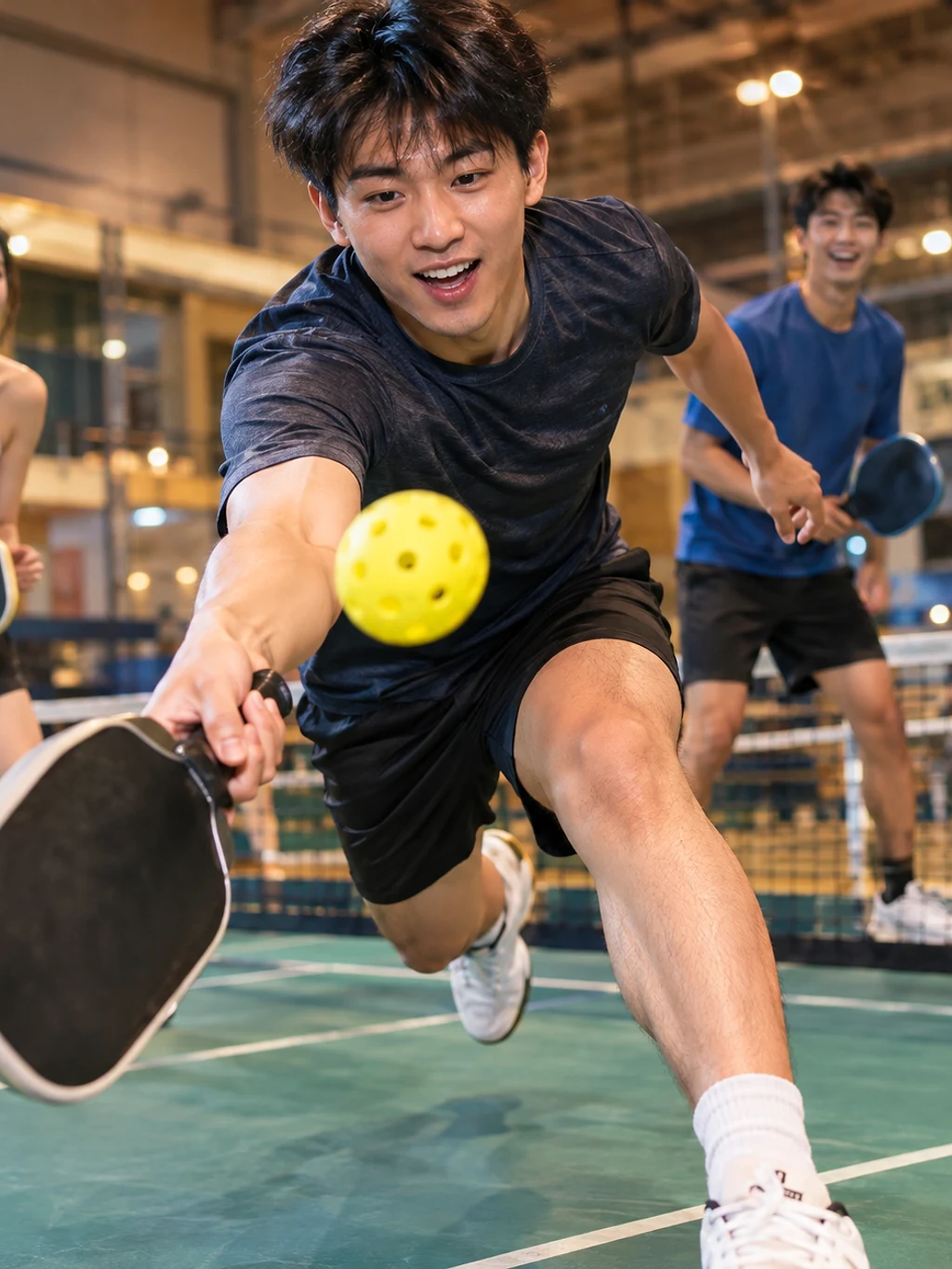
匹克球在中国火了:八百万人常打,一年一千场比赛
Pickleball Is Taking Off in China: 8 Million Regular Players and 1,000 Tournaments a Year
About this story
Pickleball — a paddle like an oversized ping-pong bat, a badminton-sized court, tennis-style bounces and a plastic ball full of holes — was invented in 1965 by two dads on an island in Washington State to entertain bored kids. Now about 8 million people in China play it regularly, and the China Pickleball Tour has grown from 80-odd stops in 2024 to about 1,000 this year. A Shenzhen student sums up its appeal: 'Just play and you get it.' Chinese listening practice at four levels. HSK 3 Chinese listening practice.
This is an HSK 3-4 Chinese listening episode that runs about 3 minutes. The full Mandarin script is shown with tap-for-pinyin and a line-by-line English translation, so you can listen and read at once — comprehensible input in the sense of Stephen Krashen's i+1 theory. It teaches 12 key vocabulary words such as 决定、教授、适合 and walks through 3 grammar patterns, each explained in English with examples. The same news story is retold at 4 difficulty levels — use the level selector above to find the version that is challenging but still understandable for you.
Read at your level
原文Read the complete story in Chinese. Reveal pinyin and English only when you need them.
English transcript reference
A paddle much bigger than a ping-pong paddle, a plastic ball full of little holes, and a net lower than a badminton net.
That's pickleball, a sport that has taken off fast in China over the past few years.
In September 2023, a student we'll call Joe started his first year at the Chinese University of Hong Kong in Shenzhen.
Choosing a PE class, he didn't want badminton, which he already knew well, and he felt tennis meant too much running and was too tiring.
After watching videos online, he decided to try pickleball.
The first class started with bouncing the ball on the paddle; the professor demonstrated a few times, and he quickly got the ball over the net.
Now he can't remember what his first shot felt like — only four words: just play and you get it.
Pickleball has a nickname: "three-not-alike."
Its paddle is like an enlarged ping-pong paddle, and its court is the same size as a badminton doubles court, about thirteen-plus meters long and six meters wide.
The ball can bounce before you hit it, which is like tennis.
On each side of the net there's a zone a bit over two meters wide that players call "the kitchen"; standing there, you can't volley the ball out of the air.
That rule stops players from smashing at the net all the time, so games depend more on patience and control.
The sport was actually born in a family's backyard in America.
In the summer of 1965, on an island in Washington State, two fathers wanted to find something for their bored kids to do.
They had a badminton court, but not all the equipment, so they grabbed other paddles and a plastic ball with holes and started hitting it across the net.
Later they lowered the net and invited neighbors to play; the three families changed the rules as they played, and a new sport was born.
Today pickleball is hugely popular in America, and has been the country's fastest-growing sport three years in a row.
In China, an estimated eight million people play regularly, and about twenty million have tried it.
Why is it so popular?
First, it's easy to pick up; people with a background in badminton, ping-pong or tennis learn it almost instantly.
Second, the court is small and there's less running, so older people can keep it up.
Most members of one Beijing club are middle-aged or older, and some are nearly seventy.
Third, it's very social.
Doubles needs four players, and when a game ends, people waiting at the side can rotate in.
One Shanghai club has more than 1,200 members, over seventy percent of them young people aged twenty to thirty-five.
And a badminton court only needs a lower net and a few extra lines to become a pickleball court, so the cost is low.
Competitions are multiplying fast.
The China Pickleball Tour had only eighty-some stops in 2024; this year it has grown to about a thousand, and ninety-nine cities have hosted events.
Sports brands like Li Ning and Anta have also started launching pickleball products.
Do you think pickleball will become a sport everyone in China can play, like ping-pong and badminton?
Listen again
Try it without the transcript and notice what sounds clearer.
What vocabulary does this episode teach?
词汇HSK 3. 他决定试试匹克球.
HSK 3. 教授示范了几次.
HSK 3. 它很适合社交.
HSK 3. 比赛也在快速增加.
HSK 2. 一项这几年在中国迅速流行起来的运动.
HSK 2. 它为什么这么受欢迎? — 受欢迎 = popular.
一项这几年在中国迅速流行起来的运动.
匹克球有个外号,叫“三不像”.
诞生在美国的一个家庭后院.
器材却不齐全.
首先,容易上手.
中国匹克球巡回赛 — counted in stops (站).
* beyond level超纲词
What grammar patterns appear in this episode?
语法首先……其次……第三……
Firstly… secondly… thirdly — lists reasons.
首先,容易上手,有羽毛球、乒乓球或网球基础的人,更是一学就会。
其次,场地小,跑动少,年纪大的人也能坚持。
一……就……
As soon as… then.
首先,容易上手,有羽毛球、乒乓球或网球基础的人,更是一学就会。
只要……,就……
As long as… then.
另外,羽毛球场只要把网放低、再画几条线,就能改成匹克球场,成本很低。
Proper Nouns
专有名词Free account
Keep learning from this story
Create a free account to keep saved words and your preferred level together.
- Keep words with their story context
- Remember your preferred level
- Build your vocabulary over time