
A Chinese podcast · Same story, 4 levels
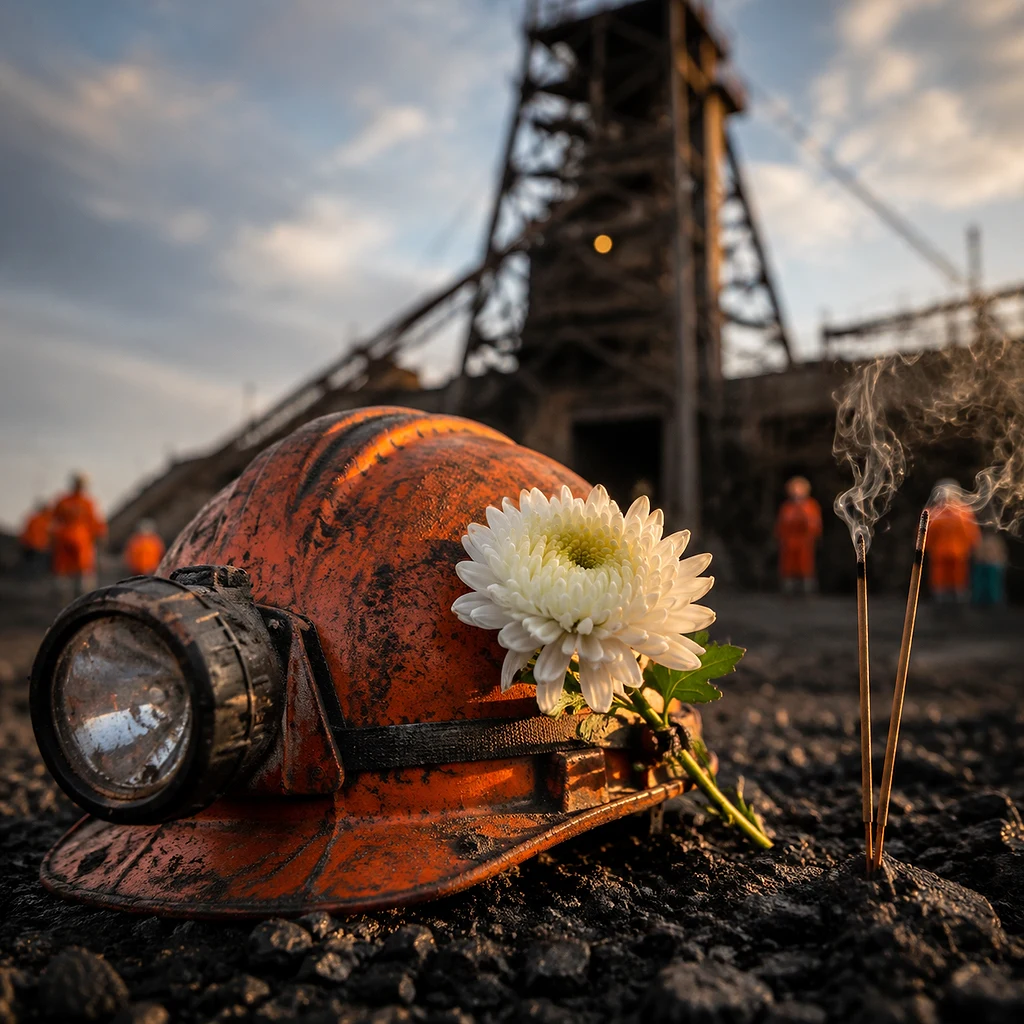
山西的煤矿大爆炸
Shanxi Mine Blast Involves 247 Workers
About this story
The May 22, 2026 Liushenyu coal mine gas explosion in Shanxi — 247 miners underground, 82 dead, plus what reporters uncovered about ignored safety warnings, fines, and 'black workers' with no contracts. HSK 2 Chinese listening practice.
This is an HSK 2 Chinese listening episode that runs about 6 minutes. The full Mandarin script is shown with tap-for-pinyin and a line-by-line English translation, so you can listen and read at once — comprehensible input in the sense of Stephen Krashen's i+1 theory. It teaches 12 key vocabulary words such as 工作、新闻、公司 and walks through 6 grammar patterns, each explained in English with examples. The same news story is retold at 4 difficulty levels — use the level selector above to find the version that is challenging but still understandable for you.
Read at your level
原文Read the complete story in Chinese. Reveal pinyin and English only when you need them.
English transcript reference
Let me tell you a very sad news story.
Recently in Shanxi, something big happened.
A coal mine had a major accident.
Over eighty people died.
Two people, even now, haven't been found.
Over a hundred people were injured.
All of China is watching this news.
Let's talk about it today.
Let's go slowly.
First, let's say what a coal mine is.
A coal mine is a place where people dig coal out from under a mountain.
Coal is black.
Coal can burn.
People use coal to make electricity.
China has a lot of coal.
Shanxi is the most famous place for it.
Shanxi has many, many coal mines.
Many people in Shanxi work as miners.
A miner is a person who works in a coal mine.
Every day they go down under the mountain.
Under the mountain it's dark and hot.
They use machines to dig coal.
Once they finish digging, they pull the coal back up.
This work is very tiring.
It's also dangerous.
Why is it dangerous?
Because there's a kind of gas under the mountain.
This gas is called "wasi" — methane gas.
You can't see it.
It has no smell either.
But when this gas meets fire, it explodes.
Once it explodes, the whole mine has an accident.
The people down there can't get out.
So the work of a miner is very dangerous.
Every day they go down.
And they don't know if they can come back up.
Their families are worried every day too.
Worried that they'll come home safely.
This time the mine that had the accident is called "Liushenyu Coal Mine."
It's in Changzhi City, Shanxi Province.
A company called "Tongzhou Group" runs it.
The accident happened at 7:29 p.m. on May 22.
That night, there were 247 miners in the mine.
They were working.
Suddenly, the gas exploded.
The whole mine shook.
Fire, smoke — everywhere.
Some people, who were far from the blast, escaped.
Some people, too close, did not.
After the accident, the country sent people to rescue them.
Six rescue teams, over three hundred people.
They brought equipment and looked for survivors one by one.
They searched for several days.
In the end, they learned: 82 people died.
Two people, they can't find.
Over 100 people are injured.
Of those, four are in critical condition.
What do 82 people mean?
It means 82 families are permanently missing a person.
Some were husbands.
Some were fathers.
Some were sons.
Some were still very young.
Some weren't even married yet.
Some had children still in primary school.
They can never go home again.
Their families can no longer wait for them.
The phone in their house will never ring again.
Later, reporters investigated.
They uncovered some bad things.
First: this mine was actually not safe.
Two years ago, in 2024.
The country had said: this mine has big problems.
Too much gas, very dangerous.
But the mine wasn't shut down.
It stayed open.
People still went down.
Second: last year this mine was fined twice.
Both times for safety problems.
But the people running the mine didn't fix anything.
They thought: paying a small fine is no big deal.
Keep operating.
Third: of those 247 miners, half were "black workers."
"Black workers" means informal, unregulated workers.
They hadn't signed contracts.
They had no insurance.
When something happens, their families might not even get money.
This whole thing made a lot of people angry.
People asked: why did the country warn about this mine two years ago, but it stayed open?
Why were so many of them "black workers"?
Why does it always take a major accident before anyone steps in?
Now, the boss of the mine has been arrested.
Over ten others have also been arrested.
The country also sent an investigation team.
To figure out exactly what happened.
To figure out whose responsibility this is.
To figure out who kept letting this mine operate.
But no matter how they investigate.
82 people, they can't come back.
The seats in those homes will be empty forever.
This thing.
Is China's biggest mining disaster in 15 years.
After this happened, many people spoke online.
Some said: someone needs to apologize to the families.
Some said: arrest everyone who runs these mines.
Some said: this kind of mine should never be allowed to open again.
But everyone knows.
Saying is one thing.
Doing is another.
Finally I want to ask you a question.
In your country, is there work like this?
Work that's very tiring, very dangerous.
But many people still do it?
Why are people willing to do this kind of work?
Is it because of the money?
Is it because they have no other choice?
Think about it.
How does your country take care of those people?
Listen again
Try it without the transcript and notice what sounds clearer.
What vocabulary does this episode teach?
词汇HSK 1. Used many times — 危险的工作 = dangerous work; 矿工的工作 = the work of a miner.
HSK 2 noun. The whole episode is framed as a news story — a very sad one.
HSK 2 noun. 是一家叫'通洲集团'的公司开的 = it was run by a company called Tongzhou Group.
HSK 2 verb. 他们的家里人也每天都担心 = their family members are worried every day too.
HSK 2 adverb. Goes before the verb: 一起吃饭 = eat together.
HSK 2 adjective. Both literal (煤是黑色的 = coal is black) and figurative (黑工 = 'black worker' = informal/illegal worker).
Beyond HSK 1-2. The central topic noun. 煤 (coal) + 矿 (mine). The script glosses what a mine is.
Beyond HSK 1-2. 矿 (mine) + 工 (worker). The script glosses the term inline: 矿工就是去煤矿里工作的人.
Beyond HSK 1-2. The most feared word in Chinese coal mining. The script glosses it inline: 看不见,没有味道,遇到火就会爆炸.
Beyond HSK 1-2. 瓦斯爆炸 = gas explosion. The direct cause of the disaster.
HSK 3, beyond the HSK 1-2 target. The episode hammers this word repeatedly — coal mining is 危险.
HSK 3, beyond the HSK 1-2 target. 安全问题 = safety problems. Used when describing why the mine was penalized.
* beyond level超纲词
What grammar patterns appear in this episode?
语法The 把 construction: re-orders the object before the verb to emphasize what is done to it. Requires a resultative verb.
再把煤拉上来。
因为... + 所以...
Cause-and-effect: 'because... so...'. Both clauses are typically kept in Chinese.
为什么危险呢?
因为山下面有一种气。
因为安全问题。
Subject + 让 + Object + Verb
让 = 'to let / cause / make'. Marks causation: A makes B do or be something.
这个事情让很多人很生气。
瓦斯遇到火,就会爆炸。
Verb + 着
着 after a verb marks an ongoing state or that the action is in progress.
矿没关。还是开着。
家里的位置,永远空着。
Subject + 觉得 + Clause
Use 觉得 to express opinion or feeling, followed by a clause.
他们觉得:罚一点钱没事。
这个工作很累。
其中 + Number + Noun
其中 means 'among them / of those'. Used to specify a subset.
其中四个人,伤得很重。
有一半是'黑工'。
Proper nouns
专有名词Free account
Keep learning from this story
Create a free account to keep saved words and your preferred level together.
- Keep words with their story context
- Remember your preferred level
- Build your vocabulary over time