
A Chinese podcast · Same story, 3 levels
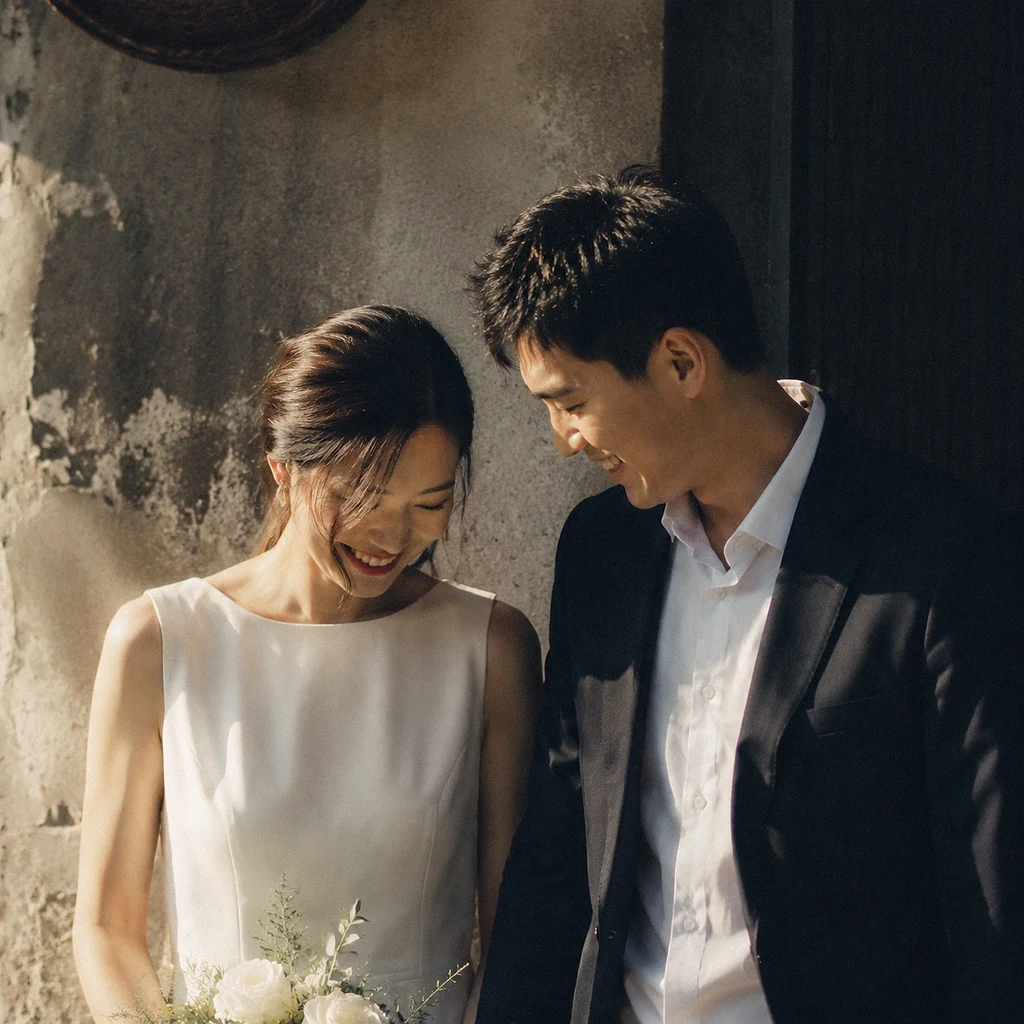
简单的婚礼,大大的快乐
Sichuan Couple Xiao Lu and Xiao Bao Skip the Big Wedding for a Simple, Happy One
About this story
A simple Sichuan story — Xiao Lu and Xiao Bao skip the big wedding and pick a small, happy ceremony. HSK 1 Chinese listening practice.
This is an HSK 1 Chinese listening episode that runs about 4 minutes. The full Mandarin script is shown with tap-for-pinyin and a line-by-line English translation, so you can listen and read at once — comprehensible input in the sense of Stephen Krashen's i+1 theory. It teaches 15 key vocabulary words such as 贵、累、快乐 and walks through 5 grammar patterns, each explained in English with examples. The same news story is retold at 3 difficulty levels — use the level selector above to find the version that is challenging but still understandable for you.
Read at your level
原文Read the complete story in Chinese. Reveal pinyin and English only when you need them.
English transcript reference
Speaking of young people getting married, there have been many changes now.
In the past, getting married was a big event.
Getting married required spending a lot of money.
One had to treat guests in a restaurant.
One had to invite many people to eat.
There had to be delicious dishes.
There had to be good wine.
Mom and Dad were very happy.
But what about the young people?
Young people were very tired.
Young people didn't like it.
They felt it was too expensive.
They didn't want to do that.
Now, what do they do?
I am going to tell three stories.
The first story is in Sichuan.
There are big mountains there.
The mountains are very high and very beautiful.
There was a young couple.
The boy was called Xiao Lu.
The girl was called Xiao Bao.
They wanted to get married.
But, Mom and Dad were not happy.
Why were they not happy?
Because of money matters.
The girl's mother said:
"You need to buy a house."
"No house, no way."
The boy didn't buy a house.
The girl was also very sad.
They didn't want to quarrel.
Later, they left.
They went into the big mountains.
There were only the two of them.
What clothes did they wear?
They didn't wear beautiful dresses.
They wore very thick clothes.
Because it was very cold on the mountain.
What did they do?
They looked at the scenery.
They drank milk tea.
The milk tea was sweet.
Their hearts were also sweet.
They took photos.
There were only two people in the photos.
Behind them were big mountains.
They were very happy.
This is called a "destination wedding".
It doesn't need a lot of money.
It only needs two people to be together.
The second story is at a place for listening to music.
There was a young couple.
They liked listening to music.
They didn't want to go to a photo studio.
The photos at the studio are too fake.
They went to a music festival.
There were many people there.
Everyone was singing.
Everyone was dancing.
They also went to dance.
Did everyone know them?
Everyone didn't know them.
However, everyone was very happy.
Someone gave them alcohol to drink.
Someone said: "Wish you well!"
They took photos there.
Everyone was looking at them.
They felt very blessed.
This is also called getting married.
This isn't a very expensive wedding.
This is a happy wedding.
The third story is in a garden.
This girl was called Qian Qian.
She didn't like heavy meals.
She liked eating vegetables.
She didn't want to waste things.
Where did she get married?
In a small garden.
Many people came that day.
There were friends they knew.
There were also people they didn't know.
What did they eat?
They ate rice and vegetables.
There was no expensive alcohol.
There were no expensive dishes.
How much money did one person spend?
One hundred yuan.
This is very little, right?
But everyone was very happy.
Everyone sat together.
Everyone spoke and chatted.
The girl's parents didn't come.
Because they were not used to it.
But the girl didn't care.
She felt this was her business.
She was with her husband.
They lived in a place with a garden.
They read books and wrote.
Their life was very simple.
What do these stories say?
They talk about today's young people.
They don't want expensive weddings.
They don't want old habits.
This is not just because of money.
Some young people have money.
But they don't want to spend it.
Why?
Because getting married is one's own business.
It's not for others to see.
It's not for "face".
It is for the love between two people.
This is today's topic.
This is called "new choices".
Young people chose simplicity.
Young people chose themselves.
Listen again
Try it without the transcript and notice what sounds clearer.
What vocabulary does this episode teach?
词汇Adjective describing something that costs a lot of money. Opposite of 便宜 (piányi).
Adjective used to describe physical or mental fatigue.
Adjective describing a feeling of joy or happiness.
Verb used for putting on clothes, shoes, or socks.
Noun referring to an affair, matter, or business.
Verb used to express an opinion or a sensation.
HSK 1. you (plural).
HSK 1. they; them.
Verb-object compound. Note that you say 'A 和 B 结婚' (A marries B), not 'A 结婚 B'.
Adjective meaning uncomplicated or simple in nature/lifestyle.
Can be a noun (habit) or a verb (to be accustomed to).
Noun specifically referring to the wedding ceremony/event, distinct from the act of marrying (结婚).
Noun referring to the view or landscape.
Place where professional photos are taken.
Verb meaning to use more than necessary (money, time, resources).
* beyond level超纲词
What grammar patterns appear in this episode?
语法In Chinese, when an adjective is used as the predicate (to describe the subject), the verb 'shì' (is) is generally not used. Instead, the adverb 'hěn' (very) links the subject and the adjective. Even if you don't mean 'very', 'hěn' is often included for grammatical balance.
年轻人很累。
山很高,很漂亮。
女生的妈妈说:“你要买房子。”
This pattern expresses existence, meaning 'There is/are [Object] at [Place]'. It is the standard way to say 'there is' or 'there are'.
那里有大山。
那里有很多人。
The auxiliary verb 'yào' is used before a main verb to indicate a necessity (need to), a requirement (have to), or a future intention (going to/want to).
结婚要花很多钱。
要在饭馆请客。
我要讲三个故事。
This structure is used to emphasize a characteristic or quality of the noun. It turns the adjective into a nominal phrase.
奶茶是甜的。
他们的心里也是甜的。
Using 'zài' before a verb indicates the progressive aspect, meaning the action is currently happening (similar to '-ing' in English).
大家都在唱歌。
大家都在跳舞。
Proper Nouns
专有名词Sources
来源Free account
Keep learning from this story
Create a free account to keep saved words and your preferred level together.
- Keep words with their story context
- Remember your preferred level
- Build your vocabulary over time