
A Chinese podcast · Same story, 4 levels
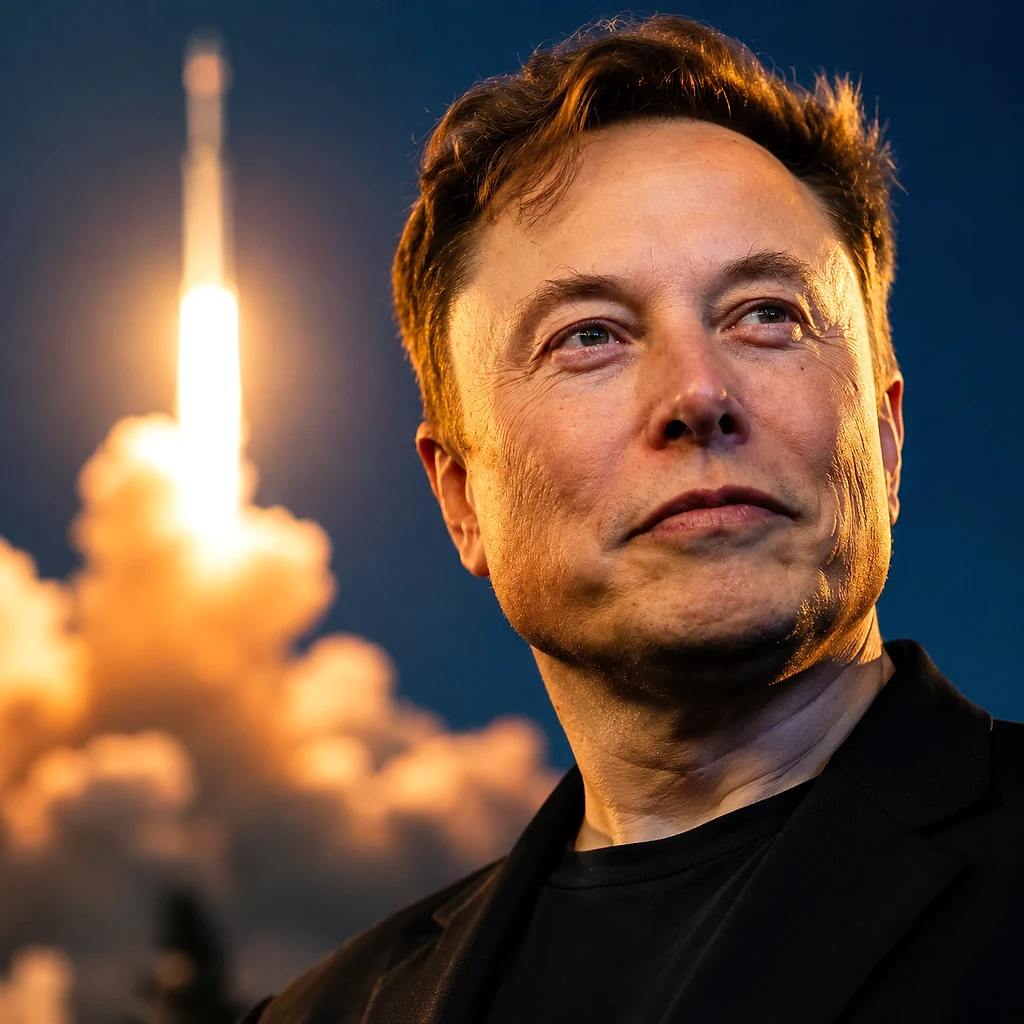
7500 亿美元的史诗级 IPO:SpaceX 上市,与一个万亿富翁的诞生
SpaceX Goes Public at $750 Billion Valuation
About this story
Advanced Chinese listening practice. The full story of SpaceX's record $75B IPO on June 12, 2026: reusable rockets and Starlink, the SPCX debut on Nasdaq, the $1.77T (briefly $2T) valuation, Musk as the first trillionaire, the unusual 30% retail allocation, and the deeper question of why the world bets so heavily on the narrative of going to space. HSK 5-6 Chinese listening practice.
This is an HSK 5-6 Chinese listening episode that runs about 5 minutes. The full Mandarin script is shown with tap-for-pinyin and a line-by-line English translation, so you can listen and read at once — comprehensible input in the sense of Stephen Krashen's i+1 theory. It teaches 14 key vocabulary words such as 上市、IPO / 首次公开募股、机构 and walks through 7 grammar patterns, each explained in English with examples. The same news story is retold at 4 difficulty levels — use the level selector above to find the version that is challenging but still understandable for you.
Read at your level
原文Read the complete story in Chinese. Reveal pinyin and English only when you need them.
English transcript reference
Today we'll talk about something destined to be written into history.
Yesterday, June 12, SpaceX officially went public.
This is the largest IPO in human history.
Let's first briefly introduce SpaceX.
It's an American aerospace company.
The boss is Musk.
It's most famous for two things.
First, reusable rockets.
Old rockets, once launched, were scrapped.
Extremely expensive.
But SpaceX managed to let a rocket, after launching into the sky,
steadily fly back down, land, and be used again.
This greatly lowered the cost of going to space.
Second, Starlink.
In low Earth orbit, SpaceX
has deployed tens of thousands of small satellites.
These satellites form a net,
able to provide high-speed internet to any corner of the globe.
Even in the middle of the ocean, on a battlefield, in a desert,
you can connect to the network.
So Starlink has now become
SpaceX's most profitable business.
Okay, that's the background.
Let's talk about 'going public' itself.
For friends not so familiar with finance,
let's first explain what an IPO is.
IPO, in Chinese, is called 'first public offering of shares'.
Put plainly, it's when an originally private company,
for the first time, takes its shares to a stock exchange,
and sells them openly to the public.
Before this, SpaceX was a private company.
Its shares were held by only a small number of people.
Ordinary people couldn't buy in even with money.
But after going public yesterday, things changed.
Any ordinary investor
can now buy SpaceX stock on the market.
The ticker is SPCX, traded on Nasdaq.
Let's look at some numbers.
This IPO's offering price was set at 135 dollars per share.
But market demand was truly red-hot.
The opening price shot straight to 150 dollars.
Intraday, it touched as high as 176 dollars.
It finally closed, settling at around 161 dollars.
This means that on the first day of trading,
the share price rose about 19%.
And the whole IPO raised funds
of about 75 billion dollars.
What kind of scale is this?
It broke the record in one stroke,
becoming the largest IPO in the world ever.
After going public, SpaceX's valuation
reached about 1.77 trillion dollars.
Intraday it briefly broke 2 trillion.
It instantly became America's sixth-largest public company.
And the biggest winner of this feast, with no suspense,
is Musk himself.
As SpaceX's share price soared,
the value of the shares he holds exploded upward.
He officially became the world's
first 'trillionaire'.
In other words, his personal wealth
broke through the one-trillion-dollar mark for the first time.
In human history, this is the first time
a single person has accumulated such enormous wealth.
However, this IPO
also has one detail especially worth mentioning.
Usually when a company goes public,
the portion left for retail — that is, ordinary individual investors —
is often small, about only 5% to 10%.
The bulk is taken by large institutions.
But according to reports, this time Musk specifically requested
leaving as much as 30% of the shares
for ordinary retail investors.
More than three times the industry norm.
Behind this is, in fact, Musk's consistent thinking:
he wants the ordinary people who believe in and support him
to also be able to get on this train and share in the company's growth dividend.
Of course, you could also say
this is a very clever way
of turning fans into shareholders.
So, let's step back and think about a question.
Why do so many people in the world
frantically want to buy into an aerospace company?
Bear in mind, aerospace is a business
of huge investment, slow returns, and high risk.
When it comes down to it, what people are buying
is not today's rockets and satellites.
It's a narrative about the future.
A narrative that humanity will eventually move into space on a large scale.
With real money,
they've cast a vote of confidence in this narrative.
Will this future actually come true?
No one can give an answer.
Maybe decades later, looking back,
yesterday was the dawn of a great era.
Maybe, it's just another
overhyped bubble.
History will deliver its verdict.
At the end of the show, I want to leave the question with you.
Humanity spends so much money and so much effort,
desperately trying to leave Earth and head for space.
What do you think the meaning of this is?
Are we, in the end, fleeing from something,
or running toward something?
This question has no standard answer.
But it's worth us, when we gaze up at the stars,
thinking it through seriously.
Listen again
Try it without the transcript and notice what sounds clearer.
What vocabulary does this episode teach?
词汇Central concept, glossed via IPO. SpaceX 正式上市 = SpaceX officially went public.
Glossed inline: 一家原本私有的公司,第一次把股份拿到证券交易所公开发售 = a private company sells shares publicly for the first time.
HSK 1-4. institution, organization.
HSK 1-4. market.
HSK 1-4. cost.
HSK 1-4. investment; to invest.
HSK 1-4. the internet; network.
Glossed inline: 发射上天以后,还能飞回来,再用一次 = after launching, it can fly back and be reused.
在近地轨道上部署了成千上万颗小卫星 = deployed tens of thousands of satellites in low Earth orbit.
SpaceX 的估值,来到了大约 1.77 万亿美元 = SpaceX's valuation reached about 1.77 trillion dollars.
Glossed inline: 普通个人投资者 = ordinary individual investors. Contrast with 大型机构 (big institutions).
随着 SpaceX 的股价飙升 = as SpaceX's share price soared.
买的是一个关于未来的叙事 = what they buy is a narrative about the future.
也许它只是又一个被过度高估的泡沫 = maybe it's just another overhyped bubble.
* beyond level超纲词
What grammar patterns appear in this episode?
语法说白了 / 说到底 (put plainly / when it comes down to it)
Spoken markers that cut to the essence before a plain restatement.
说白了,就是一家原本私有的公司。
说到底,大家买的,其实不是今天的火箭和卫星。
哪怕 ... 都 / 也 ... (even if / no matter)
Strong concessive — 'even in the most extreme case, still'.
哪怕是在大海中央,在战场上,在沙漠里,都能连上网络。
随着 + Clause, + Result
'As X happens, Y follows'. Marks a driving change.
随着 SpaceX 的股价飙升,他手中持有的股份,价值暴涨。
不是 X,而是 Y (not X, but Y)
Strong correction, central to the closing argument.
大家买的,其实不是今天的火箭和卫星。而是一个关于未来的叙事。
一举 + Verb (in one stroke)
Marks a single decisive action achieving a big result.
它一举打破了纪录。
也许 ... 也许 ... (maybe X, maybe Y)
Paired speculation presenting two possible futures.
也许几十年后回头看,昨天是一个伟大时代的开端。也许,它只是又一个被过度高估的泡沫。
到底是 ... 还是 ...? (after all, X or Y?)
Sharpened either-or question for rhetorical weight.
我们到底是在逃离什么,还是在奔向什么?
Proper nouns
专有名词Free account
Keep learning from this story
Create a free account to keep saved words and your preferred level together.
- Keep words with their story context
- Remember your preferred level
- Build your vocabulary over time