
A Chinese podcast · Same story, 4 levels
State Farm 拒赔屋顶,一年少赔十四亿美元:最先反对的,是它自己的代理人
State Farm Denied Roof Claims to Save $1.4 Billion
About this story
Unsealed Oklahoma court documents allege State Farm systematically cut roof-damage payouts, keeping $1.4 billion in a single year — and its own agents wrote letters trying to stop it. Chinese listening practice at four levels. HSK 2 Chinese listening practice.
This is an HSK 2 Chinese listening episode that runs about 5 minutes. The full Mandarin script is shown with tap-for-pinyin and a line-by-line English translation, so you can listen and read at once — comprehensible input in the sense of Stephen Krashen's i+1 theory. It teaches 12 key vocabulary words such as 公司、相信、事情 and walks through 3 grammar patterns, each explained in English with examples. The same news story is retold at 4 difficulty levels — use the level selector above to find the version that is challenging but still understandable for you.
Read at your level
原文Read the complete story in Chinese. Reveal pinyin and English only when you need them.
English transcript reference
In America, there is a story that has made a lot of people very angry.
This story has something to do with your home.
So what is insurance?
Insurance works like this.
Every month you give a company some money.
The company says to you: when your home breaks, I will give you money.
Your home breaks, and you do not have that much money.
But you have insurance, so the company gives you the money.
You use that money to make your home good again.
That is insurance.
In America, almost everyone who owns a home buys insurance.
The biggest insurance company in America is called State Farm.
For many, many years, this company said one sentence to people:
We pay what we owe, no more and no less.
Not a penny more, not a penny less.
Americans heard it for years, and believed it for years.
Every month they gave State Farm money.
They thought: if my home breaks, this company will help me.
In some parts of America, the weather gets very bad.
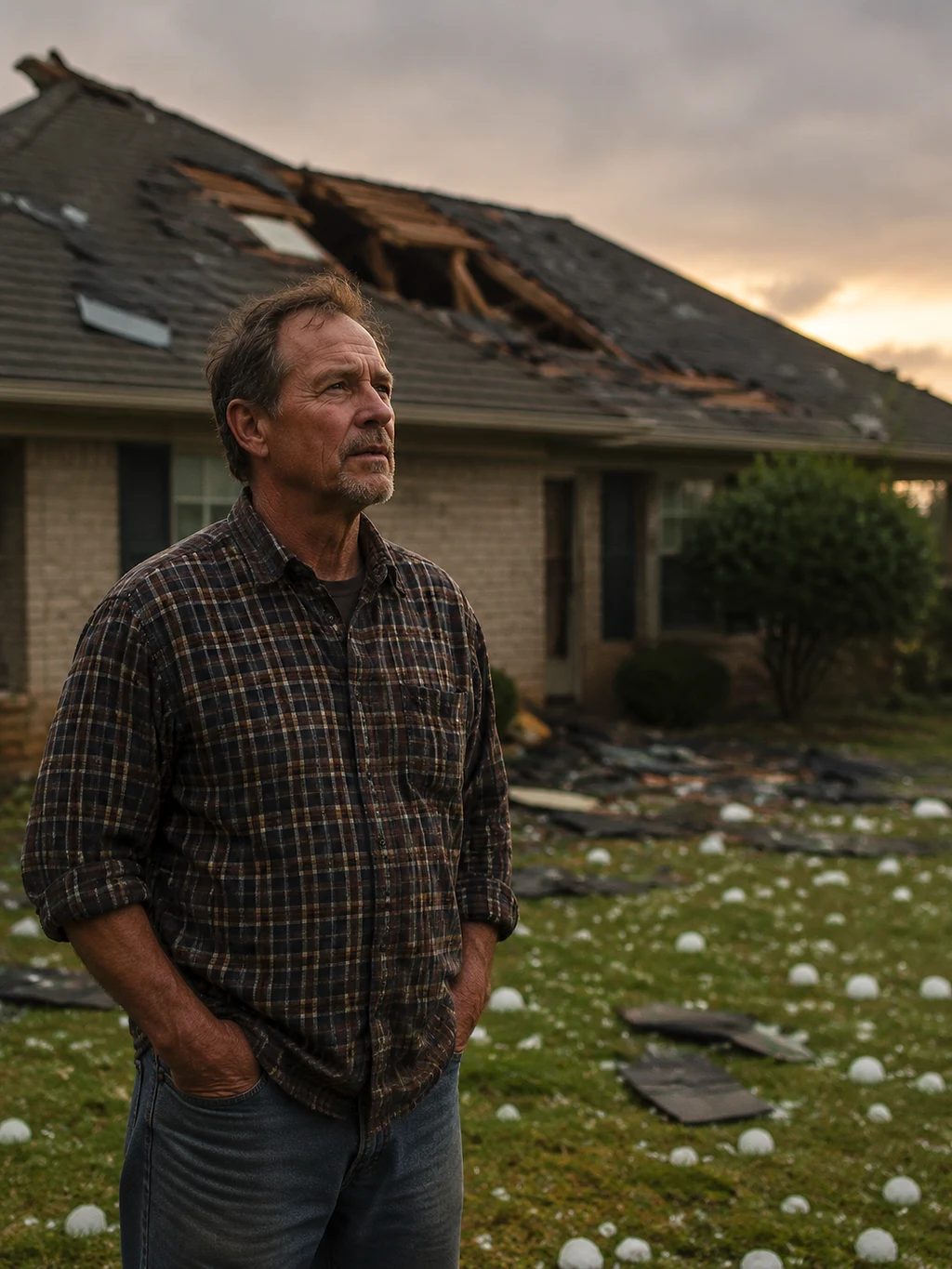
Heavy rain falls from the sky, and hail falls too.
Hail is ice that comes down from the sky.
Hail is hard, and it comes down fast.
Hail hits the top of a home, and the top of the home breaks.
Once the top breaks, the rain gets into the house.
Once water gets in, people cannot live there.
So when the top of a home breaks, it has to be replaced with a new one.
Replacing it costs a great deal of money.
This is the moment when people turn to the insurance company.
In 2020, a meeting was held inside State Farm.
At that meeting, someone said one sentence.
He said: the top of the house is our biggest opportunity.
Opportunity here means: something worth doing.
But this "worth it" was worth it for the company.
For the people who bought the insurance, it was not.
What he meant was: we are paying out too much.
What he meant was: from now on, we should pay a little less.
From that year on, things slowly changed.
Before, out of a hundred people who asked State Farm for a new roof,
the company would say yes to about eighty-five of them.
And afterwards?
The company said yes to very few.
What many people heard was: your home is not that badly damaged.
What many people heard was: no need to replace it, we will patch it up for you.
But patching it up uses very little money.
And very little money cannot truly make the home good again.
Over one year, how much did the company hold back?
One point four billion dollars.
One point four billion dollars, in a single year.
That money, the company kept for itself.
The first people to say this was wrong were State Farm's own people.
Every day they talk to customers, and they talk to the company.
In 2021, one of them wrote a letter to the company.
The letter said: that sentence of ours is no longer true.
The letter said: we pay what we owe, no more and no less — we cannot do that anymore.
The letter said: we are paying out extremely little now.
The letter said: customers have to argue with us for a long time before they get their money.
When he wrote that letter, he still worked at the company.
He wrote it because he wanted the company to do the right thing.
Later, all of this reached the court.
A court is the place that decides who is right and who is wrong.
The court made State Farm hand over the company's internal documents.
There were eight hundred thousand documents.
This August, people got to see thirty-one of them.
What was written inside is exactly what we have been describing.
State Farm says: we did nothing wrong.
State Farm says: we have helped many Americans and paid them a great deal of money.
This November and December, the cases go to trial.
Think about it: you give a company money every month, for many years.
Then the day comes when you truly need that money, and they say: no.
What would you do?
Listen again
Try it without the transcript and notice what sounds clearer.
What vocabulary does this episode teach?
词汇HSK 2. The insurer at the centre of the story.
HSK 2. 美国人听了很多年,也相信了很多年 — trust is what the whole story is about.
HSK 2. Opens the episode: 在美国,有一件事情,让很多人非常生气。
HSK 2. Used to gloss the key word: 机会的意思是:一件可以做的好事。
HSK 2. 你每个月给一个公司一些钱 — the monthly payment that defines insurance.
HSK 2. 美国最大的一个保险公司 and 我们最大的机会 — the superlative carries both halves of the story.
The load-bearing word. The script defines it before using it: you pay monthly, and when your home breaks the company pays you.
Glossed as 冰雹,是从天上下来的冰 — the thing that actually breaks the roofs.
HSK 3, above the HSK 1-2 floor. The word the executive used about roofs, which is why it is worth learning here.
Glossed as 法院,是看谁对谁不对的地方。
HSK 3. The agents talk about 客人 having to argue for a long time to get their money.
The pivot of the whole scandal: 修一修 (patch it up) instead of 换新的 (replace it).
* beyond level超纲词
What grammar patterns appear in this episode?
语法但是……
The plain contrast connector. It comes at the start of the second clause and is the most natural way to turn a sentence around at this level.
你的家坏了,你没有那么多钱。但是你有保险,公司就给你钱。
可是修一修,用的是很少的钱。
A,就 B
Says B follows immediately from A. 就 links cause to effect much more tightly than 然后, and this episode uses it to run the chain hail → roof → water → cannot live there.
冰雹打在家的上面,家的上面就坏了。
家的上面坏了,雨就进到家里。
家里进了水,人就不能住了。
一定要 + verb
Expresses necessity — it has to be done, there is no other option.
所以,家的上面坏了,一定要换一个新的。
Proper nouns
专有名词Sources
来源Free account
Keep learning from this story
Create a free account to keep saved words and your preferred level together.
- Keep words with their story context
- Remember your preferred level
- Build your vocabulary over time